| Best Friends and More | ||||||||||||||||||||
| Mountain Views News, Combined Edition Saturday, April 26, 2025 | ||||||||||||||||||||
| ||||||||||||||||||||
|
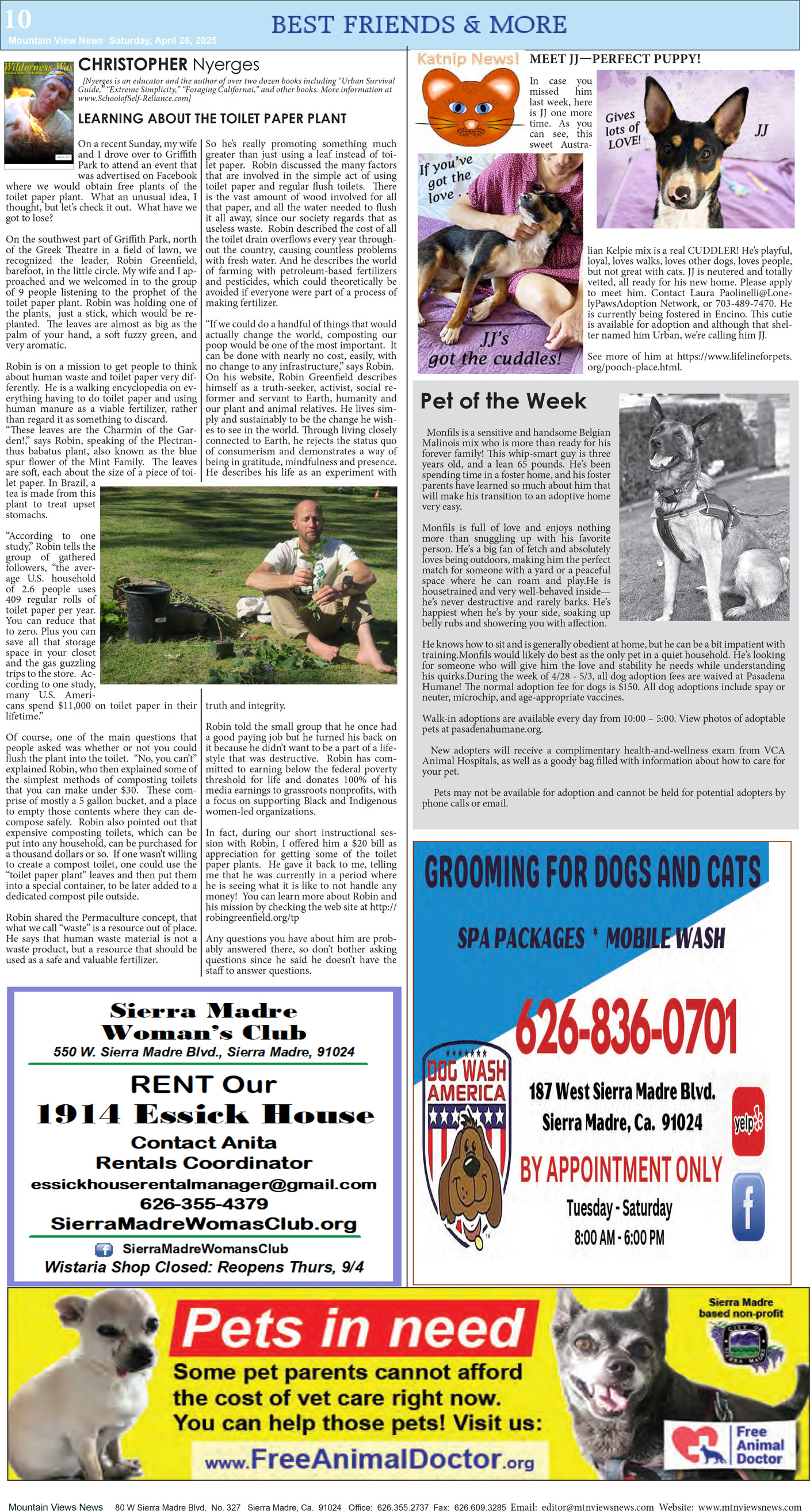
10 Mountain View News Saturday, April 26, 2025 MEET JJ—PERFECT PUPPY! In case you missed him last week, here is JJ one more time. As you can see, this sweet Australian Kelpie mix is a real CUDDLER! He’s playful, loyal, loves walks, loves other dogs, loves people, but not great with cats. JJ is neutered and totally vetted, all ready for his new home. Please apply to meet him. Contact Laura Paolinelli@LonelyPawsAdoption Network, or 703-489-7470. He is currently being fostered in Encino. This cutie is available for adoption and although that shelter named him Urban, we’re calling him JJ. See more of him at https://www.lifelineforpets. org/pooch-place.html. CHRISTOPHER Nyerges [Nyerges is an educator and the author of over two dozen books including “Urban Survival Guide,” “Extreme Simplicity,” “Foraging Californai,” and other books. More information at www.SchoolofSelf-Reliance.com] LEARNING ABOUT THE TOILET PAPER PLANT On a recent Sunday, my wife and I drove over to Griffith Park to attend an event that was advertised on Facebook where we would obtain free plants of the toilet paper plant. What an unusual idea, I thought, but let’s check it out. What have we got to lose? On the southwest part of Griffith Park, north of the Greek Theatre in a field of lawn, we recognized the leader, Robin Greenfield, barefoot, in the little circle. My wife and I approached and we welcomed in to the group of 9 people listening to the prophet of the toilet paper plant. Robin was holding one of the plants, just a stick, which would be replanted. The leaves are almost as big as the palm of your hand, a soft fuzzy green, and very aromatic. Robin is on a mission to get people to think about human waste and toilet paper very differently. He is a walking encyclopedia on everything having to do toilet paper and using human manure as a viable fertilizer, rather than regard it as something to discard. “These leaves are the Charmin of the Garden!,” says Robin, speaking of the Plectranthus babatus plant, also known as the blue spur flower of the Mint Family. The leaves are soft, each about the size of a piece of toilet paper. In Brazil, a tea is made from this plant to treat upset stomachs. “According to one study,” Robin tells the group of gathered followers, “the average U.S. household of 2.6 people uses 409 regular rolls of toilet paper per year. You can reduce that to zero. Plus you can save all that storage space in your closet and the gas guzzling trips to the store. According to one study, many U.S. Americans spend $11,000 on toilet paper in their lifetime.” Of course, one of the main questions that people asked was whether or not you could flush the plant into the toilet. “No, you can’t” explained Robin, who then explained some of the simplest methods of composting toilets that you can make under $30. These comprise of mostly a 5 gallon bucket, and a place to empty those contents where they can decompose safely. Robin also pointed out that expensive composting toilets, which can be put into any household, can be purchased for a thousand dollars or so. If one wasn’t willing to create a compost toilet, one could use the “toilet paper plant” leaves and then put them into a special container, to be later added to a dedicated compost pile outside. Robin shared the Permaculture concept, that what we call “waste” is a resource out of place. He says that human waste material is not a waste product, but a resource that should be used as a safe and valuable fertilizer. So he’s really promoting something much greater than just using a leaf instead of toilet paper. Robin discussed the many factors that are involved in the simple act of using toilet paper and regular flush toilets. There is the vast amount of wood involved for all that paper, and all the water needed to flush it all away, since our society regards that as useless waste. Robin described the cost of all the toilet drain overflows every year throughout the country, causing countless problems with fresh water. And he describes the world of farming with petroleum-based fertilizers and pesticides, which could theoretically be avoided if everyone were part of a process of making fertilizer. “If we could do a handful of things that would actually change the world, composting our poop would be one of the most important. It can be done with nearly no cost, easily, with no change to any infrastructure,” says Robin. On his website, Robin Greenfield describes himself as a truth-seeker, activist, social reformer and servant to Earth, humanity and our plant and animal relatives. He lives simply and sustainably to be the change he wishes to see in the world. Through living closely connected to Earth, he rejects the status quo of consumerism and demonstrates a way of being in gratitude, mindfulness and presence. He describes his life as an experiment with truth and integrity. Robin told the small group that he once had a good paying job but he turned his back on it because he didn’t want to be a part of a lifestyle that was destructive. Robin has committed to earning below the federal poverty threshold for life and donates 100% of his media earnings to grassroots nonprofits, with a focus on supporting Black and Indigenous women-led organizations. In fact, during our short instructional session with Robin, I offered him a $20 bill as appreciation for getting some of the toilet paper plants. He gave it back to me, telling me that he was currently in a period where he is seeing what it is like to not handle any money! You can learn more about Robin and his mission by checking the web site at http:// robingreenfield.org/tp Any questions you have about him are probably answered there, so don’t bother asking questions since he said he doesn’t have the staff to answer questions. Pet of the Week Monfils is a sensitive and handsome Belgian Malinois mix who is more than ready for his forever family! This whip-smart guy is three years old, and a lean 65 pounds. He’s been spending time in a foster home, and his foster parents have learned so much about him that will make his transition to an adoptive home very easy. Monfils is full of love and enjoys nothing more than snuggling up with his favorite person. He’s a big fan of fetch and absolutely loves being outdoors, making him the perfect match for someone with a yard or a peaceful space where he can roam and play.He is housetrained and very well-behaved inside— he’s never destructive and rarely barks. He’s happiest when he’s by your side, soaking up belly rubs and showering you with affection. He knows how to sit and is generally obedient at home, but he can be a bit impatient with training.Monfils would likely do best as the only pet in a quiet household. He’s looking for someone who will give him the love and stability he needs while understanding his quirks.During the week of 4/28 - 5/3, all dog adoption fees are waived at Pasadena Humane! The normal adoption fee for dogs is $150. All dog adoptions include spay or neuter, microchip, and age-appropriate vaccines. Walk-in adoptions are available every day from 10:00 – 5:00. View photos of adoptable pets at pasadenahumane.org. New adopters will receive a complimentary health-and-wellness exam from VCA Animal Hospitals, as well as a goody bag filled with information about how to care for your pet. Pets may not be available for adoption and cannot be held for potential adopters by phone calls or email. Mountain Views News 80 W Sierra Madre Blvd. No. 327 Sierra Madre, Ca. 91024 Office: 626.355.2737 Fax: 626.609.3285 Email: editor@mtnviewsnews.com Website: www.mtnviewsnews.com | ||||||||||||||||||||
| |