| Sports & More | ||||||||||||||||||||
| Mountain Views News, Combined Edition Saturday, May 10, 2025 | ||||||||||||||||||||
| ||||||||||||||||||||
|
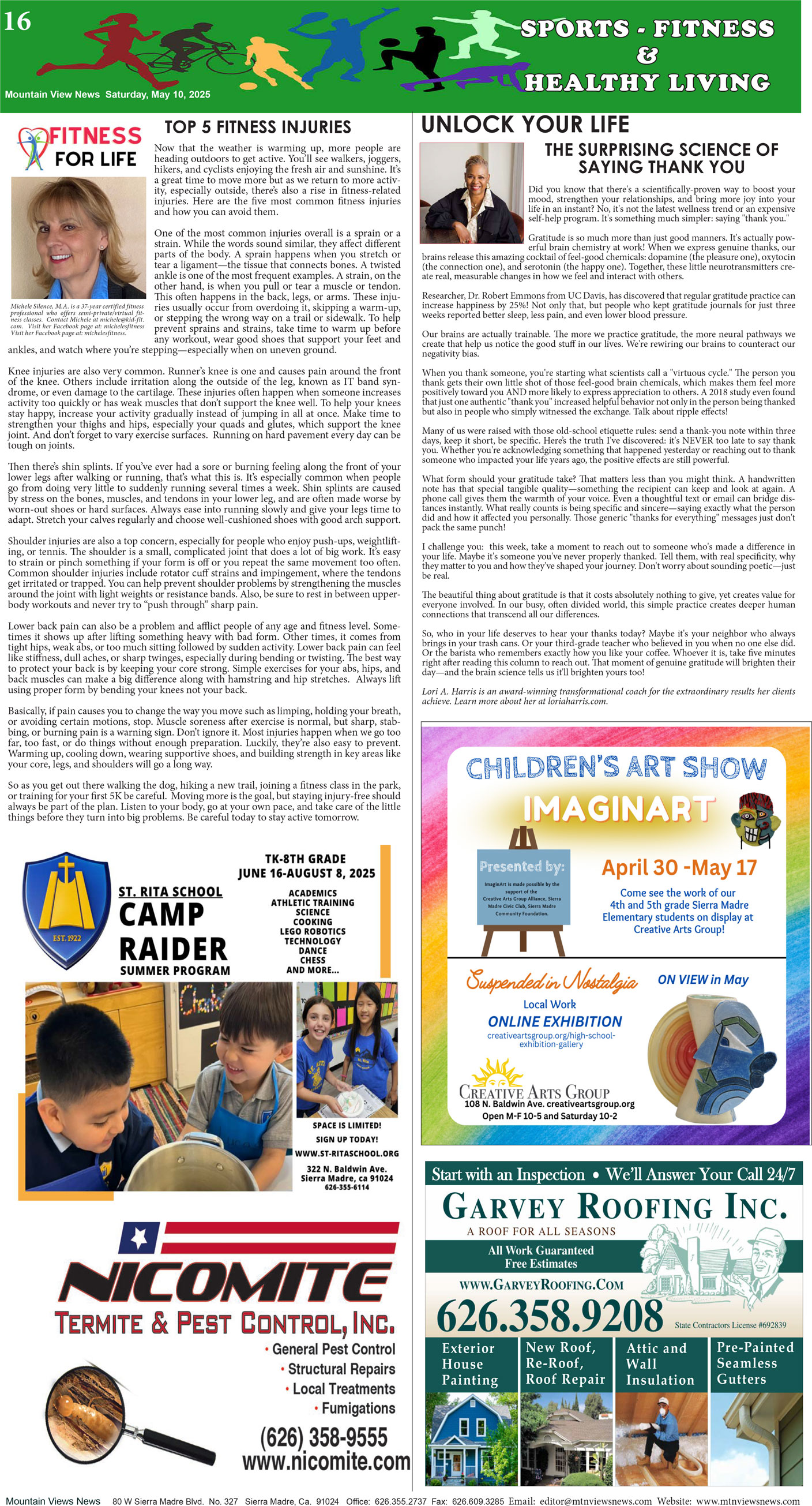
16 SPORTS - FITNESS SPORTS - FITNESS & & HEALTHY LIVINGHEALTHY LIVING Mountain View News Saturday, May 10, 2025 UNLOCK YOUR LIFE Michele Silence, M.A. is a 37-year certified fitness professional who offers semi-private/virtual fitness classes. Contact Michele at michele@kid-fit. com. Visit her Facebook page at: michelesfitness Visit her Facebook page at: michelesfitness. TOP 5 FITNESS INJURIES Now that the weather is warming up, more people are heading outdoors to get active. You’ll see walkers, joggers, hikers, and cyclists enjoying the fresh air and sunshine. It’s a great time to move more but as we return to more activity, especially outside, there’s also a rise in fitness-related injuries. Here are the five most common fitness injuries and how you can avoid them. One of the most common injuries overall is a sprain or a strain. While the words sound similar, they affect different parts of the body. A sprain happens when you stretch or tear a ligament—the tissue that connects bones. A twisted ankle is one of the most frequent examples. A strain, on the other hand, is when you pull or tear a muscle or tendon. This often happens in the back, legs, or arms. These injuries usually occur from overdoing it, skipping a warm-up, or stepping the wrong way on a trail or sidewalk. To help prevent sprains and strains, take time to warm up before any workout, wear good shoes that support your feet and ankles, and watch where you’re stepping—especially when on uneven ground. Knee injuries are also very common. Runner’s knee is one and causes pain around the front of the knee. Others include irritation along the outside of the leg, known as IT band syndrome, or even damage to the cartilage. These injuries often happen when someone increases activity too quickly or has weak muscles that don’t support the knee well. To help your knees stay happy, increase your activity gradually instead of jumping in all at once. Make time to strengthen your thighs and hips, especially your quads and glutes, which support the knee joint. And don’t forget to vary exercise surfaces. Running on hard pavement every day can be tough on joints. Then there’s shin splints. If you’ve ever had a sore or burning feeling along the front of your lower legs after walking or running, that’s what this is. It’s especially common when people go from doing very little to suddenly running several times a week. Shin splints are caused by stress on the bones, muscles, and tendons in your lower leg, and are often made worse by worn-out shoes or hard surfaces. Always ease into running slowly and give your legs time to adapt. Stretch your calves regularly and choose well-cushioned shoes with good arch support. Shoulder injuries are also a top concern, especially for people who enjoy push-ups, weightlifting, or tennis. The shoulder is a small, complicated joint that does a lot of big work. It’s easy to strain or pinch something if your form is off or you repeat the same movement too often. Common shoulder injuries include rotator cuff strains and impingement, where the tendons get irritated or trapped. You can help prevent shoulder problems by strengthening the muscles around the joint with light weights or resistance bands. Also, be sure to rest in between upper- body workouts and never try to “push through” sharp pain. Lower back pain can also be a problem and afflict people of any age and fitness level. Sometimes it shows up after lifting something heavy with bad form. Other times, it comes from tight hips, weak abs, or too much sitting followed by sudden activity. Lower back pain can feel like stiffness, dull aches, or sharp twinges, especially during bending or twisting. The best way to protect your back is by keeping your core strong. Simple exercises for your abs, hips, and back muscles can make a big difference along with hamstring and hip stretches. Always lift using proper form by bending your knees not your back. Basically, if pain causes you to change the way you move such as limping, holding your breath, or avoiding certain motions, stop. Muscle soreness after exercise is normal, but sharp, stabbing, or burning pain is a warning sign. Don’t ignore it. Most injuries happen when we go too far, too fast, or do things without enough preparation. Luckily, they’re also easy to prevent. Warming up, cooling down, wearing supportive shoes, and building strength in key areas like your core, legs, and shoulders will go a long way. So as you get out there walking the dog, hiking a new trail, joining a fitness class in the park, or training for your first 5K be careful. Moving more is the goal, but staying injury-free should always be part of the plan. Listen to your body, go at your own pace, and take care of the little things before they turn into big problems. Be careful today to stay active tomorrow. THE SURPRISING SCIENCE OF SAYING THANK YOU Did you know that there's a scientifically-proven way to boost your mood, strengthen your relationships, and bring more joy into your life in an instant? No, it's not the latest wellness trend or an expensive self-help program. It's something much simpler: saying "thank you." Gratitude is so much more than just good manners. It's actually powerful brain chemistry at work! When we express genuine thanks, our brains release this amazing cocktail of feel-good chemicals: dopamine (the pleasure one), oxytocin (the connection one), and serotonin (the happy one). Together, these little neurotransmitters create real, measurable changes in how we feel and interact with others. Researcher, Dr. Robert Emmons from UC Davis, has discovered that regular gratitude practice can increase happiness by 25%! Not only that, but people who kept gratitude journals for just three weeks reported better sleep, less pain, and even lower blood pressure. Our brains are actually trainable. The more we practice gratitude, the more neural pathways we create that help us notice the good stuff in our lives. We're rewiring our brains to counteract our negativity bias. When you thank someone, you're starting what scientists call a "virtuous cycle." The person you thank gets their own little shot of those feel-good brain chemicals, which makes them feel more positively toward you AND more likely to express appreciation to others. A 2018 study even found that just one authentic "thank you" increased helpful behavior not only in the person being thanked but also in people who simply witnessed the exchange. Talk about ripple effects! Many of us were raised with those old-school etiquette rules: send a thank-you note within three days, keep it short, be specific. Here’s the truth I've discovered: it's NEVER too late to say thank you. Whether you're acknowledging something that happened yesterday or reaching out to thank someone who impacted your life years ago, the positive effects are still powerful. What form should your gratitude take? That matters less than you might think. A handwritten note has that special tangible quality—something the recipient can keep and look at again. A phone call gives them the warmth of your voice. Even a thoughtful text or email can bridge distances instantly. What really counts is being specific and sincere—saying exactly what the person did and how it affected you personally. Those generic "thanks for everything" messages just don't pack the same punch! I challenge you: this week, take a moment to reach out to someone who's made a difference in your life. Maybe it's someone you've never properly thanked. Tell them, with real specificity, why they matter to you and how they've shaped your journey. Don't worry about sounding poetic—just be real. The beautiful thing about gratitude is that it costs absolutely nothing to give, yet creates value for everyone involved. In our busy, often divided world, this simple practice creates deeper human connections that transcend all our differences. So, who in your life deserves to hear your thanks today? Maybe it's your neighbor who always brings in your trash cans. Or your third-grade teacher who believed in you when no one else did. Or the barista who remembers exactly how you like your coffee. Whoever it is, take five minutes right after reading this column to reach out. That moment of genuine gratitude will brighten their day—and the brain science tells us it'll brighten yours too! Lori A. Harris is an award-winning transformational coach for the extraordinary results her clients achieve. Learn more about her at loriaharris.com. SSttaarrtt wwiitthh aann IInnssppeeccttiioonn WWee’’llll AAnnsswweerr YYoouurr CCaallll 2244//77 Exterior House Painting New Roof, Re-Roof, Roof Repair Attic and Wall Insulation Pre-Painted Seamless Gutters Mountain Views News 80 W Sierra Madre Blvd. No. 327 Sierra Madre, Ca. 91024 Office: 626.355.2737 Fax: 626.609.3285 Email: editor@mtnviewsnews.com Website: www.mtnviewsnews.com | ||||||||||||||||||||
| |