| Best Friends and More | ||||||||||||||||||
| Mountain Views News, Combined Edition Saturday, August 2, 2025 | ||||||||||||||||||
| ||||||||||||||||||
|
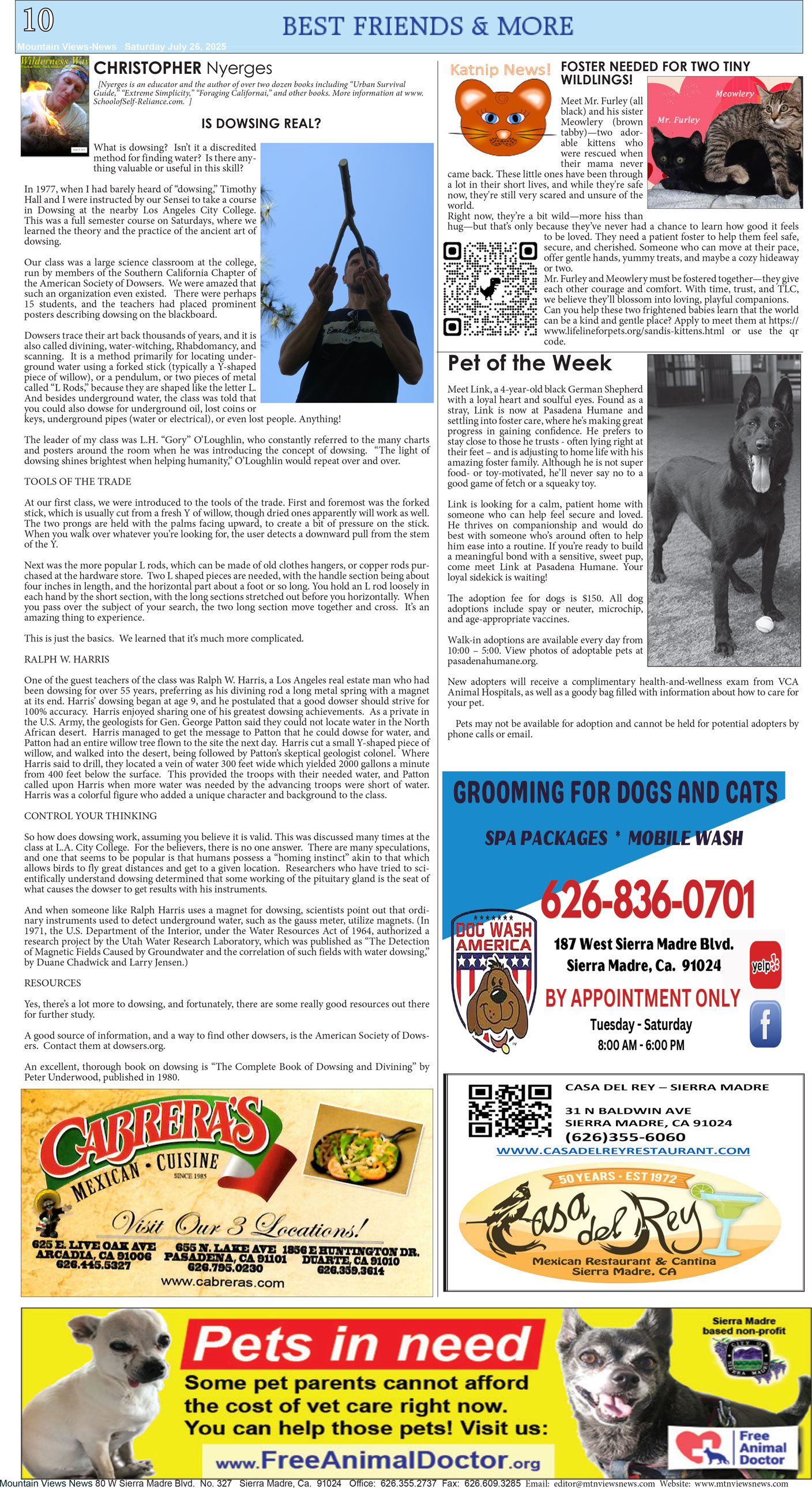
1010 Mountain Views-News Saturday July 26, 2025 FOSTER NEEDED FOR TWO TINY WILDLINGS! Meet Mr. Furley (all black) and his sister Meowlery (brown tabby)—two adorable kittens who were rescued when their mama never came back. These little ones have been through a lot in their short lives, and while they're safe now, they're still very scared and unsure of the world. Right now, they’re a bit wild—more hiss than hug—but that’s only because they’ve never had a chance to learn how good it feels to be loved. They need a patient foster to help them feel safe, secure, and cherished. Someone who can move at their pace, offer gentle hands, yummy treats, and maybe a cozy hideaway or two. Mr. Furley and Meowlery must be fostered together—they give each other courage and comfort. With time, trust, and TLC, we believe they’ll blossom into loving, playful companions. Can you help these two frightened babies learn that the world can be a kind and gentle place? Apply to meet them at https:// www.lifelineforpets.org/sandis-kittens.html or use the qr code. CHRISTOPHER Nyerges [Nyerges is an educator and the author of over two dozen books including “Urban Survival Guide,” “Extreme Simplicity,” “Foraging Californai,” and other books. More information at www. SchoolofSelf-Reliance.com. ] IS DOWSING REAL? What is dowsing? Isn’t it a discredited method for finding water? Is there anything valuable or useful in this skill? In 1977, when I had barely heard of “dowsing,” Timothy Hall and I were instructed by our Sensei to take a course in Dowsing at the nearby Los Angeles City College. This was a full semester course on Saturdays, where we learned the theory and the practice of the ancient art of dowsing. Our class was a large science classroom at the college, run by members of the Southern California Chapter of the American Society of Dowsers. We were amazed that such an organization even existed. There were perhaps 15 students, and the teachers had placed prominent posters describing dowsing on the blackboard. Dowsers trace their art back thousands of years, and it is also called divining, water-witching, Rhabdomancy, and scanning. It is a method primarily for locating underground water using a forked stick (typically a Y-shaped piece of willow), or a pendulum, or two pieces of metal called “L Rods,” because they are shaped like the letter L. And besides underground water, the class was told that you could also dowse for underground oil, lost coins or keys, underground pipes (water or electrical), or even lost people. Anything! The leader of my class was L.H. “Gory” O’Loughlin, who constantly referred to the many charts and posters around the room when he was introducing the concept of dowsing. “The light of dowsing shines brightest when helping humanity,” O’Loughlin would repeat over and over. TOOLS OF THE TRADE At our first class, we were introduced to the tools of the trade. First and foremost was the forked stick, which is usually cut from a fresh Y of willow, though dried ones apparently will work as well. The two prongs are held with the palms facing upward, to create a bit of pressure on the stick. When you walk over whatever you’re looking for, the user detects a downward pull from the stem of the Y. Next was the more popular L rods, which can be made of old clothes hangers, or copper rods purchased at the hardware store. Two L shaped pieces are needed, with the handle section being about four inches in length, and the horizontal part about a foot or so long. You hold an L rod loosely in each hand by the short section, with the long sections stretched out before you horizontally. When you pass over the subject of your search, the two long section move together and cross. It’s an amazing thing to experience. This is just the basics. We learned that it’s much more complicated. RALPH W. HARRIS One of the guest teachers of the class was Ralph W. Harris, a Los Angeles real estate man who had been dowsing for over 55 years, preferring as his divining rod a long metal spring with a magnet at its end. Harris’ dowsing began at age 9, and he postulated that a good dowser should strive for 100% accuracy. Harris enjoyed sharing one of his greatest dowsing achievements. As a private in the U.S. Army, the geologists for Gen. George Patton said they could not locate water in the North African desert. Harris managed to get the message to Patton that he could dowse for water, and Patton had an entire willow tree flown to the site the next day. Harris cut a small Y-shaped piece of willow, and walked into the desert, being followed by Patton’s skeptical geologist colonel. Where Harris said to drill, they located a vein of water 300 feet wide which yielded 2000 gallons a minute from 400 feet below the surface. This provided the troops with their needed water, and Patton called upon Harris when more water was needed by the advancing troops were short of water. Harris was a colorful figure who added a unique character and background to the class. CONTROL YOUR THINKING So how does dowsing work, assuming you believe it is valid. This was discussed many times at the class at L.A. City College. For the believers, there is no one answer. There are many speculations, and one that seems to be popular is that humans possess a “homing instinct” akin to that which allows birds to fly great distances and get to a given location. Researchers who have tried to scientifically understand dowsing determined that some working of the pituitary gland is the seat of what causes the dowser to get results with his instruments. And when someone like Ralph Harris uses a magnet for dowsing, scientists point out that ordinary instruments used to detect underground water, such as the gauss meter, utilize magnets. (In 1971, the U.S. Department of the Interior, under the Water Resources Act of 1964, authorized a research project by the Utah Water Research Laboratory, which was published as “The Detection of Magnetic Fields Caused by Groundwater and the correlation of such fields with water dowsing,” by Duane Chadwick and Larry Jensen.) RESOURCES Yes, there’s a lot more to dowsing, and fortunately, there are some really good resources out there for further study. A good source of information, and a way to find other dowsers, is the American Society of Dowsers. Contact them at dowsers.org. An excellent, thorough book on dowsing is “The Complete Book of Dowsing and Divining” by Peter Underwood, published in 1980. Pet of the Week Meet Link, a 4-year-old black German Shepherd with a loyal heart and soulful eyes. Found as a stray, Link is now at Pasadena Humane and settling into foster care, where he's making great progress in gaining confidence. He prefers to stay close to those he trusts - often lying right at their feet – and is adjusting to home life with his amazing foster family. Although he is not super food- or toy-motivated, he’ll never say no to a good game of fetch or a squeaky toy. Link is looking for a calm, patient home with someone who can help feel secure and loved. He thrives on companionship and would do best with someone who’s around often to help him ease into a routine. If you’re ready to build a meaningful bond with a sensitive, sweet pup, come meet Link at Pasadena Humane. Your loyal sidekick is waiting! The adoption fee for dogs is $150. All dog adoptions include spay or neuter, microchip, and age-appropriate vaccines. Walk-in adoptions are available every day from 10:00 – 5:00. View photos of adoptable pets at pasadenahumane.org. New adopters will receive a complimentary health-and-wellness exam from VCA Animal Hospitals, as well as a goody bag filled with information about how to care for your pet. Pets may not be available for adoption and cannot be held for potential adopters by phone calls or email. Mountain Views News 80 W Sierra Madre Blvd. No. 327 Sierra Madre, Ca. 91024 Office: 626.355.2737 Fax: 626.609.3285 Email: editor@mtnviewsnews.com Website: www.mtnviewsnews.com | ||||||||||||||||||
| |