| Best Friends and More | ||||||||||||||||||
| Mountain Views News, Combined Edition Saturday, August 23, 2025 | ||||||||||||||||||
| ||||||||||||||||||
|
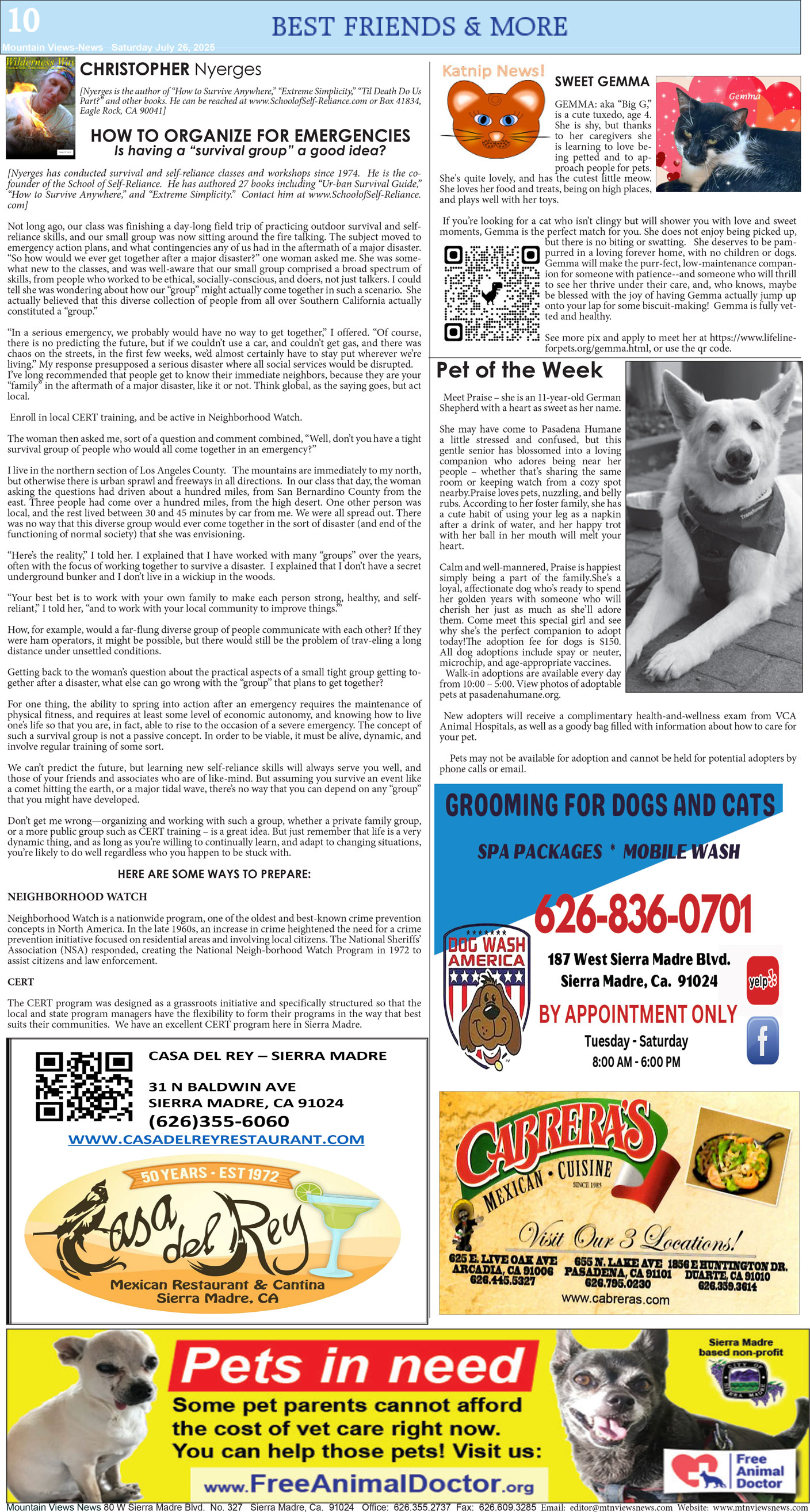
1010 Mountain Views-News Saturday July 26, 2025 CHRISTOPHER Nyerges [Nyerges is the author of “How to Survive Anywhere,” “Extreme Simplicity,” “Til Death Do Us Part?” and other books. He can be reached at www.SchoolofSelf-Reliance.com or Box 41834, Eagle Rock, CA 90041] HOW TO ORGANIZE FOR EMERGENCIES Is having a “survival group” a good idea? SWEET GEMMA GEMMA: aka “Big G,” is a cute tuxedo, age 4. She is shy, but thanks to her caregivers she is learning to love being petted and to approach people for pets. She's quite lovely, and has the cutest little meow. She loves her food and treats, being on high places, and plays well with her toys. If you’re looking for a cat who isn’t clingy but will shower you with love and sweet moments, Gemma is the perfect match for you. She does not enjoy being picked up, but there is no biting or swatting. She deserves to be pam- purred in a loving forever home, with no children or dogs. Gemma will make the purr-fect, low-maintenance companion for someone with patience--and someone who will thrill to see her thrive under their care, and, who knows, maybe be blessed with the joy of having Gemma actually jump up onto your lap for some biscuit-making! Gemma is fully vetted and healthy. See more pix and apply to meet her at https://www.lifelineforpets. org/gemma.html, or use the qr code. [Nyerges has conducted survival and self-reliance classes and workshops since 1974. He is the co- founder of the School of Self-Reliance. He has authored 27 books including “Ur-ban Survival Guide,” “How to Survive Anywhere,” and “Extreme Simplicity.” Contact him at www.SchoolofSelf-Reliance. com] Not long ago, our class was finishing a day-long field trip of practicing outdoor survival and self- reliance skills, and our small group was now sitting around the fire talking. The subject moved to emergency action plans, and what contingencies any of us had in the aftermath of a major disaster. “So how would we ever get together after a major disaster?” one woman asked me. She was somewhat new to the classes, and was well-aware that our small group comprised a broad spectrum of skills, from people who worked to be ethical, socially-conscious, and doers, not just talkers. I could tell she was wondering about how our “group” might actually come together in such a scenario. She actually believed that this diverse collection of people from all over Southern California actually constituted a “group.” “In a serious emergency, we probably would have no way to get together,” I offered. “Of course, there is no predicting the future, but if we couldn’t use a car, and couldn’t get gas, and there was chaos on the streets, in the first few weeks, we’d almost certainly have to stay put wherever we’re living.” My response presupposed a serious disaster where all social services would be disrupted. I’ve long recommended that people get to know their immediate neighbors, because they are your “family” in the aftermath of a major disaster, like it or not. Think global, as the saying goes, but act local. Enroll in local CERT training, and be active in Neighborhood Watch. The woman then asked me, sort of a question and comment combined, “Well, don’t you have a tight survival group of people who would all come together in an emergency?” I live in the northern section of Los Angeles County. The mountains are immediately to my north, but otherwise there is urban sprawl and freeways in all directions. In our class that day, the woman asking the questions had driven about a hundred miles, from San Bernardino County from the east. Three people had come over a hundred miles, from the high desert. One other person was local, and the rest lived between 30 and 45 minutes by car from me. We were all spread out. There was no way that this diverse group would ever come together in the sort of disaster (and end of the functioning of normal society) that she was envisioning. “Here’s the reality,” I told her. I explained that I have worked with many “groups” over the years, often with the focus of working together to survive a disaster. I explained that I don’t have a secret underground bunker and I don’t live in a wickiup in the woods. “Your best bet is to work with your own family to make each person strong, healthy, and self- reliant,” I told her, “and to work with your local community to improve things.”’ How, for example, would a far-flung diverse group of people communicate with each other? If they were ham operators, it might be possible, but there would still be the problem of trav-eling a long distance under unsettled conditions. Getting back to the woman’s question about the practical aspects of a small tight group getting together after a disaster, what else can go wrong with the “group” that plans to get together? For one thing, the ability to spring into action after an emergency requires the maintenance of physical fitness, and requires at least some level of economic autonomy, and knowing how to live one’s life so that you are, in fact, able to rise to the occasion of a severe emergency. The concept of such a survival group is not a passive concept. In order to be viable, it must be alive, dynamic, and involve regular training of some sort. We can’t predict the future, but learning new self-reliance skills will always serve you well, and those of your friends and associates who are of like-mind. But assuming you survive an event like a comet hitting the earth, or a major tidal wave, there’s no way that you can depend on any “group” that you might have developed. Don’t get me wrong—organizing and working with such a group, whether a private family group, or a more public group such as CERT training – is a great idea. But just remember that life is a very dynamic thing, and as long as you’re willing to continually learn, and adapt to changing situations, you’re likely to do well regardless who you happen to be stuck with. HERE ARE SOME WAYS TO PREPARE: NEIGHBORHOOD WATCH Neighborhood Watch is a nationwide program, one of the oldest and best-known crime prevention concepts in North America. In the late 1960s, an increase in crime heightened the need for a crime prevention initiative focused on residential areas and involving local citizens. The National Sheriffs’ Association (NSA) responded, creating the National Neigh-borhood Watch Program in 1972 to assist citizens and law enforcement. CERT The CERT program was designed as a grassroots initiative and specifically structured so that the local and state program managers have the flexibility to form their programs in the way that best suits their communities. We have an excellent CERT program here in Sierra Madre. Pet of the Week Meet Praise – she is an 11-year-old German Shepherd with a heart as sweet as her name. She may have come to Pasadena Humane a little stressed and confused, but this gentle senior has blossomed into a loving companion who adores being near her people – whether that’s sharing the same room or keeping watch from a cozy spot nearby.Praise loves pets, nuzzling, and belly rubs. According to her foster family, she has a cute habit of using your leg as a napkin after a drink of water, and her happy trot with her ball in her mouth will melt your heart. Calm and well-mannered, Praise is happiest simply being a part of the family.She’s a loyal, affectionate dog who’s ready to spend her golden years with someone who will cherish her just as much as she’ll adore them. Come meet this special girl and see why she’s the perfect companion to adopt today!The adoption fee for dogs is $150. All dog adoptions include spay or neuter, microchip, and age-appropriate vaccines. Walk-in adoptions are available every day from 10:00 – 5:00. View photos of adoptable pets at pasadenahumane.org. New adopters will receive a complimentary health-and-wellness exam from VCA Animal Hospitals, as well as a goody bag filled with information about how to care for your pet. Pets may not be available for adoption and cannot be held for potential adopters by phone calls or email. Mountain Views News 80 W Sierra Madre Blvd. No. 327 Sierra Madre, Ca. 91024 Office: 626.355.2737 Fax: 626.609.3285 Email: editor@mtnviewsnews.com Website: www.mtnviewsnews.com | ||||||||||||||||||
| |