| Your Vote Matters! | ||||||||||||||||||||
| Mountain Views News, Combined Edition Saturday, October 11, 2025 | ||||||||||||||||||||
| ||||||||||||||||||||
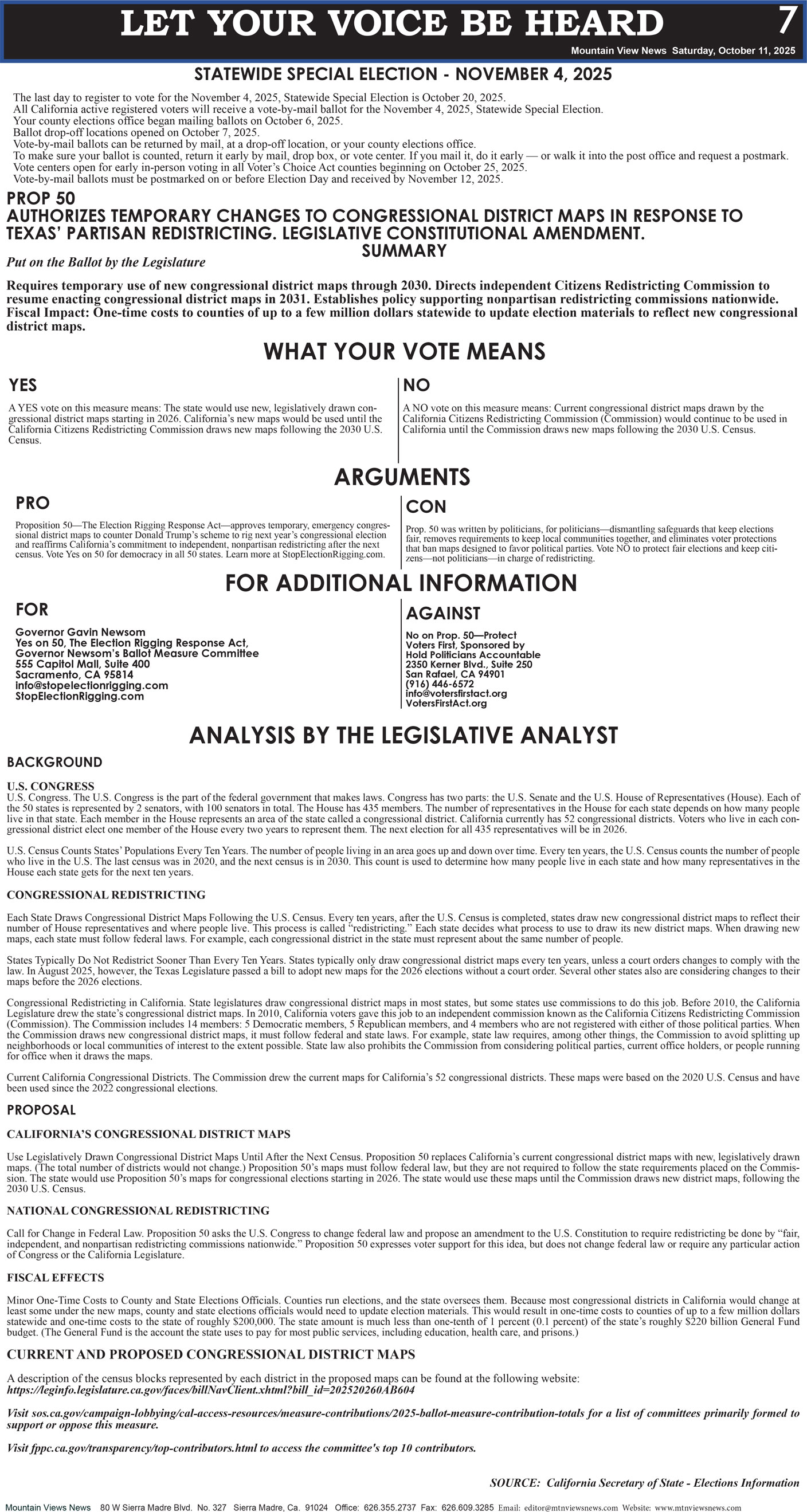
77 LET YOUR VOICE BE HEARD Mountain View News Saturday, October 11, 2025 STATEWIDE SPECIAL ELECTION - NOVEMBER 4, 2025 The last day to register to vote for the November 4, 2025, Statewide Special Election is October 20, 2025. All California active registered voters will receive a vote-by-mail ballot for the November 4, 2025, Statewide Special Election. Your county elections office began mailing ballots on October 6, 2025. Ballot drop-off locations opened on October 7, 2025. Vote-by-mail ballots can be returned by mail, at a drop-off location, or your county elections office. To make sure your ballot is counted, return it early by mail, drop box, or vote center. If you mail it, do it early — or walk it into the post office and request a postmark. Vote centers open for early in-person voting in all Voter’s Choice Act counties beginning on October 25, 2025. Vote-by-mail ballots must be postmarked on or before Election Day and received by November 12, 2025. PROP 50 AUTHORIZES TEMPORARY CHANGES TO CONGRESSIONAL DISTRICT MAPS IN RESPONSE TO TEXAS’ PARTISAN REDISTRICTING. LEGISLATIVE CONSTITUTIONAL AMENDMENT. SUMMARY Put on the Ballot by the Legislature Requires temporary use of new congressional district maps through 2030. Directs independent Citizens Redistricting Commission to resume enacting congressional district maps in 2031. Establishes policy supporting nonpartisan redistricting commissions nationwide. Fiscal Impact: One-time costs to counties of up to a few million dollars statewide to update election materials to reflect new congressional district maps. WHAT YOUR VOTE MEANS YES A YES vote on this measure means: The state would use new, legislatively drawn congressional district maps starting in 2026. California’s new maps would be used until the California Citizens Redistricting Commission draws new maps following the 2030 U.S. Census. NO A NO vote on this measure means: Current congressional district maps drawn by the California Citizens Redistricting Commission (Commission) would continue to be used in California until the Commission draws new maps following the 2030 U.S. Census. ARGUMENTS PRO Proposition 50—The Election Rigging Response Act—approves temporary, emergency congressional district maps to counter Donald Trump’s scheme to rig next year’s congressional election and reaffirms California’s commitment to independent, nonpartisan redistricting after the next census. Vote Yes on 50 for democracy in all 50 states. Learn more at StopElectionRigging.com. FOR Governor Gavin Newsom Yes on 50, The Election Rigging Response Act, Governor Newsom’s Ballot Measure Committee 555 Capitol Mall, Suite 400 Sacramento, CA 95814 info@stopelectionrigging.com StopElectionRigging.com CON Prop. 50 was written by politicians, for politicians—dismantling safeguards that keep elections fair, removes requirements to keep local communities together, and eliminates voter protections that ban maps designed to favor political parties. Vote NO to protect fair elections and keep citizens— not politicians—in charge of redistricting. AGAINST No on Prop. 50—Protect Voters First, Sponsored by Hold Politicians Accountable 2350 Kerner Blvd., Suite 250 San Rafael, CA 94901 (916) 446-6572 info@votersfirstact.org VotersFirstAct.org FOR ADDITIONAL INFORMATION ANALYSIS BY THE LEGISLATIVE ANALYST BACKGROUND U.S. CONGRESS U.S. Congress. The U.S. Congress is the part of the federal government that makes laws. Congress has two parts: the U.S. Senate and the U.S. House of Representatives (House). Each of the 50 states is represented by 2 senators, with 100 senators in total. The House has 435 members. The number of representatives in the House for each state depends on how many people live in that state. Each member in the House represents an area of the state called a congressional district. California currently has 52 congressional districts. Voters who live in each congressional district elect one member of the House every two years to represent them. The next election for all 435 representatives will be in 2026. U.S. Census Counts States’ Populations Every Ten Years. The number of people living in an area goes up and down over time. Every ten years, the U.S. Census counts the number of people who live in the U.S. The last census was in 2020, and the next census is in 2030. This count is used to determine how many people live in each state and how many representatives in the House each state gets for the next ten years. CONGRESSIONAL REDISTRICTING Each State Draws Congressional District Maps Following the U.S. Census. Every ten years, after the U.S. Census is completed, states draw new congressional district maps to reflect their number of House representatives and where people live. This process is called “redistricting.” Each state decides what process to use to draw its new district maps. When drawing new maps, each state must follow federal laws. For example, each congressional district in the state must represent about the same number of people. States Typically Do Not Redistrict Sooner Than Every Ten Years. States typically only draw congressional district maps every ten years, unless a court orders changes to comply with the law. In August 2025, however, the Texas Legislature passed a bill to adopt new maps for the 2026 elections without a court order. Several other states also are considering changes to their maps before the 2026 elections. Congressional Redistricting in California. State legislatures draw congressional district maps in most states, but some states use commissions to do this job. Before 2010, the California Legislature drew the state’s congressional district maps. In 2010, California voters gave this job to an independent commission known as the California Citizens Redistricting Commission (Commission). The Commission includes 14 members: 5 Democratic members, 5 Republican members, and 4 members who are not registered with either of those political parties. When the Commission draws new congressional district maps, it must follow federal and state laws. For example, state law requires, among other things, the Commission to avoid splitting up neighborhoods or local communities of interest to the extent possible. State law also prohibits the Commission from considering political parties, current office holders, or people running for office when it draws the maps. Current California Congressional Districts. The Commission drew the current maps for California’s 52 congressional districts. These maps were based on the 2020 U.S. Census and have been used since the 2022 congressional elections. PROPOSAL CALIFORNIA’S CONGRESSIONAL DISTRICT MAPS Use Legislatively Drawn Congressional District Maps Until After the Next Census. Proposition 50 replaces California’s current congressional district maps with new, legislatively drawn maps. (The total number of districts would not change.) Proposition 50’s maps must follow federal law, but they are not required to follow the state requirements placed on the Commission. The state would use Proposition 50’s maps for congressional elections starting in 2026. The state would use these maps until the Commission draws new district maps, following the 2030 U.S. Census. NATIONAL CONGRESSIONAL REDISTRICTING Call for Change in Federal Law. Proposition 50 asks the U.S. Congress to change federal law and propose an amendment to the U.S. Constitution to require redistricting be done by “fair, independent, and nonpartisan redistricting commissions nationwide.” Proposition 50 expresses voter support for this idea, but does not change federal law or require any particular action of Congress or the California Legislature. FISCAL EFFECTS Minor One-Time Costs to County and State Elections Officials. Counties run elections, and the state oversees them. Because most congressional districts in California would change at least some under the new maps, county and state elections officials would need to update election materials. This would result in one-time costs to counties of up to a few million dollars statewide and one-time costs to the state of roughly $200,000. The state amount is much less than one-tenth of 1 percent (0.1 percent) of the state’s roughly $220 billion General Fund budget. (The General Fund is the account the state uses to pay for most public services, including education, health care, and prisons.) CURRENT AND PROPOSED CONGRESSIONAL DISTRICT MAPS A description of the census blocks represented by each district in the proposed maps can be found at the following website: https://leginfo.legislature.ca.gov/faces/billNavClient.xhtml?bill_id=202520260AB604 Visit sos.ca.gov/campaign-lobbying/cal-access-resources/measure-contributions/2025-ballot-measure-contribution-totals for a list of committees primarily formed to support or oppose this measure. Visit fppc.ca.gov/transparency/top-contributors.html to access the committee's top 10 contributors. SOURCE: California Secretary of State - Elections Information Mountain Views News 80 W Sierra Madre Blvd. No. 327 Sierra Madre, Ca. 91024 Office: 626.355.2737 Fax: 626.609.3285 Email: editor@mtnviewsnews.com Website: www.mtnviewsnews.com | ||||||||||||||||||||
| |