| Best Friends and More | ||||||||||||||||||
| Mountain Views News, Combined Edition Saturday, November 1, 2025 | ||||||||||||||||||
| ||||||||||||||||||
|
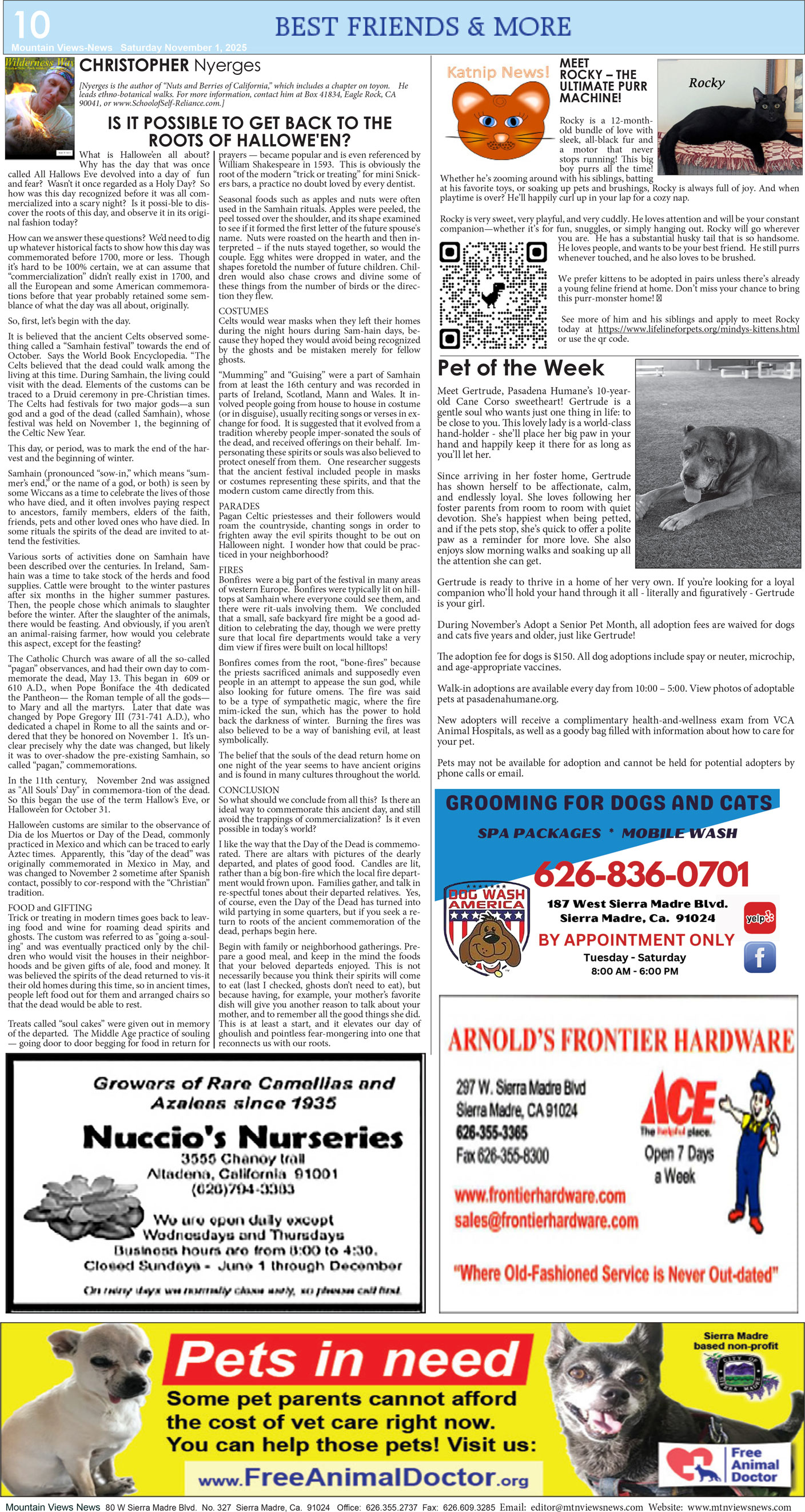
1010 Mountain Views-News Saturday November 1, 2025 CHRISTOPHER Nyerges [Nyerges is the author of “Nuts and Berries of California,” which includes a chapter on toyon. He leads ethno-botanical walks. For more information, contact him at Box 41834, Eagle Rock, CA 90041, or www.SchoolofSelf-Reliance.com.] IS IT POSSIBLE TO GET BACK TO THE ROOTS OF HALLOWE'EN? MEET ROCKY – THE ULTIMATE PURR MACHINE! Rocky is a 12-month- old bundle of love with sleek, all-black fur and a motor that never stops running! This big boy purrs all the time! Whether he’s zooming around with his siblings, batting at his favorite toys, or soaking up pets and brushings, Rocky is always full of joy. And when playtime is over? He’ll happily curl up in your lap for a cozy nap. Rocky is very sweet, very playful, and very cuddly. He loves attention and will be your constant companion—whether it’s for fun, snuggles, or simply hanging out. Rocky will go wherever you are. He has a substantial husky tail that is so handsome. He loves people, and wants to be your best friend. He still purrs whenever touched, and he also loves to be brushed. We prefer kittens to be adopted in pairs unless there’s already a young feline friend at home. Don’t miss your chance to bring this purr-monster home! 💕 See more of him and his siblings and apply to meet Rocky today at https://www.lifelineforpets.org/mindys-kittens.html or use the qr code. What is Hallowe’en all about? Why has the day that was once called All Hallows Eve devolved into a day of fun and fear? Wasn’t it once regarded as a Holy Day? So how was this day recognized before it was all commercialized into a scary night? Is it possi-ble to discover the roots of this day, and observe it in its original fashion today? How can we answer these questions? We’d need to dig up whatever historical facts to show how this day was commemorated before 1700, more or less. Though it’s hard to be 100% certain, we at can assume that “commercialization” didn’t really exist in 1700, and all the European and some American commemorations before that year probably retained some semblance of what the day was all about, originally. So, first, let’s begin with the day. It is believed that the ancient Celts observed something called a “Samhain festival” towards the end of October. Says the World Book Encyclopedia. “The Celts believed that the dead could walk among the living at this time. During Samhain, the living could visit with the dead. Elements of the customs can be traced to a Druid ceremony in pre-Christian times. The Celts had festivals for two major gods—a sun god and a god of the dead (called Samhain), whose festival was held on November 1, the beginning of the Celtic New Year. This day, or period, was to mark the end of the harvest and the beginning of winter. Samhain (pronounced “sow-in,” which means “summer’s end,” or the name of a god, or both) is seen by some Wiccans as a time to celebrate the lives of those who have died, and it often involves paying respect to ancestors, family members, elders of the faith, friends, pets and other loved ones who have died. In some rituals the spirits of the dead are invited to attend the festivities. Various sorts of activities done on Samhain have been described over the centuries. In Ireland, Samhain was a time to take stock of the herds and food supplies. Cattle were brought to the winter pastures after six months in the higher summer pastures. Then, the people chose which animals to slaughter before the winter. After the slaughter of the animals, there would be feasting. And obviously, if you aren’t an animal-raising farmer, how would you celebrate this aspect, except for the feasting? The Catholic Church was aware of all the so-called “pagan” observances, and had their own day to commemorate the dead, May 13. This began in 609 or 610 A.D., when Pope Boniface the 4th dedicated the Pantheon— the Roman temple of all the gods— to Mary and all the martyrs. Later that date was changed by Pope Gregory III (731-741 A.D.), who dedicated a chapel in Rome to all the saints and ordered that they be honored on November 1. It’s unclear precisely why the date was changed, but likely it was to over-shadow the pre-existing Samhain, so called “pagan,” commemorations. In the 11th century, November 2nd was assigned as "All Souls’ Day" in commemora-tion of the dead. So this began the use of the term Hallow’s Eve, or Hallowe’en for October 31. Hallowe’en customs are similar to the observance of Dia de los Muertos or Day of the Dead, commonly practiced in Mexico and which can be traced to early Aztec times. Apparently, this “day of the dead” was originally commemorated in Mexico in May, and was changed to November 2 sometime after Spanish contact, possibly to cor-respond with the “Christian” tradition. FOOD and GIFTING Trick or treating in modern times goes back to leaving food and wine for roaming dead spirits and ghosts. The custom was referred to as "going a-souling" and was eventually practiced only by the children who would visit the houses in their neighborhoods and be given gifts of ale, food and money. It was believed the spirits of the dead returned to vis-it their old homes during this time, so in ancient times, people left food out for them and arranged chairs so that the dead would be able to rest. Treats called “soul cakes” were given out in memory of the departed. The Middle Age practice of souling — going door to door begging for food in return for prayers — became popular and is even referenced by William Shakespeare in 1593. This is obviously the root of the modern “trick or treating” for mini Snickers bars, a practice no doubt loved by every dentist. Seasonal foods such as apples and nuts were often used in the Samhain rituals. Apples were peeled, the peel tossed over the shoulder, and its shape examined to see if it formed the first letter of the future spouse's name. Nuts were roasted on the hearth and then interpreted – if the nuts stayed together, so would the couple. Egg whites were dropped in water, and the shapes foretold the number of future children. Children would also chase crows and divine some of these things from the number of birds or the direction they flew. COSTUMES Celts would wear masks when they left their homes during the night hours during Sam-hain days, because they hoped they would avoid being recognized by the ghosts and be mistaken merely for fellow ghosts. “Mumming” and “Guising” were a part of Samhain from at least the 16th century and was recorded in parts of Ireland, Scotland, Mann and Wales. It involved people going from house to house in costume (or in disguise), usually reciting songs or verses in ex- change for food. It is suggested that it evolved from a tradition whereby people imper-sonated the souls of the dead, and received offerings on their behalf. Impersonating these spirits or souls was also believed to protect oneself from them. One researcher suggests that the ancient festival included people in masks or costumes representing these spirits, and that the modern custom came directly from this. PARADES Pagan Celtic priestesses and their followers would roam the countryside, chanting songs in order to frighten away the evil spirits thought to be out on Halloween night. I wonder how that could be practiced in your neighborhood? FIRES Bonfires were a big part of the festival in many areas of western Europe. Bonfires were typically lit on hilltops at Samhain where everyone could see them, and there were rit-uals involving them. We concluded that a small, safe backyard fire might be a good addition to celebrating the day, though we were pretty sure that local fire departments would take a very dim view if fires were built on local hilltops! Bonfires comes from the root, “bone-fires” because the priests sacrificed animals and supposedly even people in an attempt to appease the sun god, while also looking for future omens. The fire was said to be a type of sympathetic magic, where the fire mim-icked the sun, which has the power to hold back the darkness of winter. Burning the fires was also believed to be a way of banishing evil, at least symbolically. The belief that the souls of the dead return home on one night of the year seems to have ancient origins and is found in many cultures throughout the world. CONCLUSION So what should we conclude from all this? Is there an ideal way to commemorate this ancient day, and still avoid the trappings of commercialization? Is it even possible in today’s world? I like the way that the Day of the Dead is commemorated. There are altars with pictures of the dearly departed, and plates of good food. Candles are lit, rather than a big bon-fire which the local fire department would frown upon. Families gather, and talk in re-spectful tones about their departed relatives. Yes, of course, even the Day of the Dead has turned into wild partying in some quarters, but if you seek a return to roots of the ancient commemoration of the dead, perhaps begin here. Begin with family or neighborhood gatherings. Prepare a good meal, and keep in the mind the foods that your beloved departeds enjoyed. This is not necessarily because you think their spirits will come to eat (last I checked, ghosts don’t need to eat), but because having, for example, your mother’s favorite dish will give you another reason to talk about your mother, and to remember all the good things she did. This is at least a start, and it elevates our day of ghoulish and pointless fear-mongering into one that reconnects us with our roots. Pet of the Week Meet Gertrude, Pasadena Humane’s 10-year- old Cane Corso sweetheart! Gertrude is a gentle soul who wants just one thing in life: to be close to you. This lovely lady is a world-class hand-holder - she’ll place her big paw in your hand and happily keep it there for as long as you’ll let her. Since arriving in her foster home, Gertrude has shown herself to be affectionate, calm, and endlessly loyal. She loves following her foster parents from room to room with quiet devotion. She’s happiest when being petted, and if the pets stop, she’s quick to offer a polite paw as a reminder for more love. She also enjoys slow morning walks and soaking up all the attention she can get. Gertrude is ready to thrive in a home of her very own. If you’re looking for a loyal companion who’ll hold your hand through it all - literally and figuratively - Gertrude is your girl. During November’s Adopt a Senior Pet Month, all adoption fees are waived for dogs and cats five years and older, just like Gertrude! The adoption fee for dogs is $150. All dog adoptions include spay or neuter, microchip, and age-appropriate vaccines. Walk-in adoptions are available every day from 10:00 – 5:00. View photos of adoptable pets at pasadenahumane.org. New adopters will receive a complimentary health-and-wellness exam from VCA Animal Hospitals, as well as a goody bag filled with information about how to care for your pet. Pets may not be available for adoption and cannot be held for potential adopters by phone calls or email. Mountain Views News 80 W Sierra Madre Blvd. No. 327 Sierra Madre, Ca. 91024 Office: 626.355.2737 Fax: 626.609.3285 Email: editor@mtnviewsnews.com Website: www.mtnviewsnews.com | ||||||||||||||||||
| |