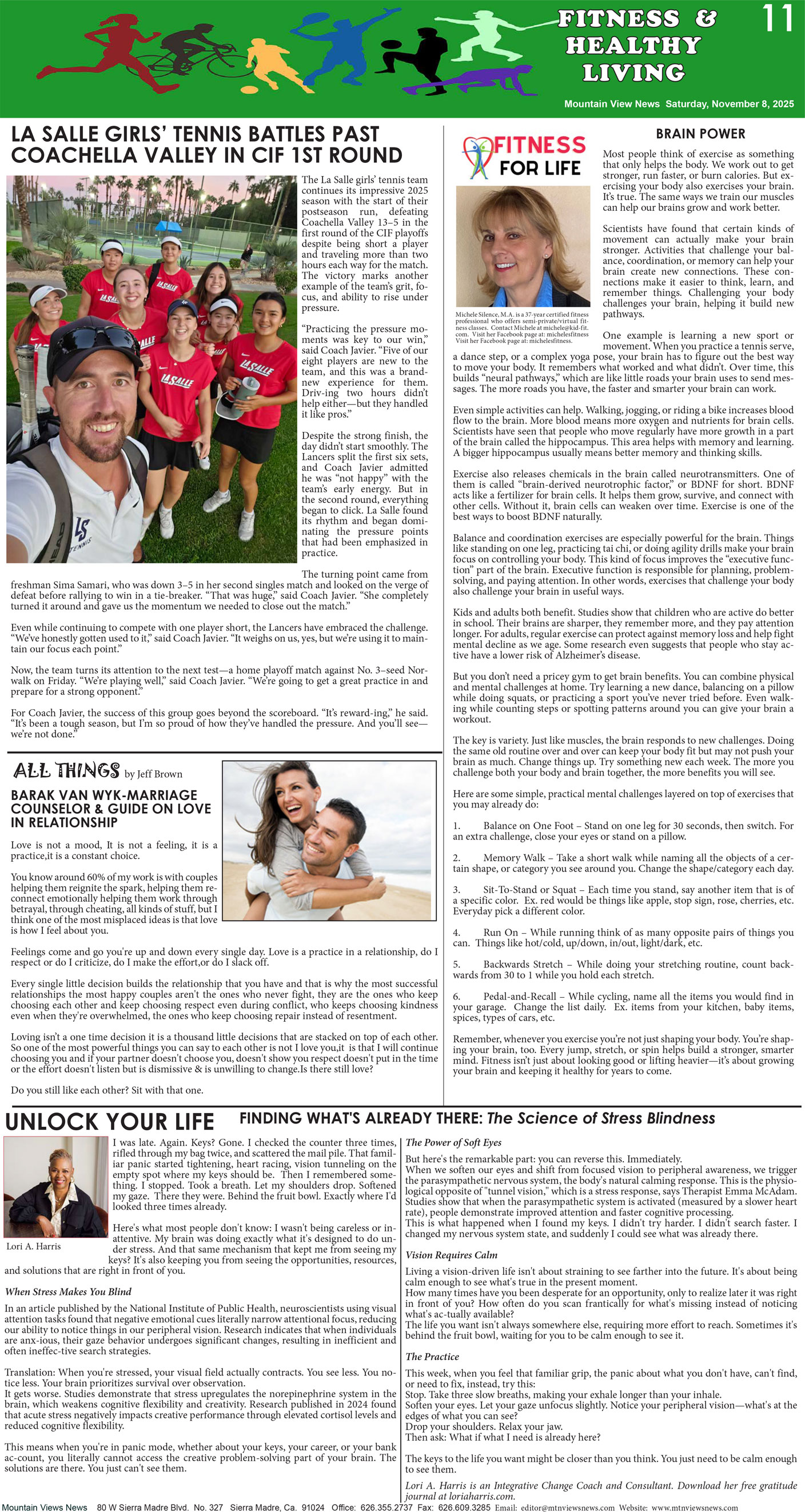
| Health & Fitness | ||||||||||||||||||
| Mountain Views News, Combined Edition Saturday, November 8, 2025 | ||||||||||||||||||
| ||||||||||||||||||
1111 FITNESS & FITNESS & HEALTHY HEALTHY LIVINGLIVING Mountain View News Saturday, November 8, 2025 LA SALLE GIRLS’ TENNIS BATTLES PAST COACHELLA VALLEY IN CIF 1ST ROUND The La Salle girls’ tennis team continues its impressive 2025 season with the start of their postseason run, defeating Coachella Valley 13–5 in the first round of the CIF playoffs despite being short a player and traveling more than two hours each way for the match. The victory marks another example of the team’s grit, focus, and ability to rise under pressure. “Practicing the pressure moments was key to our win,” said Coach Javier. “Five of our eight players are new to the team, and this was a brand- new experience for them. Driv-ing two hours didn’t help either—but they handled it like pros.” Despite the strong finish, the day didn’t start smoothly. The Lancers split the first six sets, and Coach Javier admitted he was “not happy” with the team’s early energy. But in the second round, everything began to click. La Salle found its rhythm and began dominating the pressure points that had been emphasized in practice. The turning point came from freshman Sima Samari, who was down 3–5 in her second singles match and looked on the verge of defeat before rallying to win in a tie-breaker. “That was huge,” said Coach Javier. “She completely turned it around and gave us the momentum we needed to close out the match.” Even while continuing to compete with one player short, the Lancers have embraced the challenge. “We’ve honestly gotten used to it,” said Coach Javier. “It weighs on us, yes, but we’re using it to maintain our focus each point.” Now, the team turns its attention to the next test—a home playoff match against No. 3–seed Norwalk on Friday. “We’re playing well,” said Coach Javier. “We’re going to get a great practice in and prepare for a strong opponent.” For Coach Javier, the success of this group goes beyond the scoreboard. “It’s reward-ing,” he said. “It’s been a tough season, but I’m so proud of how they’ve handled the pressure. And you’ll see— we’re not done.” Michele Silence, M.A. is a 37-year certified fitness professional who offers semi-private/virtual fitness classes. Contact Michele at michele@kid-fit. com. Visit her Facebook page at: michelesfitness Visit her Facebook page at: michelesfitness. BRAIN POWER Most people think of exercise as something that only helps the body. We work out to get stronger, run faster, or burn calories. But exercising your body also exercises your brain. It’s true. The same ways we train our muscles can help our brains grow and work better. Scientists have found that certain kinds of movement can actually make your brain stronger. Activities that challenge your balance, coordination, or memory can help your brain create new connections. These connections make it easier to think, learn, and remember things. Challenging your body challenges your brain, helping it build new pathways. One example is learning a new sport or movement. When you practice a tennis serve, a dance step, or a complex yoga pose, your brain has to figure out the best way to move your body. It remembers what worked and what didn’t. Over time, this builds “neural pathways,” which are like little roads your brain uses to send messages. The more roads you have, the faster and smarter your brain can work. Even simple activities can help. Walking, jogging, or riding a bike increases blood flow to the brain. More blood means more oxygen and nutrients for brain cells. Scientists have seen that people who move regularly have more growth in a part of the brain called the hippocampus. This area helps with memory and learning. A bigger hippocampus usually means better memory and thinking skills. Exercise also releases chemicals in the brain called neurotransmitters. One of them is called “brain-derived neurotrophic factor,” or BDNF for short. BDNF acts like a fertilizer for brain cells. It helps them grow, survive, and connect with other cells. Without it, brain cells can weaken over time. Exercise is one of the best ways to boost BDNF naturally. Balance and coordination exercises are especially powerful for the brain. Things like standing on one leg, practicing tai chi, or doing agility drills make your brain focus on controlling your body. This kind of focus improves the “executive function” part of the brain. Executive function is responsible for planning, problem- solving, and paying attention. In other words, exercises that challenge your body also challenge your brain in useful ways. Kids and adults both benefit. Studies show that children who are active do better in school. Their brains are sharper, they remember more, and they pay attention longer. For adults, regular exercise can protect against memory loss and help fight mental decline as we age. Some research even suggests that people who stay active have a lower risk of Alzheimer’s disease. But you don’t need a pricey gym to get brain benefits. You can combine physical and mental challenges at home. Try learning a new dance, balancing on a pillow while doing squats, or practicing a sport you’ve never tried before. Even walking while counting steps or spotting patterns around you can give your brain a workout. The key is variety. Just like muscles, the brain responds to new challenges. Doing the same old routine over and over can keep your body fit but may not push your brain as much. Change things up. Try something new each week. The more you challenge both your body and brain together, the more benefits you will see. Here are some simple, practical mental challenges layered on top of exercises that you may already do: 1. Balance on One Foot – Stand on one leg for 30 seconds, then switch. For an extra challenge, close your eyes or stand on a pillow. 2. Memory Walk – Take a short walk while naming all the objects of a certain shape, or category you see around you. Change the shape/category each day. 3. Sit-To-Stand or Squat – Each time you stand, say another item that is of a specific color. Ex. red would be things like apple, stop sign, rose, cherries, etc. Everyday pick a different color. 4. Run On – While running think of as many opposite pairs of things you can. Things like hot/cold, up/down, in/out, light/dark, etc. 5. Backwards Stretch – While doing your stretching routine, count backwards from 30 to 1 while you hold each stretch. 6. Pedal-and-Recall – While cycling, name all the items you would find in your garage. Change the list daily. Ex. items from your kitchen, baby items, spices, types of cars, etc. Remember, whenever you exercise you’re not just shaping your body. You’re shaping your brain, too. Every jump, stretch, or spin helps build a stronger, smarter mind. Fitness isn’t just about looking good or lifting heavier—it’s about growing your brain and keeping it healthy for years to come. ALL THINGS by Jeff Brown BARAK VAN WYK-MARRIAGE COUNSELOR & GUIDE ON LOVE IN RELATIONSHIP Love is not a mood, It is not a feeling, it is a practice,it is a constant choice. You know around 60% of my work is with couples helping them reignite the spark, helping them reconnect emotionally helping them work through betrayal, through cheating, all kinds of stuff, but I think one of the most misplaced ideas is that love is how I feel about you. Feelings come and go you're up and down every single day. Love is a practice in a relationship, do I respect or do I criticize, do I make the effort,or do I slack off. Every single little decision builds the relationship that you have and that is why the most successful relationships the most happy couples aren't the ones who never fight, they are the ones who keep choosing each other and keep choosing respect even during conflict, who keeps choosing kindness even when they're overwhelmed, the ones who keep choosing repair instead of resentment. Loving isn’t a one time decision it is a thousand little decisions that are stacked on top of each other. So one of the most powerful things you can say to each other is not I love you,it is that I will continue choosing you and if your partner doesn't choose you, doesn't show you respect doesn't put in the time or the effort doesn't listen but is dismissive & is unwilling to change.Is there still love? Do you still like each other? Sit with that one. UNLOCK YOUR LIFE FINDING WHAT'S ALREADY THERE: The Science of Stress Blindness I was late. Again. Keys? Gone. I checked the counter three times, rifled through my bag twice, and scattered the mail pile. That familiar panic started tightening, heart racing, vision tunneling on the empty spot where my keys should be. Then I remembered something. I stopped. Took a breath. Let my shoulders drop. Softened my gaze. There they were. Behind the fruit bowl. Exactly where I'd looked three times already. Here's what most people don't know: I wasn't being careless or inattentive. My brain was doing exactly what it's designed to do under stress. And that same mechanism that kept me from seeing my keys? It's also keeping you from seeing the opportunities, resources, and solutions that are right in front of you. When Stress Makes You Blind In an article published by the National Institute of Public Health, neuroscientists using visual attention tasks found that negative emotional cues literally narrow attentional focus, reducing our ability to notice things in our peripheral vision. Research indicates that when individuals are anx-ious, their gaze behavior undergoes significant changes, resulting in inefficient and often ineffec-tive search strategies. Translation: When you're stressed, your visual field actually contracts. You see less. You notice less. Your brain prioritizes survival over observation. It gets worse. Studies demonstrate that stress upregulates the norepinephrine system in the brain, which weakens cognitive flexibility and creativity. Research published in 2024 found that acute stress negatively impacts creative performance through elevated cortisol levels and reduced cognitive flexibility. This means when you're in panic mode, whether about your keys, your career, or your bank ac-count, you literally cannot access the creative problem-solving part of your brain. The solutions are there. You just can't see them. The Power of Soft Eyes But here's the remarkable part: you can reverse this. Immediately. When we soften our eyes and shift from focused vision to peripheral awareness, we trigger the parasympathetic nervous system, the body's natural calming response. This is the physiological opposite of "tunnel vision," which is a stress response, says Therapist Emma McAdam. Studies show that when the parasympathetic system is activated (measured by a slower heart rate), people demonstrate improved attention and faster cognitive processing. This is what happened when I found my keys. I didn't try harder. I didn't search faster. I changed my nervous system state, and suddenly I could see what was already there. Vision Requires Calm Living a vision-driven life isn't about straining to see farther into the future. It's about being calm enough to see what's true in the present moment. How many times have you been desperate for an opportunity, only to realize later it was right in front of you? How often do you scan frantically for what's missing instead of noticing what's ac-tually available? The life you want isn't always somewhere else, requiring more effort to reach. Sometimes it's behind the fruit bowl, waiting for you to be calm enough to see it. The Practice This week, when you feel that familiar grip, the panic about what you don't have, can't find, or need to fix, instead, try this: Stop. Take three slow breaths, making your exhale longer than your inhale. Soften your eyes. Let your gaze unfocus slightly. Notice your peripheral vision—what's at the edges of what you can see? Drop your shoulders. Relax your jaw. Then ask: What if what I need is already here? The keys to the life you want might be closer than you think. You just need to be calm enough to see them. Lori A. Harris is an Integrative Change Coach and Consultant. Download her free gratitude journal at loriaharris.com. Lori A. Harris Mountain Views News 80 W Sierra Madre Blvd. No. 327 Sierra Madre, Ca. 91024 Office: 626.355.2737 Fax: 626.609.3285 Email: editor@mtnviewsnews.com Website: www.mtnviewsnews.com | ||||||||||||||||||
| |