| Health & Fitness | ||||||||||||||||||
| Mountain Views News, Combined Edition Saturday, November 15, 2025 | ||||||||||||||||||
| ||||||||||||||||||
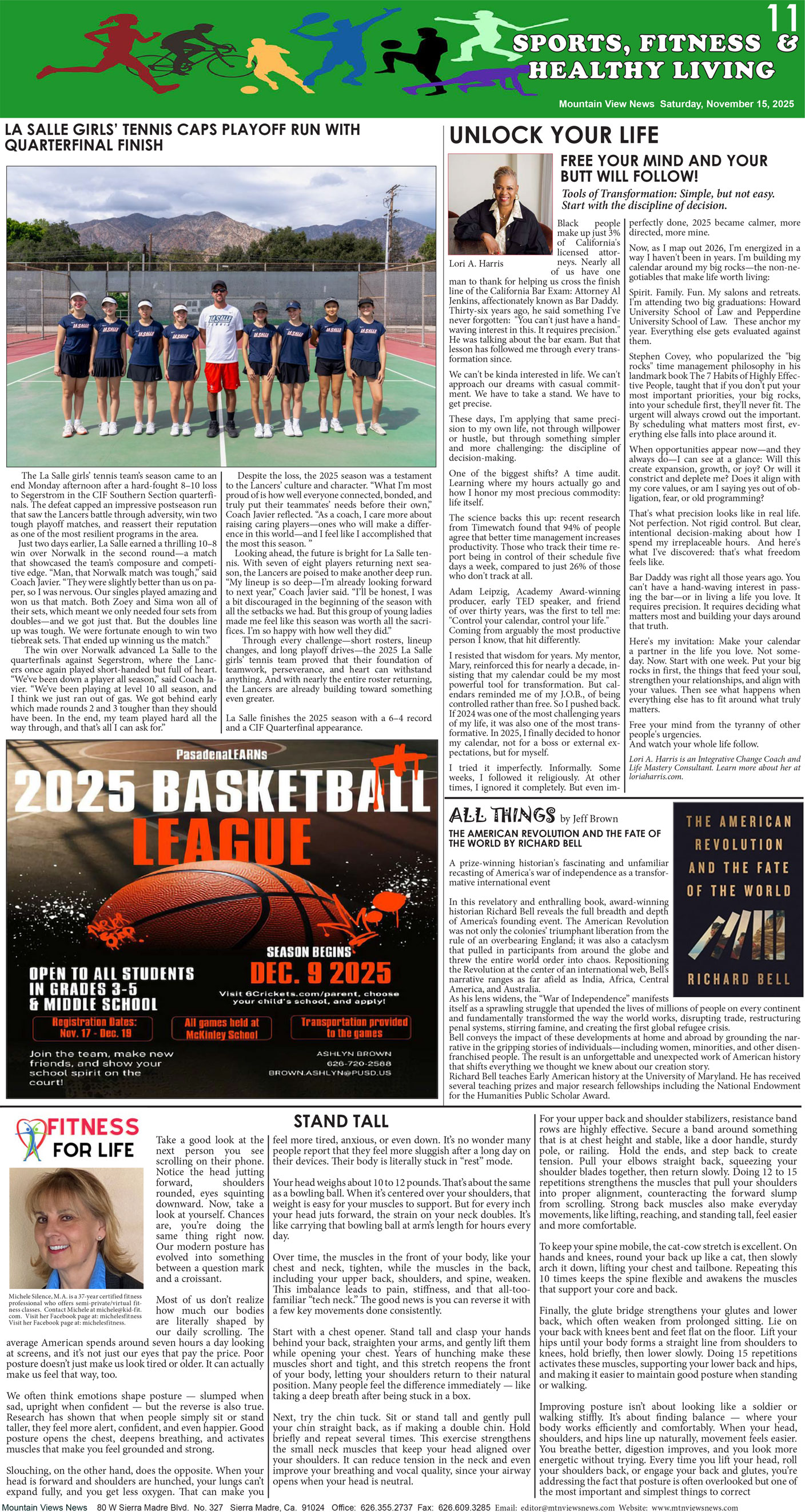
1111 SPORTS, FITNESS & SPORTS, FITNESS & HEALTHY LIVINGHEALTHY LIVING Mountain View News Saturday, November 15, 2025 LA SALLE GIRLS’ TENNIS CAPS PLAYOFF RUN WITH QUARTERFINAL FINISH Lori A. Harris FREE YOUR MIND AND YOUR BUTT WILL FOLLOW! Tools of Transformation: Simple, but not easy. Start with the discipline of decision. Black people make up just 3% of California's licensed attorneys. Nearly all of us have one man to thank for helping us cross the finish line of the California Bar Exam: Attorney Al Jenkins, affectionately known as Bar Daddy. Thirty-six years ago, he said something I've never forgotten: "You can't just have a hand- waving interest in this. It requires precision." He was talking about the bar exam. But that lesson has followed me through every transformation since. We can't be kinda interested in life. We can't approach our dreams with casual commitment. We have to take a stand. We have to get precise. These days, I'm applying that same precision to my own life, not through willpower or hustle, but through something simpler and more challenging: the discipline of decision-making. One of the biggest shifts? A time audit. Learning where my hours actually go and how I honor my most precious commodity: life itself. The science backs this up: recent research from Timewatch found that 94% of people agree that better time management increases productivity. Those who track their time report being in control of their schedule five days a week, compared to just 26% of those who don't track at all. Adam Leipzig, Academy Award-winning producer, early TED speaker, and friend of over thirty years, was the first to tell me: "Control your calendar, control your life." Coming from arguably the most productive person I know, that hit differently. I resisted that wisdom for years. My mentor, Mary, reinforced this for nearly a decade, insisting that my calendar could be my most powerful tool for transformation. But calendars reminded me of my J.O.B., of being controlled rather than free. So I pushed back. If 2024 was one of the most challenging years of my life, it was also one of the most transformative. In 2025, I finally decided to honor my calendar, not for a boss or external expectations, but for myself. I tried it imperfectly. Informally. Some weeks, I followed it religiously. At other times, I ignored it completely. But even imperfectly done, 2025 became calmer, more directed, more mine. Now, as I map out 2026, I'm energized in a way I haven't been in years. I'm building my calendar around my big rocks—the non-negotiables that make life worth living: Spirit. Family. Fun. My salons and retreats. I'm attending two big graduations: Howard University School of Law and Pepperdine University School of Law. These anchor my year. Everything else gets evaluated against them. Stephen Covey, who popularized the "big rocks" time management philosophy in his landmark book The 7 Habits of Highly Effective People, taught that if you don't put your most important priorities, your big rocks, into your schedule first, they'll never fit. The urgent will always crowd out the important. By scheduling what matters most first, everything else falls into place around it. When opportunities appear now—and they always do—I can see at a glance: Will this create expansion, growth, or joy? Or will it constrict and deplete me? Does it align with my core values, or am I saying yes out of obligation, fear, or old programming? That's what precision looks like in real life. Not perfection. Not rigid control. But clear, intentional decision-making about how I spend my irreplaceable hours. And here's what I've discovered: that's what freedom feels like. Bar Daddy was right all those years ago. You can't have a hand-waving interest in passing the bar—or in living a life you love. It requires precision. It requires deciding what matters most and building your days around that truth. Here's my invitation: Make your calendar a partner in the life you love. Not someday. Now. Start with one week. Put your big rocks in first, the things that feed your soul, strengthen your relationships, and align with your values. Then see what happens when everything else has to fit around what truly matters. Free your mind from the tyranny of other people's urgencies. And watch your whole life follow. Lori A. Harris is an Integrative Change Coach and Life Mastery Consultant. Learn more about her at loriaharris.com. The La Salle girls’ tennis team’s season came to an end Monday afternoon after a hard-fought 8–10 loss to Segerstrom in the CIF Southern Section quarterfinals. The defeat capped an impressive postseason run that saw the Lancers battle through adversity, win two tough playoff matches, and reassert their reputation as one of the most resilient programs in the area. Just two days earlier, La Salle earned a thrilling 10–8 win over Norwalk in the second round—a match that showcased the team’s composure and competitive edge. “Man, that Norwalk match was tough,” said Coach Javier. “They were slightly better than us on paper, so I was nervous. Our singles played amazing and won us that match. Both Zoey and Sima won all of their sets, which meant we only needed four sets from doubles—and we got just that. But the doubles line up was tough. We were fortunate enough to win two tiebreak sets. That ended up winning us the match.” The win over Norwalk advanced La Salle to the quarterfinals against Segerstrom, where the Lancers once again played short-handed but full of heart. “We’ve been down a player all season,” said Coach Javier. “We’ve been playing at level 10 all season, and I think we just ran out of gas. We got behind early which made rounds 2 and 3 tougher than they should have been. In the end, my team played hard all the way through, and that’s all I can ask for.” Despite the loss, the 2025 season was a testament to the Lancers’ culture and character. “What I’m most proud of is how well everyone connected, bonded, and truly put their teammates’ needs before their own,” Coach Javier reflected. “As a coach, I care more about raising caring players—ones who will make a difference in this world—and I feel like I accomplished that the most this season. ” Looking ahead, the future is bright for La Salle tennis. With seven of eight players returning next season, the Lancers are poised to make another deep run. “My lineup is so deep—I’m already looking forward to next year,” Coach Javier said. “I’ll be honest, I was a bit discouraged in the beginning of the season with all the setbacks we had. But this group of young ladies made me feel like this season was worth all the sacrifices. I’m so happy with how well they did.” Through every challenge—short rosters, lineup changes, and long playoff drives—the 2025 La Salle girls’ tennis team proved that their foundation of teamwork, perseverance, and heart can withstand anything. And with nearly the entire roster returning, the Lancers are already building toward something even greater. La Salle finishes the 2025 season with a 6–4 record and a CIF Quarterfinal appearance. ALL THINGS by Jeff Brown THE AMERICAN REVOLUTION AND THE FATE OF THE WORLD BY RICHARD BELL A prize-winning historian's fascinating and unfamiliar recasting of America's war of independence as a transformative international event In this revelatory and enthralling book, award-winning historian Richard Bell reveals the full breadth and depth of America’s founding event. The American Revolution was not only the colonies’ triumphant liberation from the rule of an overbearing England; it was also a cataclysm that pulled in participants from around the globe and threw the entire world order into chaos. Repositioning the Revolution at the center of an international web, Bell’s narrative ranges as far afield as India, Africa, Central America, and Australia. As his lens widens, the “War of Independence” manifests itself as a sprawling struggle that upended the lives of millions of people on every continent and fundamentally transformed the way the world works, disrupting trade, restructuring penal systems, stirring famine, and creating the first global refugee crisis. Bell conveys the impact of these developments at home and abroad by grounding the narrative in the gripping stories of individuals—including women, minorities, and other disenfranchised people. The result is an unforgettable and unexpected work of American history that shifts everything we thought we knew about our creation story. Richard Bell teaches Early American history at the University of Maryland. He has received several teaching prizes and major research fellowships including the National Endowment for the Humanities Public Scholar Award. Michele Silence, M.A. is a 37-year certified fitness professional who offers semi-private/virtual fitness classes. Contact Michele at michele@kid-fit. com. Visit her Facebook page at: michelesfitness Visit her Facebook page at: michelesfitness. STAND TALL Take a good look at the next person you see scrolling on their phone. Notice the head jutting forward, shoulders rounded, eyes squinting downward. Now, take a look at yourself. Chances are, you’re doing the same thing right now. Our modern posture has evolved into something between a question mark and a croissant. Most of us don’t realize how much our bodies are literally shaped by our daily scrolling. The average American spends around seven hours a day looking at screens, and it’s not just our eyes that pay the price. Poor posture doesn’t just make us look tired or older. It can actually make us feel that way, too. We often think emotions shape posture — slumped when sad, upright when confident — but the reverse is also true. Research has shown that when people simply sit or stand taller, they feel more alert, confident, and even happier. Good posture opens the chest, deepens breathing, and activates muscles that make you feel grounded and strong. Slouching, on the other hand, does the opposite. When your head is forward and shoulders are hunched, your lungs can’t expand fully, and you get less oxygen. That can make you feel more tired, anxious, or even down. It’s no wonder many people report that they feel more sluggish after a long day on their devices. Their body is literally stuck in “rest” mode. Your head weighs about 10 to 12 pounds. That’s about the same as a bowling ball. When it’s centered over your shoulders, that weight is easy for your muscles to support. But for every inch your head juts forward, the strain on your neck doubles. It’s like carrying that bowling ball at arm’s length for hours every day. Over time, the muscles in the front of your body, like your chest and neck, tighten, while the muscles in the back, including your upper back, shoulders, and spine, weaken. This imbalance leads to pain, stiffness, and that all-too- familiar “tech neck.” The good news is you can reverse it with a few key movements done consistently. Start with a chest opener. Stand tall and clasp your hands behind your back, straighten your arms, and gently lift them while opening your chest. Years of hunching make these muscles short and tight, and this stretch reopens the front of your body, letting your shoulders return to their natural position. Many people feel the difference immediately — like taking a deep breath after being stuck in a box. Next, try the chin tuck. Sit or stand tall and gently pull your chin straight back, as if making a double chin. Hold briefly and repeat several times. This exercise strengthens the small neck muscles that keep your head aligned over your shoulders. It can reduce tension in the neck and even improve your breathing and vocal quality, since your airway opens when your head is neutral. For your upper back and shoulder stabilizers, resistance band rows are highly effective. Secure a band around something that is at chest height and stable, like a door handle, sturdy pole, or railing. Hold the ends, and step back to create tension. Pull your elbows straight back, squeezing your shoulder blades together, then return slowly. Doing 12 to 15 repetitions strengthens the muscles that pull your shoulders into proper alignment, counteracting the forward slump from scrolling. Strong back muscles also make everyday movements, like lifting, reaching, and standing tall, feel easier and more comfortable. To keep your spine mobile, the cat-cow stretch is excellent. On hands and knees, round your back up like a cat, then slowly arch it down, lifting your chest and tailbone. Repeating this 10 times keeps the spine flexible and awakens the muscles that support your core and back. Finally, the glute bridge strengthens your glutes and lower back, which often weaken from prolonged sitting. Lie on your back with knees bent and feet flat on the floor. Lift your hips until your body forms a straight line from shoulders to knees, hold briefly, then lower slowly. Doing 15 repetitions activates these muscles, supporting your lower back and hips, and making it easier to maintain good posture when standing or walking. Improving posture isn’t about looking like a soldier or walking stiffly. It’s about finding balance — where your body works efficiently and comfortably. When your head, shoulders, and hips line up naturally, movement feels easier. You breathe better, digestion improves, and you look more energetic without trying. Every time you lift your head, roll your shoulders back, or engage your back and glutes, you’re addressing the fact that posture is often overlooked but one of the most important and simplest things to correct Mountain Views News 80 W Sierra Madre Blvd. No. 327 Sierra Madre, Ca. 91024 Office: 626.355.2737 Fax: 626.609.3285 Email: editor@mtnviewsnews.com Website: www.mtnviewsnews.com | ||||||||||||||||||
| |