| Health & Fitness | ||||||||||||||||||
| Mountain Views News, Combined Edition Saturday, January 3, 2026 | ||||||||||||||||||
| ||||||||||||||||||
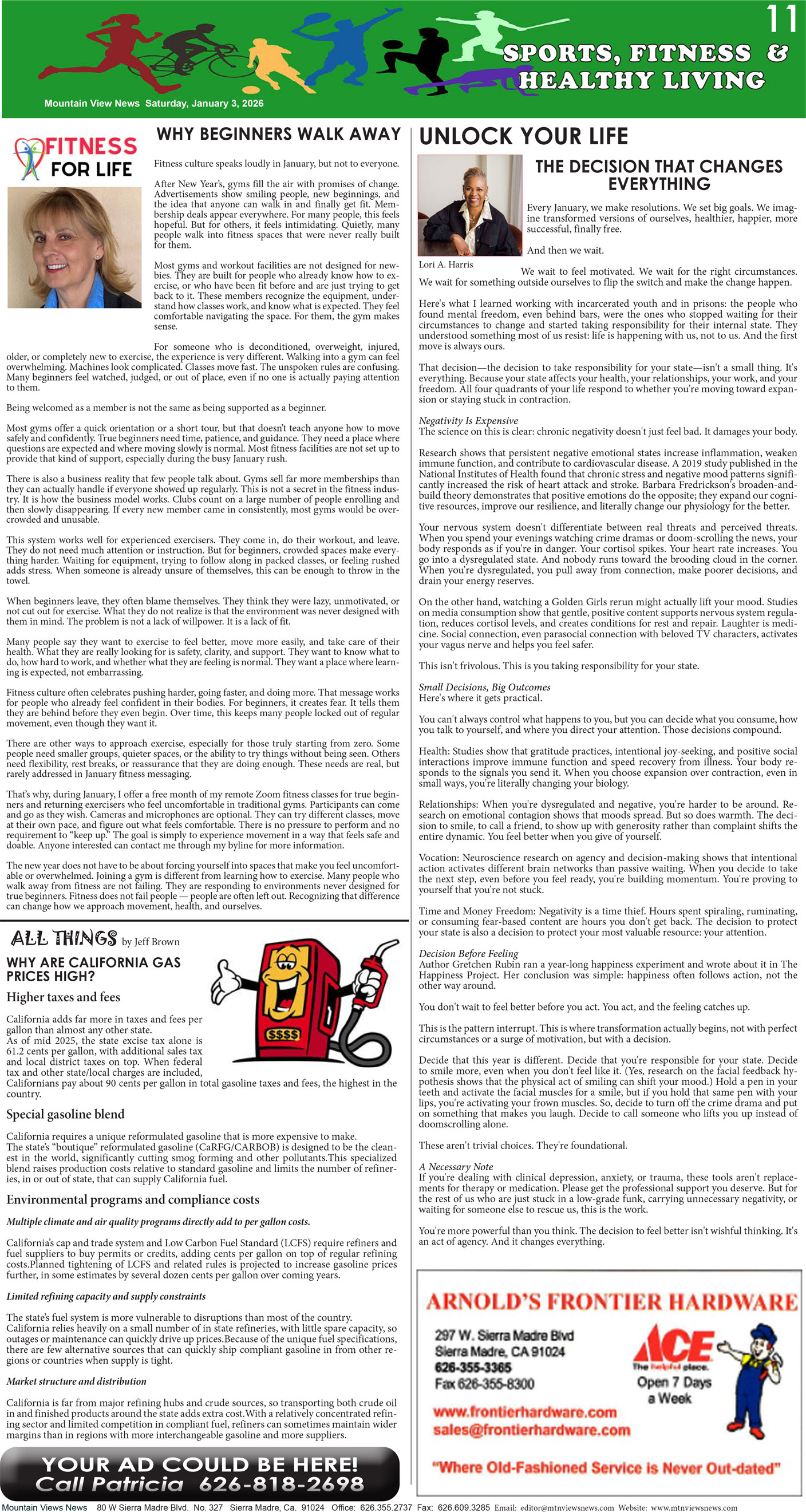
1111 SPORTS, FITNESS &SPORTS, FITNESS & HEALTHY LIVINGHEALTHY LIVING Mountain View News Saturday, January 3, 2026 1111 SPORTS, FITNESS &SPORTS, FITNESS & HEALTHY LIVINGHEALTHY LIVING Mountain View News Saturday, January 3, 2026 WHY BEGINNERS WALK AWAY UNLOCK YOUR LIFE Fitness culture speaks loudly in January, but not to everyone. After New Year’s, gyms fill the air with promises of change. Advertisements show smiling people, new beginnings, and the idea that anyone can walk in and finally get fit. Membership deals appear everywhere. For many people, this feels hopeful. But for others, it feels intimidating. Quietly, many people walk into fitness spaces that were never really built for them. Most gyms and workout facilities are not designed for newbies. They are built for people who already know how to exercise, or who have been fit before and are just trying to get back to it. These members recognize the equipment, understand how classes work, and know what is expected. They feel comfortable navigating the space. For them, the gym makes sense. For someone who is deconditioned, overweight, injured, older, or completely new to exercise, the experience is very different. Walking into a gym can feel overwhelming. Machines look complicated. Classes move fast. The unspoken rules are confusing. Many beginners feel watched, judged, or out of place, even if no one is actually paying attention to them. Being welcomed as a member is not the same as being supported as a beginner. Most gyms offer a quick orientation or a short tour, but that doesn’t teach anyone how to move safely and confidently. True beginners need time, patience, and guidance. They need a place where questions are expected and where moving slowly is normal. Most fitness facilities are not set up to provide that kind of support, especially during the busy January rush. There is also a business reality that few people talk about. Gyms sell far more memberships than they can actually handle if everyone showed up regularly. This is not a secret in the fitness industry. It is how the business model works. Clubs count on a large number of people enrolling and then slowly disappearing. If every new member came in consistently, most gyms would be overcrowded and unusable. This system works well for experienced exercisers. They come in, do their workout, and leave. They do not need much attention or instruction. But for beginners, crowded spaces make everything harder. Waiting for equipment, trying to follow along in packed classes, or feeling rushed adds stress. When someone is already unsure of themselves, this can be enough to throw in the towel. When beginners leave, they often blame themselves. They think they were lazy, unmotivated, or not cut out for exercise. What they do not realize is that the environment was never designed with them in mind. The problem is not a lack of willpower. It is a lack of fit. Many people say they want to exercise to feel better, move more easily, and take care of their health. What they are really looking for is safety, clarity, and support. They want to know what to do, how hard to work, and whether what they are feeling is normal. They want a place where learning is expected, not embarrassing. Fitness culture often celebrates pushing harder, going faster, and doing more. That message works for people who already feel confident in their bodies. For beginners, it creates fear. It tells them they are behind before they even begin. Over time, this keeps many people locked out of regular movement, even though they want it. There are other ways to approach exercise, especially for those truly starting from zero. Some people need smaller groups, quieter spaces, or the ability to try things without being seen. Others need flexibility, rest breaks, or reassurance that they are doing enough. These needs are real, but rarely addressed in January fitness messaging. That’s why, during January, I offer a free month of my remote Zoom fitness classes for true beginners and returning exercisers who feel uncomfortable in traditional gyms. Participants can come and go as they wish. Cameras and microphones are optional. They can try different classes, move at their own pace, and figure out what feels comfortable. There is no pressure to perform and no requirement to “keep up.” The goal is simply to experience movement in a way that feels safe and doable. Anyone interested can contact me through my byline for more information. The new year does not have to be about forcing yourself into spaces that make you feel uncomfortable or overwhelmed. Joining a gym is different from learning how to exercise. Many people who walk away from fitness are not failing. They are responding to environments never designed for true beginners. Fitness does not fail people — people are often left out. Recognizing that difference can change how we approach movement, health, and ourselves. ALL THINGS by Jeff Brown WHY ARE CALIFORNIA GAS PRICES HIGH? Higher taxes and fees California adds far more in taxes and fees per gallon than almost any other state. As of mid 2025, the state excise tax alone is 61.2 cents per gallon, with additional sales tax and local district taxes on top. When federal tax and other state/local charges are included, Californians pay about 90 cents per gallon in total gasoline taxes and fees, the highest in the country. Special gasoline blend California requires a unique reformulated gasoline that is more expensive to make. The state’s “boutique” reformulated gasoline (CaRFG/CARBOB) is designed to be the cleanest in the world, significantly cutting smog forming and other pollutants.This specialized blend raises production costs relative to standard gasoline and limits the number of refineries, in or out of state, that can supply California fuel. Environmental programs and compliance costs Multiple climate and air quality programs directly add to per gallon costs. California’s cap and trade system and Low Carbon Fuel Standard (LCFS) require refiners and fuel suppliers to buy permits or credits, adding cents per gallon on top of regular refining costs.Planned tightening of LCFS and related rules is projected to increase gasoline prices further, in some estimates by several dozen cents per gallon over coming years. Limited refining capacity and supply constraints The state’s fuel system is more vulnerable to disruptions than most of the country. California relies heavily on a small number of in state refineries, with little spare capacity, so outages or maintenance can quickly drive up prices.Because of the unique fuel specifications, there are few alternative sources that can quickly ship compliant gasoline in from other regions or countries when supply is tight. Market structure and distribution California is far from major refining hubs and crude sources, so transporting both crude oil in and finished products around the state adds extra cost.With a relatively concentrated refining sector and limited competition in compliant fuel, refiners can sometimes maintain wider margins than in regions with more interchangeable gasoline and more suppliers. YOUR AD COULD BE HERE! Call Patricia 626-818-2698 Mountain Views News 80 W Sierra Madre Blvd. No. 327 Sierra Madre, Ca. 91024 Office: 626.355.2737 Fax: 626.609.3285 Email: editor@mtnviewsnews.com Website: www.mtnviewsnews.com Lori A. Harris THE DECISION THAT CHANGES EVERYTHING Every January, we make resolutions. We set big goals. We imagine transformed versions of ourselves, healthier, happier, more successful, finally free. And then we wait. We wait to feel motivated. We wait for the right circumstances. We wait for something outside ourselves to flip the switch and make the change happen. Here's what I learned working with incarcerated youth and in prisons: the people who found mental freedom, even behind bars, were the ones who stopped waiting for their circumstances to change and started taking responsibility for their internal state. They understood something most of us resist: life is happening with us, not to us. And the first move is always ours. That decision—the decision to take responsibility for your state—isn't a small thing. It's everything. Because your state affects your health, your relationships, your work, and your freedom. All four quadrants of your life respond to whether you're moving toward expansion or staying stuck in contraction. Negativity Is Expensive The science on this is clear: chronic negativity doesn't just feel bad. It damages your body. Research shows that persistent negative emotional states increase inflammation, weaken immune function, and contribute to cardiovascular disease. A 2019 study published in the National Institutes of Health found that chronic stress and negative mood patterns significantly increased the risk of heart attack and stroke. Barbara Fredrickson's broaden-andbuild theory demonstrates that positive emotions do the opposite; they expand our cognitive resources, improve our resilience, and literally change our physiology for the better. Your nervous system doesn't differentiate between real threats and perceived threats. When you spend your evenings watching crime dramas or doom-scrolling the news, your body responds as if you're in danger. Your cortisol spikes. Your heart rate increases. You go into a dysregulated state. And nobody runs toward the brooding cloud in the corner. When you're dysregulated, you pull away from connection, make poorer decisions, and drain your energy reserves. On the other hand, watching a Golden Girls rerun might actually lift your mood. Studies on media consumption show that gentle, positive content supports nervous system regulation, reduces cortisol levels, and creates conditions for rest and repair. Laughter is medicine. Social connection, even parasocial connection with beloved TV characters, activates your vagus nerve and helps you feel safer. This isn't frivolous. This is you taking responsibility for your state. Small Decisions, Big Outcomes Here's where it gets practical. You can't always control what happens to you, but you can decide what you consume, how you talk to yourself, and where you direct your attention. Those decisions compound. Health: Studies show that gratitude practices, intentional joy-seeking, and positive social interactions improve immune function and speed recovery from illness. Your body responds to the signals you send it. When you choose expansion over contraction, even in small ways, you're literally changing your biology. Relationships: When you're dysregulated and negative, you're harder to be around. Research on emotional contagion shows that moods spread. But so does warmth. The decision to smile, to call a friend, to show up with generosity rather than complaint shifts the entire dynamic. You feel better when you give of yourself. Vocation: Neuroscience research on agency and decision-making shows that intentional action activates different brain networks than passive waiting. When you decide to take the next step, even before you feel ready, you're building momentum. You're proving to yourself that you're not stuck. Time and Money Freedom: Negativity is a time thief. Hours spent spiraling, ruminating, or consuming fear-based content are hours you don't get back. The decision to protect your state is also a decision to protect your most valuable resource: your attention. Decision Before Feeling Author Gretchen Rubin ran a year-long happiness experiment and wrote about it in The Happiness Project. Her conclusion was simple: happiness often follows action, not the other way around. You don't wait to feel better before you act. You act, and the feeling catches up. This is the pattern interrupt. This is where transformation actually begins, not with perfect circumstances or a surge of motivation, but with a decision. Decide that this year is different. Decide that you're responsible for your state. Decide to smile more, even when you don't feel like it. (Yes, research on the facial feedback hypothesis shows that the physical act of smiling can shift your mood.) Hold a pen in your teeth and activate the facial muscles for a smile, but if you hold that same pen with your lips, you're activating your frown muscles. So, decide to turn off the crime drama and put on something that makes you laugh. Decide to call someone who lifts you up instead of doomscrolling alone. These aren't trivial choices. They're foundational. A Necessary Note If you're dealing with clinical depression, anxiety, or trauma, these tools aren't replacements for therapy or medication. Please get the professional support you deserve. But for the rest of us who are just stuck in a low-grade funk, carrying unnecessary negativity, or waiting for someone else to rescue us, this is the work. You're more powerful than you think. The decision to feel better isn't wishful thinking. It's an act of agency. And it changes everything. | ||||||||||||||||||
| |