| Fitness & Health | ||||||||||||||||||||
| Mountain Views News, Combined Edition Saturday, February 14, 2026 | ||||||||||||||||||||
| ||||||||||||||||||||
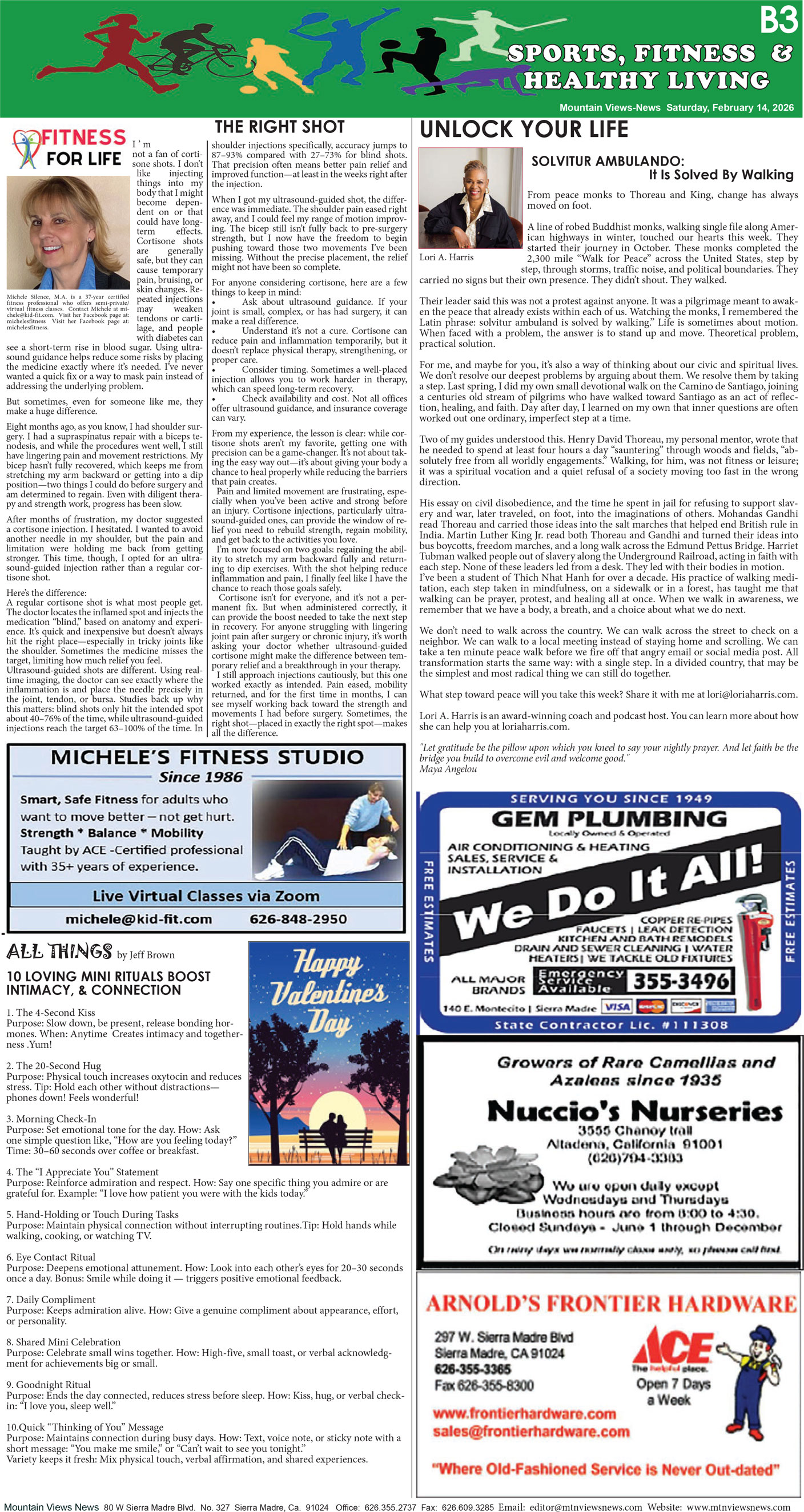
Michele Silence, M.A. is a 37-year certified fitness professional who offers semi-private/ virtual fitness classes. Contact Michele at mi- chele@kid-fit.com. Visit her Facebook page at: michelesfitness Visit her Facebook page at: michelesfitness. I’m not a fan of cortisone shots. I don’t like injecting things into mybody that I might become dependent on or that could have longterm effects. Cortisone shots are generally safe, but they can cause temporary pain, bruising, or skin changes. Repeated injections may weaken tendons or cartilage, and people with diabetes can see a short-term rise in blood sugar. Using ultrasound guidance helps reduce some risks by placing the medicine exactly where it’s needed. I’ve never wanted a quick fix or a way to mask pain instead of addressing the underlying problem. But sometimes, even for someone like me, they make a huge difference. Eight months ago, as you know, I had shoulder surgery. I had a supraspinatus repair with a biceps tenodesis, and while the procedures went well, I still have lingering pain and movement restrictions. Mybicep hasn’t fully recovered, which keeps me from stretching my arm backward or getting into a dip position—two things I could do before surgery and am determined to regain. Even with diligent therapy and strength work, progress has been slow. After months of frustration, my doctor suggested a cortisone injection. I hesitated. I wanted to avoid another needle in my shoulder, but the pain and limitation were holding me back from getting stronger. This time, though, I opted for an ultrasound- guided injection rather than a regular cortisone shot. Here’s the difference: A regular cortisone shot is what most people get. The doctor locates the inflamed spot and injects the medication “blind,” based on anatomy and experience. It’s quick and inexpensive but doesn’t alwayshit the right place—especially in tricky joints like the shoulder. Sometimes the medicine misses the target, limiting how much relief you feel. Ultrasound-guided shots are different. Using real- time imaging, the doctor can see exactly where the inflammation is and place the needle precisely in the joint, tendon, or bursa. Studies back up why this matters: blind shots only hit the intended spot about 40–76% of the time, while ultrasound-guided injections reach the target 63–100% of the time. In B3B3 SPORTS, FITNESS &SPORTS, FITNESS & HEALTHY LIVINGHEALTHY LIVING Mountain Views-News Saturday, February 14, 2026 THE RIGHT SHOT UNLOCK YOUR LIFE Lori A. Harris SOLVITUR AMBULANDO: It Is Solved By Walking From peace monks to Thoreau and King, change has always moved on foot. A line of robed Buddhist monks, walking single file along Amer ican highways in winter, touched our hearts this week. They started their journey in October. These monks completed the 2,300 mile “Walk for Peace” across the United States, step by step, through storms, traffic noise, and political boundaries. They carried no signs but their own presence. They didn’t shout. They walked. Their leader said this was not a protest against anyone. It was a pilgrimage meant to awaken the peace that already exists within each of us. Watching the monks, I remembered the Latin phrase: solvitur ambuland is solved by walking.” Life is sometimes about motion. When faced with a problem, the answer is to stand up and move. Theoretical problem, practical solution. For me, and maybe for you, it’s also a way of thinking about our civic and spiritual lives. We don’t resolve our deepest problems by arguing about them. We resolve them by taking a step. Last spring, I did my own small devotional walk on the Camino de Santiago, joining a centuries old stream of pilgrims who have walked toward Santiago as an act of reflection, healing, and faith. Day after day, I learned on my own that inner questions are often worked out one ordinary, imperfect step at a time. Two of my guides understood this. Henry David Thoreau, my personal mentor, wrote that he needed to spend at least four hours a day “sauntering” through woods and fields, “absolutely free from all worldly engagements.” Walking, for him, was not fitness or leisure; it was a spiritual vocation and a quiet refusal of a society moving too fast in the wrongdirection. His essay on civil disobedience, and the time he spent in jail for refusing to support slavery and war, later traveled, on foot, into the imaginations of others. Mohandas Gandhi read Thoreau and carried those ideas into the salt marches that helped end British rule in India. Martin Luther King Jr. read both Thoreau and Gandhi and turned their ideas into bus boycotts, freedom marches, and a long walk across the Edmund Pettus Bridge. Harriet Tubman walked people out of slavery along the Underground Railroad, acting in faith with each step. None of these leaders led from a desk. They led with their bodies in motion. I’ve been a student of Thich Nhat Hanh for over a decade. His practice of walking meditation, each step taken in mindfulness, on a sidewalk or in a forest, has taught me that walking can be prayer, protest, and healing all at once. When we walk in awareness, we remember that we have a body, a breath, and a choice about what we do next. We don’t need to walk across the country. We can walk across the street to check on a neighbor. We can walk to a local meeting instead of staying home and scrolling. We can take a ten minute peace walk before we fire off that angry email or social media post. All transformation starts the same way: with a single step. In a divided country, that may be the simplest and most radical thing we can still do together. What step toward peace will you take this week? Share it with me at lori@loriaharris.com. Lori A. Harris is an award-winning coach and podcast host. You can learn more about how she can help you at loriaharris.com. "Let gratitude be the pillow upon which you kneel to say your nightly prayer. And let faith be the bridge you build to overcome evil and welcome good." Maya Angelou shoulder injections specifically, accuracy jumps to 87–93% compared with 27–73% for blind shots. That precision often means better pain relief and improved function—at least in the weeks right after the injection. When I got my ultrasound-guided shot, the difference was immediate. The shoulder pain eased right away, and I could feel my range of motion improving. The bicep still isn’t fully back to pre-surgery strength, but I now have the freedom to begin pushing toward those two movements I’ve been missing. Without the precise placement, the relief might not have been so complete. For anyone considering cortisone, here are a few things to keep in mind: • Ask about ultrasound guidance. If your joint is small, complex, or has had surgery, it can make a real difference. • Understand it’s not a cure. Cortisone can reduce pain and inflammation temporarily, but it doesn’t replace physical therapy, strengthening, or proper care. • Consider timing. Sometimes a well-placed injection allows you to work harder in therapy, which can speed long-term recovery. • Check availability and cost. Not all offices offer ultrasound guidance, and insurance coverage can vary. From my experience, the lesson is clear: while cortisone shots aren’t my favorite, getting one with precision can be a game-changer. It’s not about taking the easy way out—it’s about giving your body a chance to heal properly while reducing the barriers that pain creates. Pain and limited movement are frustrating, especially when you’ve been active and strong before an injury. Cortisone injections, particularly ultrasound- guided ones, can provide the window of relief you need to rebuild strength, regain mobility, and get back to the activities you love. I’m now focused on two goals: regaining the ability to stretch my arm backward fully and returning to dip exercises. With the shot helping reduce inflammation and pain, I finally feel like I have the chance to reach those goals safely. Cortisone isn’t for everyone, and it’s not a permanent fix. But when administered correctly, it can provide the boost needed to take the next stepin recovery. For anyone struggling with lingeringjoint pain after surgery or chronic injury, it’s worth asking your doctor whether ultrasound-guided cortisone might make the difference between temporary relief and a breakthrough in your therapy. I still approach injections cautiously, but this one worked exactly as intended. Pain eased, mobility returned, and for the first time in months, I can see myself working back toward the strength and movements I had before surgery. Sometimes, the right shot—placed in exactly the right spot—makes all the difference. ALL THINGS by Jeff Brown 10 LOVING MINI RITUALS BOOST INTIMACY, & CONNECTION 1. The 4-Second Kiss Purpose: Slow down, be present, release bonding hormones. When: Anytime Creates intimacy and togetherness .Yum! 2. The 20-Second HugPurpose: Physical touch increases oxytocin and reduces stress. Tip: Hold each other without distractions— phones down! Feels wonderful! 3. Morning Check-InPurpose: Set emotional tone for the day. How: Ask one simple question like, “How are you feeling today?” Time: 30–60 seconds over coffee or breakfast. 4. The “I Appreciate You” StatementPurpose: Reinforce admiration and respect. How: Say one specific thing you admire or are grateful for. Example: “I love how patient you were with the kids today.” 5. Hand-Holding or Touch During TasksPurpose: Maintain physical connection without interrupting routines.Tip: Hold hands while walking, cooking, or watching TV. 6. Eye Contact RitualPurpose: Deepens emotional attunement. How: Look into each other’s eyes for 20–30 seconds once a day. Bonus: Smile while doing it — triggers positive emotional feedback. 7. Daily ComplimentPurpose: Keeps admiration alive. How: Give a genuine compliment about appearance, effort, or personality. 8. Shared Mini Celebration Purpose: Celebrate small wins together. How: High-five, small toast, or verbal acknowledgment for achievements big or small. 9. Goodnight RitualPurpose: Ends the day connected, reduces stress before sleep. How: Kiss, hug, or verbal check- in: “I love you, sleep well.” 10.Quick “Thinking of You” MessagePurpose: Maintains connection during busy days. How: Text, voice note, or sticky note with a short message: “You make me smile,” or “Can’t wait to see you tonight.” Variety keeps it fresh: Mix physical touch, verbal affirmation, and shared experiences. Mountain Views News 80 W Sierra Madre Blvd. No. 327 Sierra Madre, Ca. 91024 Office: 626.355.2737 Fax: 626.609.3285 Email: editor@mtnviewsnews.com Website: www.mtnviewsnews.com | ||||||||||||||||||||
| |