| Conversations | ||||||||||||||||
| Mountain Views News, Combined Edition Saturday, November 14, 2026 | ||||||||||||||||
| ||||||||||||||||
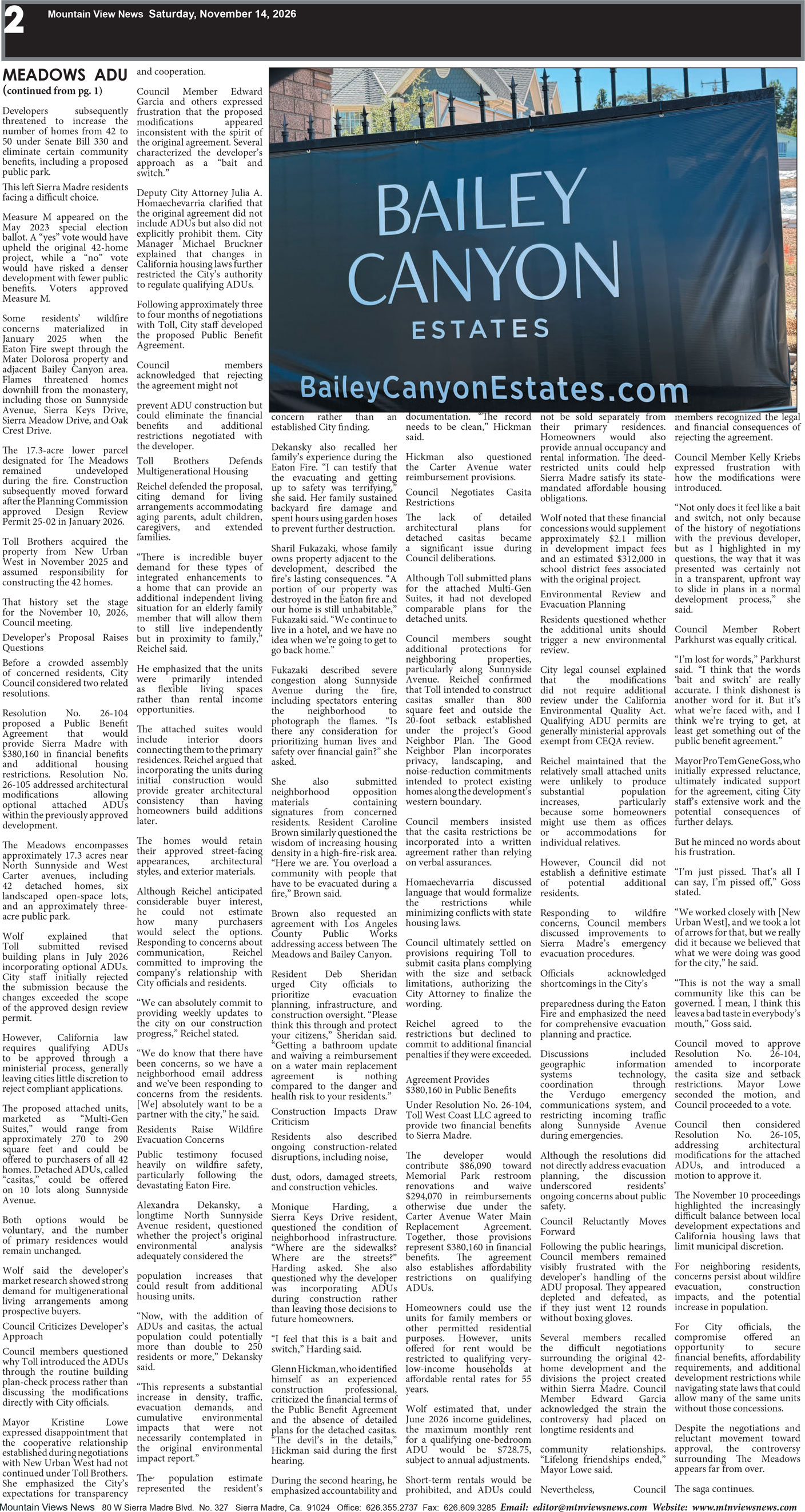
Mountain View News Saturday, November 14, 202622 Mountain View News Saturday, November 14, 202622 MEADOWS ADU (continued from pg. 1) Developers subsequentlythreatened to increase the number of homes from 42 to 50 under Senate Bill 330 and eliminate certain communitybenefits, including a proposedpublic park. This left Sierra Madre residents facing a difficult choice. Measure M appeared on theMay 2023 special election ballot. A “yes” vote would haveupheld the original 42-homeproject, while a “no” vote would have risked a denser development with fewer publicbenefits. Voters approvedMeasure M. Some residents’ wildfire concerns materialized in January 2025 when the Eaton Fire swept through the Mater Dolorosa property andadjacent Bailey Canyon area. Flames threatened homes downhill from the monastery, including those on SunnysideAvenue, Sierra Keys Drive, Sierra Meadow Drive, and OakCrest Drive. The 17.3-acre lower parceldesignated for The Meadowsremained undevelopedduring the fire. Constructionsubsequently moved forward after the Planning Commissionapproved Design Review Permit 25-02 in January 2026. Toll Brothers acquired theproperty from New UrbanWest in November 2025 and assumed responsibility for constructing the 42 homes. That history set the stagefor the November 10, 2026, Council meeting. Developer’s Proposal RaisesQuestions Before a crowded assemblyof concerned residents, CityCouncil considered two related resolutions. Resolution No. 26-104 proposed a Public Benefit Agreement that would provide Sierra Madre with$380,160 in financial benefits and additional housingrestrictions. Resolution No. 26-105 addressed architectural modifications allowingoptional attached ADUs within the previously approveddevelopment. The Meadows encompassesapproximately 17.3 acres nearNorth Sunnyside and WestCarter avenues, including42 detached homes, six landscaped open-space lots, and an approximately three- acre public park. Wolf explained that Toll submitted revised building plans in July 2026incorporating optional ADUs. City staff initially rejectedthe submission because the changes exceeded the scopeof the approved design reviewpermit. However, California law requires qualifying ADUs to be approved through aministerial process, generallyleaving cities little discretion toreject compliant applications. The proposed attached units, marketed as “Multi-Gen Suites,” would range from approximately 270 to 290 square feet and could be offered to purchasers of all 42homes. Detached ADUs, called “casitas,” could be offered on 10 lots along SunnysideAvenue. Both options would be voluntary, and the numberof primary residences wouldremain unchanged. Wolf said the developer’smarket research showed strongdemand for multigenerationalliving arrangements amongprospective buyers. Council Criticizes Developer’sApproach Council members questionedwhy Toll introduced the ADUsthrough the routine buildingplan-check process rather thandiscussing the modificationsdirectly with City officials. Mayor Kristine Lowe expressed disappointment thatthe cooperative relationshipestablished during negotiationswith New Urban West had not continued under Toll Brothers. She emphasized the City’sexpectations for transparency and cooperation. Council Member Edward Garcia and others expressedfrustration that the proposedmodifications appearedinconsistent with the spirit ofthe original agreement. Severalcharacterized the developer’sapproach as a “bait and switch.” Deputy City Attorney Julia A. Homaechevarria clarified that the original agreement did notinclude ADUs but also did not explicitly prohibit them. CityManager Michael Bruckner explained that changes in California housing laws furtherrestricted the City’s authorityto regulate qualifying ADUs. Following approximately threeto four months of negotiationswith Toll, City staff developedthe proposed Public BenefitAgreement. Council members acknowledged that rejectingthe agreement might not prevent ADU construction butcould eliminate the financial benefits and additional restrictions negotiated with the developer. Toll Brothers Defends Multigenerational Housing Reichel defended the proposal, citing demand for livingarrangements accommodatingaging parents, adult children, caregivers, and extended families. “There is incredible buyerdemand for these types of integrated enhancements toa home that can provide anadditional independent livingsituation for an elderly familymember that will allow them to still live independentlybut in proximity to family,” Reichel said. He emphasized that the units were primarily intended as flexible living spacesrather than rental income opportunities. The attached suites would include interior doors connecting them to the primaryresidences. Reichel argued thatincorporating the units duringinitial construction would provide greater architecturalconsistency than havinghomeowners build additions later. The homes would retain their approved street-facing appearances, architectural styles, and exterior materials. Although Reichel anticipatedconsiderable buyer interest, he could not estimate how many purchaserswould select the options. Responding to concerns aboutcommunication, Reichel committed to improving thecompany’s relationship with City officials and residents. “We can absolutely commit toproviding weekly updates tothe city on our constructionprogress,” Reichel stated. “We do know that there have been concerns, so we have a neighborhood email address and we’ve been responding toconcerns from the residents. [We] absolutely want to be apartner with the city,” he said. Residents Raise Wildfire Evacuation Concerns Public testimony focused heavily on wildfire safety, particularly following the devastating Eaton Fire. Alexandra Dekansky, a longtime North SunnysideAvenue resident, questionedwhether the project’s originalenvironmental analysisadequately considered the population increases that could result from additional housing units. “Now, with the addition ofADUs and casitas, the actual population could potentially more than double to 250 residents or more,” Dekanskysaid. “This represents a substantialincrease in density, traffic, evacuation demands, and cumulative environmental impacts that were not necessarily contemplated in the original environmental impact report.” The population estimate represented the resident’s concern rather than an established City finding. Dekansky also recalled herfamily’s experience during theEaton Fire. “I can testify thatthe evacuating and gettingup to safety was terrifying,” she said. Her family sustained backyard fire damage and spent hours using garden hosesto prevent further destruction. Sharil Fukazaki, whose familyowns property adjacent to thedevelopment, described the fire’s lasting consequences. “Aportion of our property was destroyed in the Eaton fire andour home is still unhabitable,” Fukazaki said. “We continue to live in a hotel, and we have noidea when we’re going to get togo back home.” Fukazaki described severe congestion along SunnysideAvenue during the fire, including spectators enteringthe neighborhood to photograph the flames. “Isthere any consideration forprioritizing human lives andsafety over financial gain?” sheasked. She also submitted neighborhood oppositionmaterials containingsignatures from concerned residents. Resident Caroline Brown similarly questioned thewisdom of increasing housingdensity in a high-fire-risk area. “Here we are. You overload a community with people thathave to be evacuated during afire,” Brown said. Brown also requested an agreement with Los AngelesCounty Public Works addressing access between TheMeadows and Bailey Canyon. Resident Deb Sheridan urged City officials to prioritize evacuation planning, infrastructure, andconstruction oversight. “Please think this through and protectyour citizens,” Sheridan said. “Getting a bathroom updateand waiving a reimbursementon a water main replacement agreement is nothingcompared to the danger andhealth risk to your residents.” Construction Impacts DrawCriticism Residents also described ongoing construction-relateddisruptions, including noise, dust, odors, damaged streets, and construction vehicles. Monique Harding, a Sierra Keys Drive resident, questioned the condition ofneighborhood infrastructure. “Where are the sidewalks? Where are the streets?” Harding asked. She also questioned why the developer was incorporating ADUs during construction rather than leaving those decisions tofuture homeowners. “I feel that this is a bait and switch,” Harding said. Glenn Hickman, who identifiedhimself as an experiencedconstruction professional, criticized the financial terms of the Public Benefit Agreementand the absence of detailed plans for the detached casitas. “The devil’s in the details,” Hickman said during the firsthearing. During the second hearing, heemphasized accountability and documentation. “The record needs to be clean,” Hickmansaid. Hickman also questionedthe Carter Avenue water reimbursement provisions. Council Negotiates Casita Restrictions The lack of detailed architectural plans for detached casitas became a significant issue duringCouncil deliberations. Although Toll submitted plansfor the attached Multi-Gen Suites, it had not developedcomparable plans for the detached units. Council members soughtadditional protections for neighboring properties, particularly along SunnysideAvenue. Reichel confirmed that Toll intended to construct casitas smaller than 800 square feet and outside the20-foot setback established under the project’s Good Neighbor Plan. The Good Neighbor Plan incorporatesprivacy, landscaping, and noise-reduction commitments intended to protect existinghomes along the development’swestern boundary. Council members insisted that the casita restrictions be incorporated into a writtenagreement rather than relyingon verbal assurances. Homaechevarria discussed language that would formalizethe restrictions while minimizing conflicts with statehousing laws. Council ultimately settled onprovisions requiring Toll tosubmit casita plans complyingwith the size and setback limitations, authorizing the City Attorney to finalize thewording. Reichel agreed to the restrictions but declined to commit to additional financial penalties if they were exceeded. Agreement Provides$380,160 in Public Benefits Under Resolution No. 26-104, Toll West Coast LLC agreed toprovide two financial benefitsto Sierra Madre. The developer would contribute $86,090 toward Memorial Park restroom renovations and waive $294,070 in reimbursements otherwise due under the Carter Avenue Water Main Replacement Agreement. Together, those provisionsrepresent $380,160 in financialbenefits. The agreementalso establishes affordabilityrestrictions on qualifyingADUs. Homeowners could use the units for family members orother permitted residential purposes. However, units offered for rent would be restricted to qualifying verylow- income households at affordable rental rates for 55 years. Wolf estimated that, under June 2026 income guidelines, the maximum monthly rentfor a qualifying one-bedroomADU would be $728.75, subject to annual adjustments. Short-term rentals would be prohibited, and ADUs could not be sold separately fromtheir primary residences. Homeowners would also provide annual occupancy andrental information. The deed- restricted units could helpSierra Madre satisfy its state- mandated affordable housingobligations. Wolf noted that these financial concessions would supplementapproximately $2.1 million in development impact feesand an estimated $312,000 in school district fees associated with the original project. Environmental Review and Evacuation Planning Residents questioned whetherthe additional units should trigger a new environmentalreview. City legal counsel explainedthat the modifications did not require additional review under the California Environmental Quality Act. Qualifying ADU permits aregenerally ministerial approvalsexempt from CEQA review. Reichel maintained that the relatively small attached units were unlikely to producesubstantial populationincreases, particularlybecause some homeowners might use them as offices or accommodations for individual relatives. However, Council did not establish a definitive estimate of potential additional residents. Responding to wildfire concerns, Council members discussed improvements to Sierra Madre’s emergencyevacuation procedures. Officials acknowledgedshortcomings in the City’s preparedness during the EatonFire and emphasized the need for comprehensive evacuationplanning and practice. Discussions included geographic information systems technology, coordination throughthe Verdugo emergencycommunications system, andrestricting incoming traffic along Sunnyside Avenue during emergencies. Although the resolutions didnot directly address evacuationplanning, the discussion underscored residents’ ongoing concerns about publicsafety. Council Reluctantly Moves Forward Following the public hearings, Council members remained visibly frustrated with the developer’s handling of theADU proposal. They appeareddepleted and defeated, as if they just went 12 roundswithout boxing gloves. Several members recalled the difficult negotiationssurrounding the original 42home development and thedivisions the project createdwithin Sierra Madre. Council Member Edward Garcia acknowledged the strain thecontroversy had placed onlongtime residents and community relationships. “Lifelong friendships ended,” Mayor Lowe said. Nevertheless, Council members recognized the legaland financial consequences ofrejecting the agreement. Council Member Kelly Kriebsexpressed frustration with how the modifications were introduced. “Not only does it feel like a baitand switch, not only because of the history of negotiationswith the previous developer, but as I highlighted in myquestions, the way that it waspresented was certainly notin a transparent, upfront wayto slide in plans in a normaldevelopment process,” she said. Council Member Robert Parkhurst was equally critical. “I’m lost for words,” Parkhurstsaid. “I think that the words ‘bait and switch’ are really accurate. I think dishonest is another word for it. But it’s what we’re faced with, and I think we’re trying to get, atleast get something out of thepublic benefit agreement.” Mayor Pro Tem Gene Goss, whoinitially expressed reluctance, ultimately indicated supportfor the agreement, citing Citystaff’s extensive work and the potential consequences of further delays. But he minced no words about his frustration. “I’m just pissed. That’s all Ican say, I’m pissed off,” Gossstated. “We worked closely with [NewUrban West], and we took a lot of arrows for that, but we reallydid it because we believed that what we were doing was goodfor the city,” he said. “This is not the way a smallcommunity like this can begoverned. I mean, I think thisleaves a bad taste in everybody’smouth,” Goss said. Council moved to approveResolution No. 26-104, amended to incorporatethe casita size and setback restrictions. Mayor Lowe seconded the motion, and Council proceeded to a vote. Council then considered Resolution No. 26-105, addressing architectural modifications for the attached ADUs, and introduced a motion to approve it. The November 10 proceedingshighlighted the increasinglydifficult balance between local development expectations andCalifornia housing laws thatlimit municipal discretion. For neighboring residents, concerns persist about wildfireevacuation, construction impacts, and the potentialincrease in population. For City officials, the compromise offered an opportunity to secure financial benefits, affordabilityrequirements, and additional development restrictions whilenavigating state laws that could allow many of the same unitswithout those concessions. Despite the negotiations andreluctant movement toward approval, the controversysurrounding The Meadows appears far from over. The saga continues. Mountain Views News 80 W Sierra Madre Blvd. No. 327 Sierra Madre, Ca. 91024 Office: 626.355.2737 Fax: 626.609.3285 Email: editor@mtnviewsnews.com Website: www.mtnviewsnews.com | ||||||||||||||||
| |