| Health & Fitness | ||||||||||||||||||||
| Mountain Views News, Combined Edition Saturday, May 24, 2025 | ||||||||||||||||||||
| ||||||||||||||||||||
|
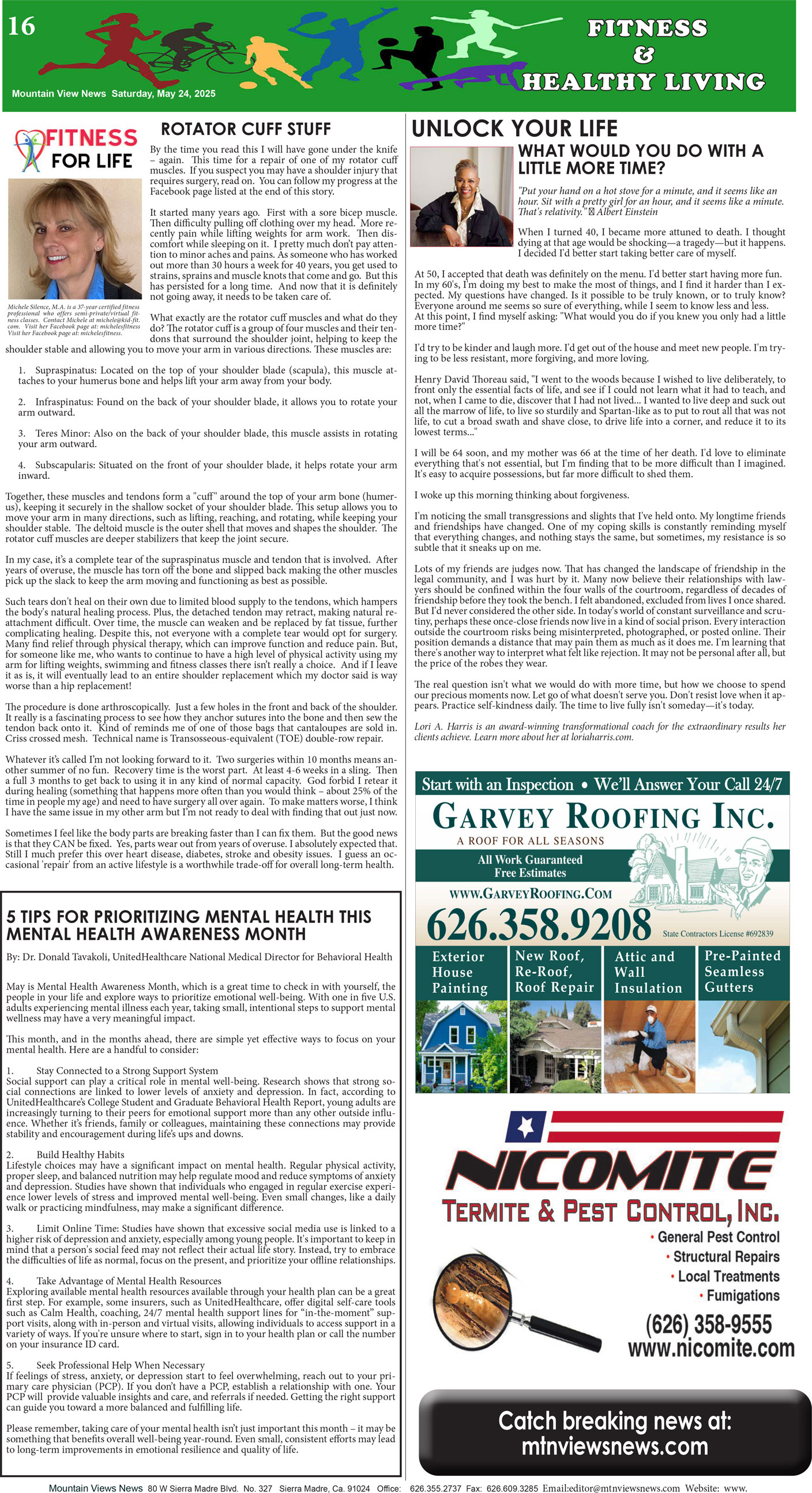
16 FITNESS FITNESS & & HEALTHY LIVINGHEALTHY LIVING Mountain View News Saturday, May 24, 2025 Michele Silence, M.A. is a 37-year certified fitness professional who offers semi-private/virtual fitness classes. Contact Michele at michele@kid-fit. com. Visit her Facebook page at: michelesfitness Visit her Facebook page at: michelesfitness. UNLOCK YOUR LIFE ROTATOR CUFF STUFF By the time you read this I will have gone under the knife – again. This time for a repair of one of my rotator cuff muscles. If you suspect you may have a shoulder injury that requires surgery, read on. You can follow my progress at the Facebook page listed at the end of this story. It started many years ago. First with a sore bicep muscle. Then difficulty pulling off clothing over my head. More recently pain while lifting weights for arm work. Then discomfort while sleeping on it. I pretty much don’t pay attention to minor aches and pains. As someone who has worked out more than 30 hours a week for 40 years, you get used to strains, sprains and muscle knots that come and go. But this has persisted for a long time. And now that it is definitely not going away, it needs to be taken care of. What exactly are the rotator cuff muscles and what do they do? The rotator cuff is a group of four muscles and their tendons that surround the shoulder joint, helping to keep the shoulder stable and allowing you to move your arm in various directions. These muscles are: 1. Supraspinatus: Located on the top of your shoulder blade (scapula), this muscle attaches to your humerus bone and helps lift your arm away from your body. 2. Infraspinatus: Found on the back of your shoulder blade, it allows you to rotate your arm outward. 3. Teres Minor: Also on the back of your shoulder blade, this muscle assists in rotating your arm outward. 4. Subscapularis: Situated on the front of your shoulder blade, it helps rotate your arm inward. Together, these muscles and tendons form a "cuff" around the top of your arm bone (humerus), keeping it securely in the shallow socket of your shoulder blade. This setup allows you to move your arm in many directions, such as lifting, reaching, and rotating, while keeping your shoulder stable. The deltoid muscle is the outer shell that moves and shapes the shoulder. The rotator cuff muscles are deeper stabilizers that keep the joint secure. In my case, it’s a complete tear of the supraspinatus muscle and tendon that is involved. After years of overuse, the muscle has torn off the bone and slipped back making the other muscles pick up the slack to keep the arm moving and functioning as best as possible. Such tears don't heal on their own due to limited blood supply to the tendons, which hampers the body's natural healing process. Plus, the detached tendon may retract, making natural reattachment difficult. Over time, the muscle can weaken and be replaced by fat tissue, further complicating healing. Despite this, not everyone with a complete tear would opt for surgery. Many find relief through physical therapy, which can improve function and reduce pain. But, for someone like me, who wants to continue to have a high level of physical activity using my arm for lifting weights, swimming and fitness classes there isn’t really a choice. And if I leave it as is, it will eventually lead to an entire shoulder replacement which my doctor said is way worse than a hip replacement! The procedure is done arthroscopically. Just a few holes in the front and back of the shoulder. It really is a fascinating process to see how they anchor sutures into the bone and then sew the tendon back onto it. Kind of reminds me of one of those bags that cantaloupes are sold in. Criss crossed mesh. Technical name is Transosseous-equivalent (TOE) double-row repair. Whatever it’s called I’m not looking forward to it. Two surgeries within 10 months means another summer of no fun. Recovery time is the worst part. At least 4-6 weeks in a sling. Then a full 3 months to get back to using it in any kind of normal capacity. God forbid I retear it during healing (something that happens more often than you would think – about 25% of the time in people my age) and need to have surgery all over again. To make matters worse, I think I have the same issue in my other arm but I’m not ready to deal with finding that out just now. Sometimes I feel like the body parts are breaking faster than I can fix them. But the good news is that they CAN be fixed. Yes, parts wear out from years of overuse. I absolutely expected that. Still I much prefer this over heart disease, diabetes, stroke and obesity issues. I guess an occasional 'repair' from an active lifestyle is a worthwhile trade-off for overall long-term health. WHAT WOULD YOU DO WITH A LITTLE MORE TIME? "Put your hand on a hot stove for a minute, and it seems like an hour. Sit with a pretty girl for an hour, and it seems like a minute. That's relativity." ― Albert Einstein When I turned 40, I became more attuned to death. I thought dying at that age would be shocking—a tragedy—but it happens. I decided I'd better start taking better care of myself. At 50, I accepted that death was definitely on the menu. I'd better start having more fun. In my 60's, I'm doing my best to make the most of things, and I find it harder than I expected. My questions have changed. Is it possible to be truly known, or to truly know? Everyone around me seems so sure of everything, while I seem to know less and less. At this point, I find myself asking: "What would you do if you knew you only had a little more time?" I'd try to be kinder and laugh more. I'd get out of the house and meet new people. I'm trying to be less resistant, more forgiving, and more loving. Henry David Thoreau said, "I went to the woods because I wished to live deliberately, to front only the essential facts of life, and see if I could not learn what it had to teach, and not, when I came to die, discover that I had not lived... I wanted to live deep and suck out all the marrow of life, to live so sturdily and Spartan-like as to put to rout all that was not life, to cut a broad swath and shave close, to drive life into a corner, and reduce it to its lowest terms..." I will be 64 soon, and my mother was 66 at the time of her death. I'd love to eliminate everything that's not essential, but I'm finding that to be more difficult than I imagined. It's easy to acquire possessions, but far more difficult to shed them. I woke up this morning thinking about forgiveness. I'm noticing the small transgressions and slights that I've held onto. My longtime friends and friendships have changed. One of my coping skills is constantly reminding myself that everything changes, and nothing stays the same, but sometimes, my resistance is so subtle that it sneaks up on me. Lots of my friends are judges now. That has changed the landscape of friendship in the legal community, and I was hurt by it. Many now believe their relationships with lawyers should be confined within the four walls of the courtroom, regardless of decades of friendship before they took the bench. I felt abandoned, excluded from lives I once shared. But I'd never considered the other side. In today's world of constant surveillance and scrutiny, perhaps these once-close friends now live in a kind of social prison. Every interaction outside the courtroom risks being misinterpreted, photographed, or posted online. Their position demands a distance that may pain them as much as it does me. I'm learning that there's another way to interpret what felt like rejection. It may not be personal after all, but the price of the robes they wear. The real question isn't what we would do with more time, but how we choose to spend our precious moments now. Let go of what doesn't serve you. Don't resist love when it appears. Practice self-kindness daily. The time to live fully isn't someday—it's today. Lori A. Harris is an award-winning transformational coach for the extraordinary results her clients achieve. Learn more about her at loriaharris.com. SSttaarrtt wwiitthh aann IInnssppeeccttiioonn WWee’’llll AAnnsswweerr YYoouurr CCaallll 2244//77 Exterior House Painting New Roof, Re-Roof, Roof Repair Attic and Wall Insulation Pre-Painted Seamless Gutters 5 TIPS FOR PRIORITIZING MENTAL HEALTH THIS MENTAL HEALTH AWARENESS MONTH By: Dr. Donald Tavakoli, UnitedHealthcare National Medical Director for Behavioral Health May is Mental Health Awareness Month, which is a great time to check in with yourself, the people in your life and explore ways to prioritize emotional well-being. With one in five U.S. adults experiencing mental illness each year, taking small, intentional steps to support mental wellness may have a very meaningful impact. This month, and in the months ahead, there are simple yet effective ways to focus on your mental health. Here are a handful to consider: 1. Stay Connected to a Strong Support System Social support can play a critical role in mental well-being. Research shows that strong social connections are linked to lower levels of anxiety and depression. In fact, according to UnitedHealthcare’s College Student and Graduate Behavioral Health Report, young adults are increasingly turning to their peers for emotional support more than any other outside influence. Whether it’s friends, family or colleagues, maintaining these connections may provide stability and encouragement during life’s ups and downs. 2. Build Healthy Habits Lifestyle choices may have a significant impact on mental health. Regular physical activity, proper sleep, and balanced nutrition may help regulate mood and reduce symptoms of anxiety and depression. Studies have shown that individuals who engaged in regular exercise experience lower levels of stress and improved mental well-being. Even small changes, like a daily walk or practicing mindfulness, may make a significant difference. 3. Limit Online Time: Studies have shown that excessive social media use is linked to a higher risk of depression and anxiety, especially among young people. It's important to keep in mind that a person's social feed may not reflect their actual life story. Instead, try to embrace the difficulties of life as normal, focus on the present, and prioritize your offline relationships. 4. Take Advantage of Mental Health Resources Exploring available mental health resources available through your health plan can be a great first step. For example, some insurers, such as UnitedHealthcare, offer digital self-care tools such as Calm Health, coaching, 24/7 mental health support lines for “in-the-moment” support visits, along with in-person and virtual visits, allowing individuals to access support in a variety of ways. If you're unsure where to start, sign in to your health plan or call the number on your insurance ID card. 5. Seek Professional Help When Necessary If feelings of stress, anxiety, or depression start to feel overwhelming, reach out to your primary care physician (PCP). If you don’t have a PCP, establish a relationship with one. Your PCP will provide valuable insights and care, and referrals if needed. Getting the right support can guide you toward a more balanced and fulfilling life. Please remember, taking care of your mental health isn’t just important this month – it may be something that benefits overall well-being year-round. Even small, consistent efforts may lead to long-term improvements in emotional resilience and quality of life. Mountain Views News 80 W Sierra Madre Blvd. No. 327 Sierra Madre, Ca. 91024 Office: 626.355.2737 Fax: 626.609.3285 Email:editor@mtnviewsnews.com Website: www. | ||||||||||||||||||||
| |