| Best Friends and More | ||||||||||||||||||
| Mountain Views News, Combined Edition Saturday, June 21, 2025 | ||||||||||||||||||
| ||||||||||||||||||
|
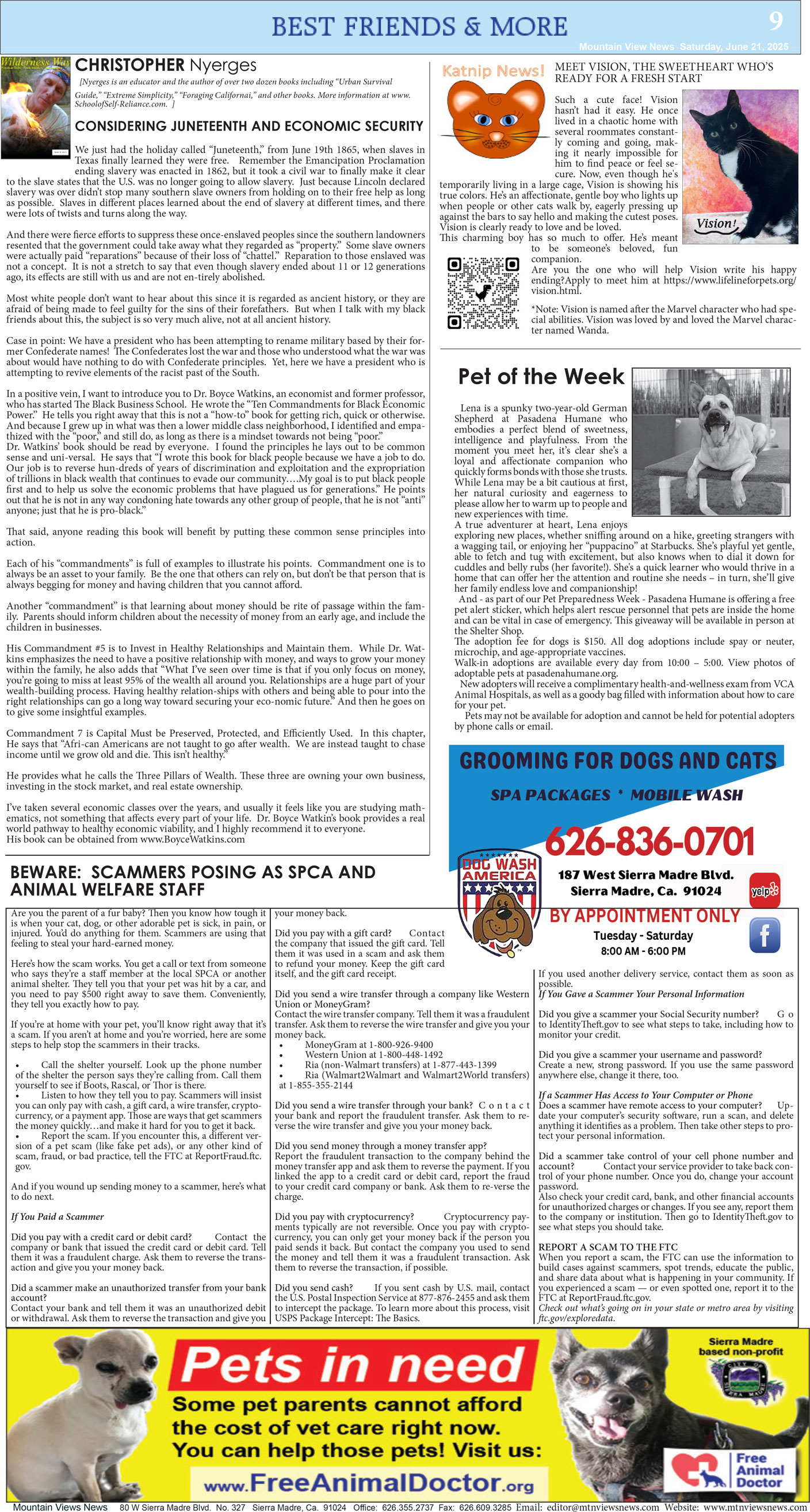
9 Mountain View News Saturday, June 21, 2025 CHRISTOPHER Nyerges [Nyerges is an educator and the author of over two dozen books including “Urban Survival Guide,” “Extreme Simplicity,” “Foraging Californai,” and other books. More information at www. SchoolofSelf-Reliance.com. ] CONSIDERING JUNETEENTH AND ECONOMIC SECURITY MEET VISION, THE SWEETHEART WHO’S READY FOR A FRESH START Such a cute face! Vision hasn’t had it easy. He once lived in a chaotic home with several roommates constantly coming and going, making it nearly impossible for him to find peace or feel secure. Now, even though he's temporarily living in a large cage, Vision is showing his true colors. He’s an affectionate, gentle boy who lights up when people or other cats walk by, eagerly pressing up against the bars to say hello and making the cutest poses. Vision is clearly ready to love and be loved. This charming boy has so much to offer. He’s meant to be someone’s beloved, fun companion. Are you the one who will help Vision write his happy ending?Apply to meet him at https://www.lifelineforpets.org/ vision.html. *Note: Vision is named after the Marvel character who had special abilities. Vision was loved by and loved the Marvel character named Wanda. We just had the holiday called “Juneteenth,” from June 19th 1865, when slaves in Texas finally learned they were free. Remember the Emancipation Proclamation ending slavery was enacted in 1862, but it took a civil war to finally make it clear to the slave states that the U.S. was no longer going to allow slavery. Just because Lincoln declared slavery was over didn’t stop many southern slave owners from holding on to their free help as long as possible. Slaves in different places learned about the end of slavery at different times, and there were lots of twists and turns along the way. And there were fierce efforts to suppress these once-enslaved peoples since the southern landowners resented that the government could take away what they regarded as “property.” Some slave owners were actually paid “reparations” because of their loss of “chattel.” Reparation to those enslaved was not a concept. It is not a stretch to say that even though slavery ended about 11 or 12 generations ago, its effects are still with us and are not en-tirely abolished. Most white people don’t want to hear about this since it is regarded as ancient history, or they are afraid of being made to feel guilty for the sins of their forefathers. But when I talk with my black friends about this, the subject is so very much alive, not at all ancient history. Case in point: We have a president who has been attempting to rename military based by their former Confederate names! The Confederates lost the war and those who understood what the war was about would have nothing to do with Confederate principles. Yet, here we have a president who is attempting to revive elements of the racist past of the South. In a positive vein, I want to introduce you to Dr. Boyce Watkins, an economist and former professor, who has started The Black Business School. He wrote the “Ten Commandments for Black Economic Power.” He tells you right away that this is not a “how-to” book for getting rich, quick or otherwise. And because I grew up in what was then a lower middle class neighborhood, I identified and empathized with the “poor,” and still do, as long as there is a mindset towards not being “poor.” Dr. Watkins’ book should be read by everyone. I found the principles he lays out to be common sense and uni-versal. He says that “I wrote this book for black people because we have a job to do. Our job is to reverse hun-dreds of years of discrimination and exploitation and the expropriation of trillions in black wealth that continues to evade our community….My goal is to put black people first and to help us solve the economic problems that have plagued us for generations.” He points out that he is not in any way condoning hate towards any other group of people, that he is not “anti” anyone; just that he is pro-black.” That said, anyone reading this book will benefit by putting these common sense principles into action. Each of his “commandments” is full of examples to illustrate his points. Commandment one is to always be an asset to your family. Be the one that others can rely on, but don’t be that person that is always begging for money and having children that you cannot afford. Another “commandment” is that learning about money should be rite of passage within the family. Parents should inform children about the necessity of money from an early age, and include the children in businesses. His Commandment #5 is to Invest in Healthy Relationships and Maintain them. While Dr. Watkins emphasizes the need to have a positive relationship with money, and ways to grow your money within the family, he also adds that “What I’ve seen over time is that if you only focus on money, you’re going to miss at least 95% of the wealth all around you. Relationships are a huge part of your wealth-building process. Having healthy relation-ships with others and being able to pour into the right relationships can go a long way toward securing your eco-nomic future.” And then he goes on to give some insightful examples. Commandment 7 is Capital Must be Preserved, Protected, and Efficiently Used. In this chapter, He says that “Afri-can Americans are not taught to go after wealth. We are instead taught to chase income until we grow old and die. This isn’t healthy.” He provides what he calls the Three Pillars of Wealth. These three are owning your own business, investing in the stock market, and real estate ownership. I’ve taken several economic classes over the years, and usually it feels like you are studying mathematics, not something that affects every part of your life. Dr. Boyce Watkin’s book provides a real world pathway to healthy economic viability, and I highly recommend it to everyone. His book can be obtained from www.BoyceWatkins.com Pet of the Week Lena is a spunky two-year-old German Shepherd at Pasadena Humane who embodies a perfect blend of sweetness, intelligence and playfulness. From the moment you meet her, it’s clear she’s a loyal and affectionate companion who quickly forms bonds with those she trusts. While Lena may be a bit cautious at first, her natural curiosity and eagerness to please allow her to warm up to people and new experiences with time. A true adventurer at heart, Lena enjoys exploring new places, whether sniffing around on a hike, greeting strangers with a wagging tail, or enjoying her “puppacino” at Starbucks. She’s playful yet gentle, able to fetch and tug with excitement, but also knows when to dial it down for cuddles and belly rubs (her favorite!). She's a quick learner who would thrive in a home that can offer her the attention and routine she needs – in turn, she’ll give her family endless love and companionship! And - as part of our Pet Preparedness Week - Pasadena Humane is offering a free pet alert sticker, which helps alert rescue personnel that pets are inside the home and can be vital in case of emergency. This giveaway will be available in person at the Shelter Shop. The adoption fee for dogs is $150. All dog adoptions include spay or neuter, microchip, and age-appropriate vaccines. Walk-in adoptions are available every day from 10:00 – 5:00. View photos of adoptable pets at pasadenahumane.org. New adopters will receive a complimentary health-and-wellness exam from VCA Animal Hospitals, as well as a goody bag filled with information about how to care for your pet. Pets may not be available for adoption and cannot be held for potential adopters by phone calls or email. BEWARE: SCAMMERS POSING AS SPCA AND ANIMAL WELFARE STAFF Are you the parent of a fur baby? Then you know how tough it is when your cat, dog, or other adorable pet is sick, in pain, or injured. You’d do anything for them. Scammers are using that feeling to steal your hard-earned money. Here’s how the scam works. You get a call or text from someone who says they’re a staff member at the local SPCA or another animal shelter. They tell you that your pet was hit by a car, and you need to pay $500 right away to save them. Conveniently, they tell you exactly how to pay. If you’re at home with your pet, you’ll know right away that it’s a scam. If you aren’t at home and you’re worried, here are some steps to help stop the scammers in their tracks. • Call the shelter yourself. Look up the phone number of the shelter the person says they’re calling from. Call them yourself to see if Boots, Rascal, or Thor is there. • Listen to how they tell you to pay. Scammers will insist you can only pay with cash, a gift card, a wire transfer, cryptocurrency, or a payment app. Those are ways that get scammers the money quickly…and make it hard for you to get it back. • Report the scam. If you encounter this, a different version of a pet scam (like fake pet ads), or any other kind of scam, fraud, or bad practice, tell the FTC at ReportFraud.ftc. gov. And if you wound up sending money to a scammer, here’s what to do next. If You Paid a Scammer Did you pay with a credit card or debit card? Contact the company or bank that issued the credit card or debit card. Tell them it was a fraudulent charge. Ask them to reverse the transaction and give you your money back. Did a scammer make an unauthorized transfer from your bank account? Contact your bank and tell them it was an unauthorized debit or withdrawal. Ask them to reverse the transaction and give you your money back. Did you pay with a gift card? Contact the company that issued the gift card. Tell them it was used in a scam and ask them to refund your money. Keep the gift card itself, and the gift card receipt. Did you send a wire transfer through a company like Western Union or MoneyGram? Contact the wire transfer company. Tell them it was a fraudulent transfer. Ask them to reverse the wire transfer and give you your money back. • MoneyGram at 1-800-926-9400 • Western Union at 1-800-448-1492 • Ria (non-Walmart transfers) at 1-877-443-1399 • Ria (Walmart2Walmart and Walmart2World transfers) at 1-855-355-2144 Did you send a wire transfer through your bank? Contact your bank and report the fraudulent transfer. Ask them to reverse the wire transfer and give you your money back. Did you send money through a money transfer app? Report the fraudulent transaction to the company behind the money transfer app and ask them to reverse the payment. If you linked the app to a credit card or debit card, report the fraud to your credit card company or bank. Ask them to re-verse the charge. Did you pay with cryptocurrency? Cryptocurrency payments typically are not reversible. Once you pay with crypto- currency, you can only get your money back if the person you paid sends it back. But contact the company you used to send the money and tell them it was a fraudulent transaction. Ask them to reverse the transaction, if possible. Did you send cash? If you sent cash by U.S. mail, contact the U.S. Postal Inspection Service at 877-876-2455 and ask them to intercept the package. To learn more about this process, visit USPS Package Intercept: The Basics. If you used another delivery service, contact them as soon as possible. If You Gave a Scammer Your Personal Information Did you give a scammer your Social Security number? Go to IdentityTheft.gov to see what steps to take, including how to monitor your credit. Did you give a scammer your username and password? Create a new, strong password. If you use the same password anywhere else, change it there, too. If a Scammer Has Access to Your Computer or Phone Does a scammer have remote access to your computer? Update your computer’s security software, run a scan, and delete anything it identifies as a problem. Then take other steps to protect your personal information. Did a scammer take control of your cell phone number and account? Contact your service provider to take back control of your phone number. Once you do, change your account password. Also check your credit card, bank, and other financial accounts for unauthorized charges or changes. If you see any, report them to the company or institution. Then go to IdentityTheft.gov to see what steps you should take. REPORT A SCAM TO THE FTC When you report a scam, the FTC can use the information to build cases against scammers, spot trends, educate the public, and share data about what is happening in your community. If you experienced a scam — or even spotted one, report it to the FTC at ReportFraud.ftc.gov. Check out what’s going on in your state or metro area by visiting ftc.gov/exploredata. Mountain Views News 80 W Sierra Madre Blvd. No. 327 Sierra Madre, Ca. 91024 Office: 626.355.2737 Fax: 626.609.3285 Email: editor@mtnviewsnews.com Website: www.mtnviewsnews.com | ||||||||||||||||||
| |