| Health & Fitness | ||||||||||||||||||||
| Mountain Views News, Combined Edition Saturday, October 4, 2025 | ||||||||||||||||||||
| ||||||||||||||||||||
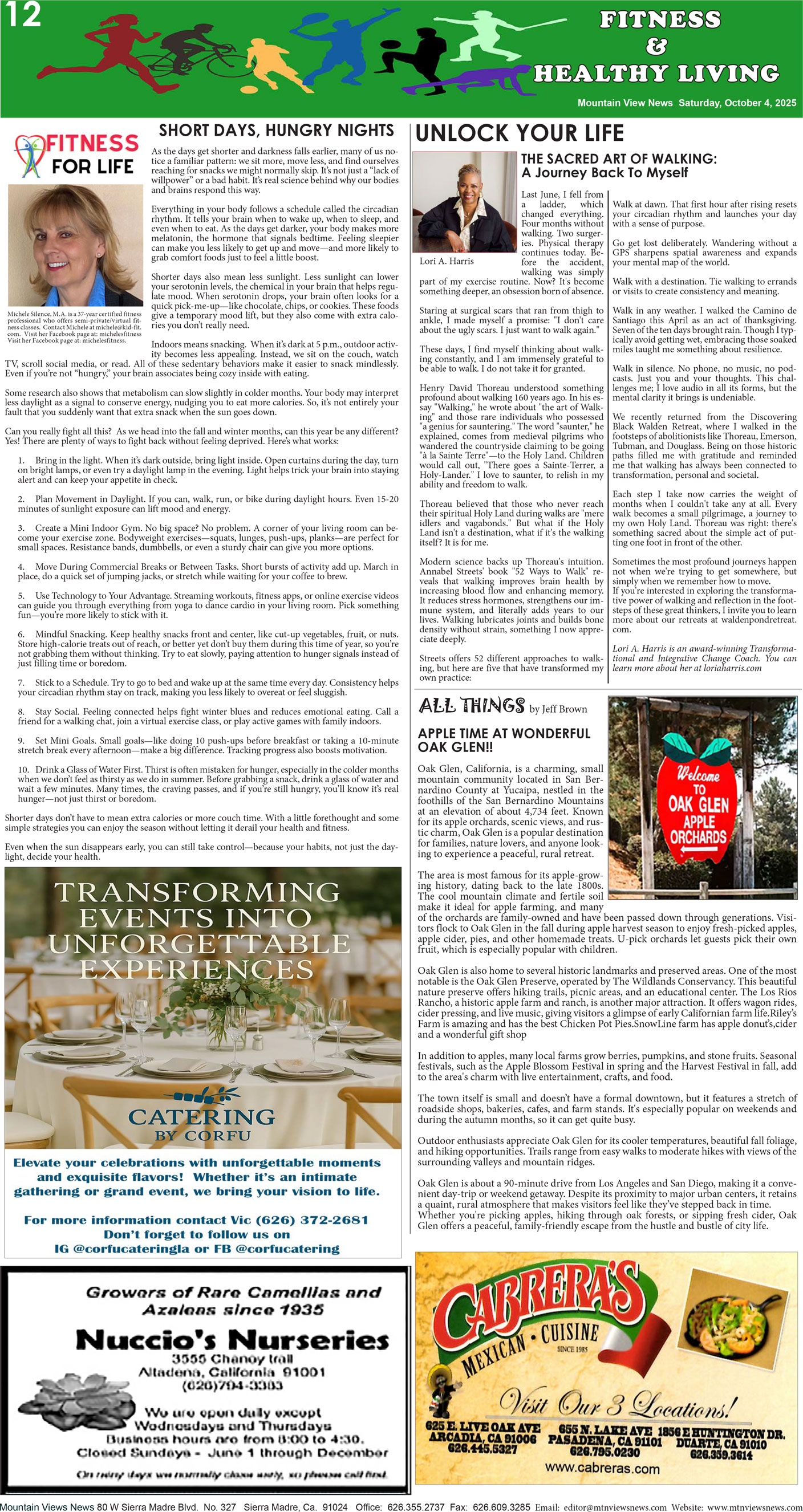
12 FITNESS FITNESS & & HEALTHY LIVINGHEALTHY LIVING Mountain View News Saturday, October 4, 2025 SHORT DAYS, HUNGRY NIGHTS Michele Silence, M.A. is a 37-year certified fitness professional who offers semi-private/virtual fitness classes. Contact Michele at michele@kid-fit. com. Visit her Facebook page at: michelesfitness Visit her Facebook page at: michelesfitness. UNLOCK YOUR LIFE As the days get shorter and darkness falls earlier, many of us notice a familiar pattern: we sit more, move less, and find ourselves reaching for snacks we might normally skip. It’s not just a “lack of willpower” or a bad habit. It’s real science behind why our bodies and brains respond this way. Everything in your body follows a schedule called the circadian rhythm. It tells your brain when to wake up, when to sleep, and even when to eat. As the days get darker, your body makes more melatonin, the hormone that signals bedtime. Feeling sleepier can make you less likely to get up and move—and more likely to grab comfort foods just to feel a little boost. Shorter days also mean less sunlight. Less sunlight can lower your serotonin levels, the chemical in your brain that helps regulate mood. When serotonin drops, your brain often looks for a quick pick-me-up—like chocolate, chips, or cookies. These foods give a temporary mood lift, but they also come with extra calories you don’t really need. Indoors means snacking. When it’s dark at 5 p.m., outdoor activity becomes less appealing. Instead, we sit on the couch, watch TV, scroll social media, or read. All of these sedentary behaviors make it easier to snack mindlessly. Even if you’re not “hungry,” your brain associates being cozy inside with eating. Some research also shows that metabolism can slow slightly in colder months. Your body may interpret less daylight as a signal to conserve energy, nudging you to eat more calories. So, it’s not entirely your fault that you suddenly want that extra snack when the sun goes down. Can you really fight all this? As we head into the fall and winter months, can this year be any different? Yes! There are plenty of ways to fight back without feeling deprived. Here’s what works: 1. Bring in the light. When it’s dark outside, bring light inside. Open curtains during the day, turn on bright lamps, or even try a daylight lamp in the evening. Light helps trick your brain into staying alert and can keep your appetite in check. 2. Plan Movement in Daylight. If you can, walk, run, or bike during daylight hours. Even 15-20 minutes of sunlight exposure can lift mood and energy. 3. Create a Mini Indoor Gym. No big space? No problem. A corner of your living room can become your exercise zone. Bodyweight exercises—squats, lunges, push-ups, planks—are perfect for small spaces. Resistance bands, dumbbells, or even a sturdy chair can give you more options. 4. Move During Commercial Breaks or Between Tasks. Short bursts of activity add up. March in place, do a quick set of jumping jacks, or stretch while waiting for your coffee to brew. 5. Use Technology to Your Advantage. Streaming workouts, fitness apps, or online exercise videos can guide you through everything from yoga to dance cardio in your living room. Pick something fun—you’re more likely to stick with it. 6. Mindful Snacking. Keep healthy snacks front and center, like cut-up vegetables, fruit, or nuts. Store high-calorie treats out of reach, or better yet don’t buy them during this time of year, so you’re not grabbing them without thinking. Try to eat slowly, paying attention to hunger signals instead of just filling time or boredom. 7. Stick to a Schedule. Try to go to bed and wake up at the same time every day. Consistency helps your circadian rhythm stay on track, making you less likely to overeat or feel sluggish. 8. Stay Social. Feeling connected helps fight winter blues and reduces emotional eating. Call a friend for a walking chat, join a virtual exercise class, or play active games with family indoors. 9. Set Mini Goals. Small goals—like doing 10 push-ups before breakfast or taking a 10-minute stretch break every afternoon—make a big difference. Tracking progress also boosts motivation. 10. Drink a Glass of Water First. Thirst is often mistaken for hunger, especially in the colder months when we don’t feel as thirsty as we do in summer. Before grabbing a snack, drink a glass of water and wait a few minutes. Many times, the craving passes, and if you’re still hungry, you’ll know it’s real hunger—not just thirst or boredom. Shorter days don’t have to mean extra calories or more couch time. With a little forethought and some simple strategies you can enjoy the season without letting it derail your health and fitness. Even when the sun disappears early, you can still take control—because your habits, not just the daylight, decide your health. THE SACRED ART OF WALKING: A Journey Back To Myself Last June, I fell from a ladder, which changed everything. Four months without walking. Two surgeries. Physical therapy continues today. Before the accident, walking was simply part of my exercise routine. Now? It's become something deeper, an obsession born of absence. Staring at surgical scars that ran from thigh to ankle, I made myself a promise: "I don't care about the ugly scars. I just want to walk again." These days, I find myself thinking about walking constantly, and I am immensely grateful to be able to walk. I do not take it for granted. Henry David Thoreau understood something profound about walking 160 years ago. In his essay "Walking," he wrote about "the art of Walking" and those rare individuals who possessed "a genius for sauntering." The word "saunter," he explained, comes from medieval pilgrims who wandered the countryside claiming to be going "à la Sainte Terre"—to the Holy Land. Children would call out, "There goes a Sainte-Terrer, a Holy-Lander." I love to saunter, to relish in my ability and freedom to walk. Thoreau believed that those who never reach their spiritual Holy Land during walks are "mere idlers and vagabonds." But what if the Holy Land isn't a destination, what if it's the walking itself? It is for me. Modern science backs up Thoreau's intuition. Annabel Streets' book "52 Ways to Walk" reveals that walking improves brain health by increasing blood flow and enhancing memory. It reduces stress hormones, strengthens our immune system, and literally adds years to our lives. Walking lubricates joints and builds bone density without strain, something I now appreciate deeply. Streets offers 52 different approaches to walking, but here are five that have transformed my own practice: Walk at dawn. That first hour after rising resets your circadian rhythm and launches your day with a sense of purpose. Go get lost deliberately. Wandering without a GPS sharpens spatial awareness and expands your mental map of the world. Walk with a destination. Tie walking to errands or visits to create consistency and meaning. Walk in any weather. I walked the Camino de Santiago this April as an act of thanksgiving. Seven of the ten days brought rain. Though I typically avoid getting wet, embracing those soaked miles taught me something about resilience. Walk in silence. No phone, no music, no podcasts. Just you and your thoughts. This challenges me; I love audio in all its forms, but the mental clarity it brings is undeniable. We recently returned from the Discovering Black Walden Retreat, where I walked in the footsteps of abolitionists like Thoreau, Emerson, Tubman, and Douglass. Being on those historic paths filled me with gratitude and reminded me that walking has always been connected to transformation, personal and societal. Each step I take now carries the weight of months when I couldn't take any at all. Every walk becomes a small pilgrimage, a journey to my own Holy Land. Thoreau was right: there's something sacred about the simple act of putting one foot in front of the other. Sometimes the most profound journeys happen not when we're trying to get somewhere, but simply when we remember how to move. If you're interested in exploring the transformative power of walking and reflection in the footsteps of these great thinkers, I invite you to learn more about our retreats at waldenpondretreat. com. Lori A. Harris is an award-winning Transformational and Integrative Change Coach. You can learn more about her at loriaharris.com Lori A. Harris ALL THINGS by Jeff Brown APPLE TIME AT WONDERFUL OAK GLEN!! Oak Glen, California, is a charming, small mountain community located in San Bernardino County at Yucaipa, nestled in the foothills of the San Bernardino Mountains at an elevation of about 4,734 feet. Known for its apple orchards, scenic views, and rustic charm, Oak Glen is a popular destination for families, nature lovers, and anyone looking to experience a peaceful, rural retreat. The area is most famous for its apple-growing history, dating back to the late 1800s. The cool mountain climate and fertile soil make it ideal for apple farming, and many of the orchards are family-owned and have been passed down through generations. Visitors flock to Oak Glen in the fall during apple harvest season to enjoy fresh-picked apples, apple cider, pies, and other homemade treats. U-pick orchards let guests pick their own fruit, which is especially popular with children. Oak Glen is also home to several historic landmarks and preserved areas. One of the most notable is the Oak Glen Preserve, operated by The Wildlands Conservancy. This beautiful nature preserve offers hiking trails, picnic areas, and an educational center. The Los Rios Rancho, a historic apple farm and ranch, is another major attraction. It offers wagon rides, cider pressing, and live music, giving visitors a glimpse of early Californian farm life.Riley’s Farm is amazing and has the best Chicken Pot Pies.SnowLine farm has apple donut’s,cider and a wonderful gift shop In addition to apples, many local farms grow berries, pumpkins, and stone fruits. Seasonal festivals, such as the Apple Blossom Festival in spring and the Harvest Festival in fall, add to the area's charm with live entertainment, crafts, and food. The town itself is small and doesn’t have a formal downtown, but it features a stretch of roadside shops, bakeries, cafes, and farm stands. It's especially popular on weekends and during the autumn months, so it can get quite busy. Outdoor enthusiasts appreciate Oak Glen for its cooler temperatures, beautiful fall foliage, and hiking opportunities. Trails range from easy walks to moderate hikes with views of the surrounding valleys and mountain ridges. Oak Glen is about a 90-minute drive from Los Angeles and San Diego, making it a convenient day-trip or weekend getaway. Despite its proximity to major urban centers, it retains a quaint, rural atmosphere that makes visitors feel like they’ve stepped back in time. Whether you're picking apples, hiking through oak forests, or sipping fresh cider, Oak Glen offers a peaceful, family-friendly escape from the hustle and bustle of city life. Mountain Views News 80 W Sierra Madre Blvd. No. 327 Sierra Madre, Ca. 91024 Office: 626.355.2737 Fax: 626.609.3285 Email: editor@mtnviewsnews.com Website: www.mtnviewsnews.com | ||||||||||||||||||||
| |