| Health & Fitness | ||||||||||||||||||||
| Mountain Views News, Combined Edition Saturday, October 25, 2025 | ||||||||||||||||||||
| ||||||||||||||||||||
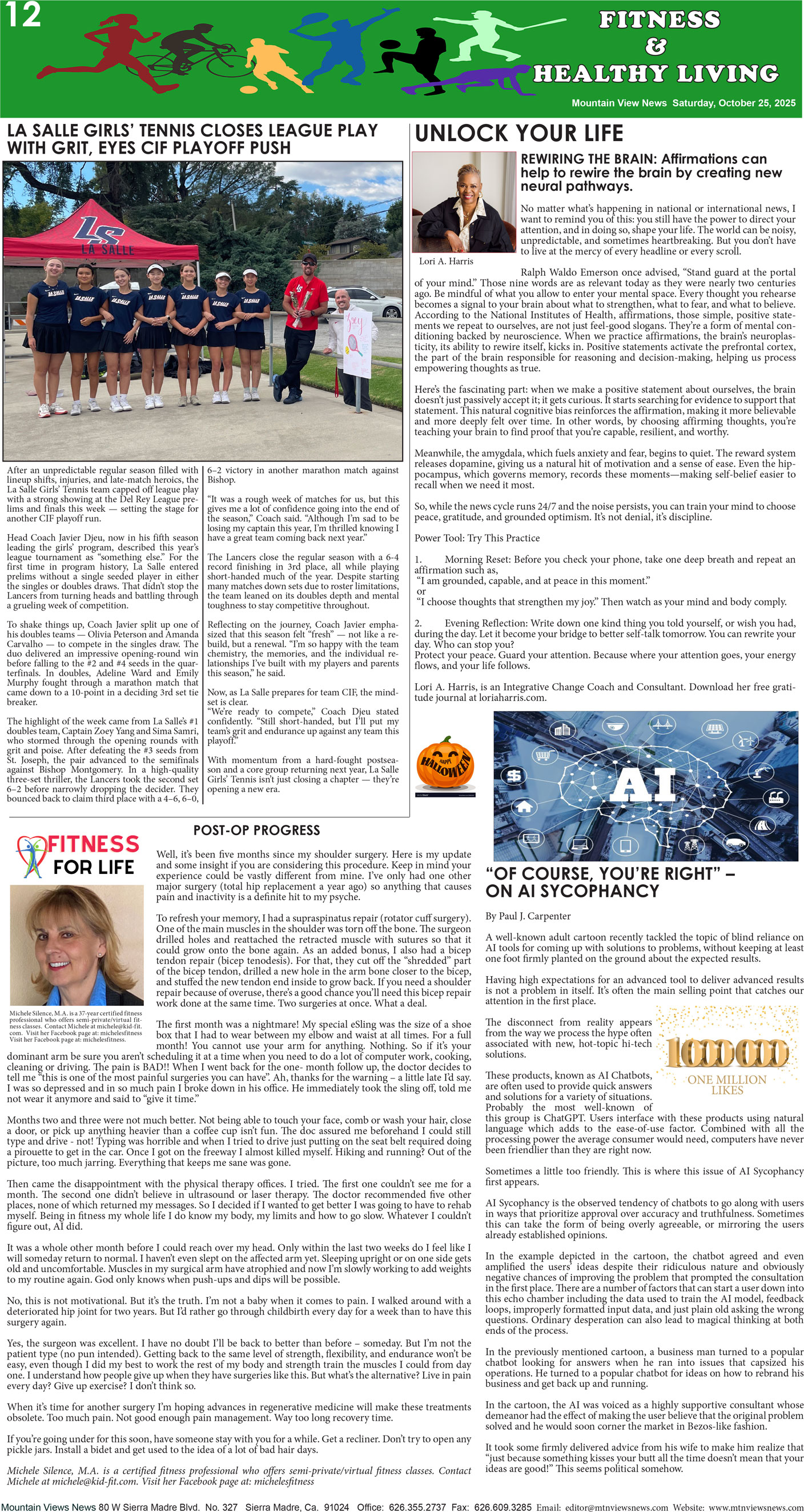
12 FITNESS FITNESS & & HEALTHY LIVINGHEALTHY LIVING Mountain View News Saturday, October 25, 2025 LA SALLE GIRLS’ TENNIS CLOSES LEAGUE PLAY WITH GRIT, EYES CIF PLAYOFF PUSH After an unpredictable regular season filled with lineup shifts, injuries, and late-match heroics, the La Salle Girls’ Tennis team capped off league play with a strong showing at the Del Rey League prelims and finals this week — setting the stage for another CIF playoff run. Head Coach Javier Djeu, now in his fifth season leading the girls’ program, described this year’s league tournament as “something else.” For the first time in program history, La Salle entered prelims without a single seeded player in either the singles or doubles draws. That didn’t stop the Lancers from turning heads and battling through a grueling week of competition. To shake things up, Coach Javier split up one of his doubles teams — Olivia Peterson and Amanda Carvalho — to compete in the singles draw. The duo delivered an impressive opening-round win before falling to the #2 and #4 seeds in the quarterfinals. In doubles, Adeline Ward and Emily Murphy fought through a marathon match that came down to a 10-point in a deciding 3rd set tie breaker. The highlight of the week came from La Salle’s #1 doubles team, Captain Zoey Yang and Sima Samri, who stormed through the opening rounds with grit and poise. After defeating the #3 seeds from St. Joseph, the pair advanced to the semifinals against Bishop Montgomery. In a high-quality three-set thriller, the Lancers took the second set 6–2 before narrowly dropping the decider. They bounced back to claim third place with a 4–6, 6–0, 6–2 victory in another marathon match against Bishop. “It was a rough week of matches for us, but this gives me a lot of confidence going into the end of the season,” Coach said. “Although I’m sad to be losing my captain this year, I’m thrilled knowing I have a great team coming back next year.” The Lancers close the regular season with a 6-4 record finishing in 3rd place, all while playing short-handed much of the year. Despite starting many matches down sets due to roster limitations, the team leaned on its doubles depth and mental toughness to stay competitive throughout. Reflecting on the journey, Coach Javier emphasized that this season felt “fresh” — not like a rebuild, but a renewal. “I’m so happy with the team chemistry, the memories, and the individual relationships I’ve built with my players and parents this season,” he said. Now, as La Salle prepares for team CIF, the mindset is clear. “We’re ready to compete,” Coach Djeu stated confidently. “Still short-handed, but I’ll put my team’s grit and endurance up against any team this playoff.” With momentum from a hard-fought postseason and a core group returning next year, La Salle Girls’ Tennis isn’t just closing a chapter — they’re opening a new era. REWIRING THE BRAIN: Affirmations can help to rewire the brain by creating new neural pathways. No matter what’s happening in national or international news, I want to remind you of this: you still have the power to direct your attention, and in doing so, shape your life. The world can be noisy, unpredictable, and sometimes heartbreaking. But you don’t have to live at the mercy of every headline or every scroll. Ralph Waldo Emerson once advised, “Stand guard at the portal of your mind.” Those nine words are as relevant today as they were nearly two centuries ago. Be mindful of what you allow to enter your mental space. Every thought you rehearse becomes a signal to your brain about what to strengthen, what to fear, and what to believe. According to the National Institutes of Health, affirmations, those simple, positive statements we repeat to ourselves, are not just feel-good slogans. They’re a form of mental conditioning backed by neuroscience. When we practice affirmations, the brain’s neuroplasticity, its ability to rewire itself, kicks in. Positive statements activate the prefrontal cortex, the part of the brain responsible for reasoning and decision-making, helping us process empowering thoughts as true. Here’s the fascinating part: when we make a positive statement about ourselves, the brain doesn’t just passively accept it; it gets curious. It starts searching for evidence to support that statement. This natural cognitive bias reinforces the affirmation, making it more believable and more deeply felt over time. In other words, by choosing affirming thoughts, you’re teaching your brain to find proof that you’re capable, resilient, and worthy. Meanwhile, the amygdala, which fuels anxiety and fear, begins to quiet. The reward system releases dopamine, giving us a natural hit of motivation and a sense of ease. Even the hippocampus, which governs memory, records these moments—making self-belief easier to recall when we need it most. So, while the news cycle runs 24/7 and the noise persists, you can train your mind to choose peace, gratitude, and grounded optimism. It’s not denial, it’s discipline. Power Tool: Try This Practice 1. Morning Reset: Before you check your phone, take one deep breath and repeat an affirmation such as, “I am grounded, capable, and at peace in this moment.” or “I choose thoughts that strengthen my joy.” Then watch as your mind and body comply. 2. Evening Reflection: Write down one kind thing you told yourself, or wish you had, during the day. Let it become your bridge to better self-talk tomorrow. You can rewrite your day. Who can stop you? Protect your peace. Guard your attention. Because where your attention goes, your energy flows, and your life follows. Lori A. Harris, is an Integrative Change Coach and Consultant. Download her free gratitude journal at loriaharris.com. Lori A. Harris POST-OP PROGRESS Michele Silence, M.A. is a 37-year certified fitness professional who offers semi-private/virtual fitness classes. Contact Michele at michele@kid-fit. com. Visit her Facebook page at: michelesfitness Visit her Facebook page at: michelesfitness. Well, it’s been five months since my shoulder surgery. Here is my update and some insight if you are considering this procedure. Keep in mind your experience could be vastly different from mine. I’ve only had one other major surgery (total hip replacement a year ago) so anything that causes pain and inactivity is a definite hit to my psyche. To refresh your memory, I had a supraspinatus repair (rotator cuff surgery). One of the main muscles in the shoulder was torn off the bone. The surgeon drilled holes and reattached the retracted muscle with sutures so that it could grow onto the bone again. As an added bonus, I also had a bicep tendon repair (bicep tenodesis). For that, they cut off the “shredded” part of the bicep tendon, drilled a new hole in the arm bone closer to the bicep, and stuffed the new tendon end inside to grow back. If you need a shoulder repair because of overuse, there’s a good chance you’ll need this bicep repair work done at the same time. Two surgeries at once. What a deal. The first month was a nightmare! My special eSling was the size of a shoe box that I had to wear between my elbow and waist at all times. For a full month! You cannot use your arm for anything. Nothing. So if it’s your dominant arm be sure you aren’t scheduling it at a time when you need to do a lot of computer work, cooking, cleaning or driving. The pain is BAD!! When I went back for the one- month follow up, the doctor decides to tell me “this is one of the most painful surgeries you can have”. Ah, thanks for the warning – a little late I’d say. I was so depressed and in so much pain I broke down in his office. He immediately took the sling off, told me not wear it anymore and said to “give it time.” Months two and three were not much better. Not being able to touch your face, comb or wash your hair, close a door, or pick up anything heavier than a coffee cup isn’t fun. The doc assured me beforehand I could still type and drive - not! Typing was horrible and when I tried to drive just putting on the seat belt required doing a pirouette to get in the car. Once I got on the freeway I almost killed myself. Hiking and running? Out of the picture, too much jarring. Everything that keeps me sane was gone. Then came the disappointment with the physical therapy offices. I tried. The first one couldn’t see me for a month. The second one didn’t believe in ultrasound or laser therapy. The doctor recommended five other places, none of which returned my messages. So I decided if I wanted to get better I was going to have to rehab myself. Being in fitness my whole life I do know my body, my limits and how to go slow. Whatever I couldn’t figure out, AI did. It was a whole other month before I could reach over my head. Only within the last two weeks do I feel like I will someday return to normal. I haven’t even slept on the affected arm yet. Sleeping upright or on one side gets old and uncomfortable. Muscles in my surgical arm have atrophied and now I’m slowly working to add weights to my routine again. God only knows when push-ups and dips will be possible. No, this is not motivational. But it’s the truth. I’m not a baby when it comes to pain. I walked around with a deteriorated hip joint for two years. But I’d rather go through childbirth every day for a week than to have this surgery again. Yes, the surgeon was excellent. I have no doubt I’ll be back to better than before – someday. But I’m not the patient type (no pun intended). Getting back to the same level of strength, flexibility, and endurance won’t be easy, even though I did my best to work the rest of my body and strength train the muscles I could from day one. I understand how people give up when they have surgeries like this. But what’s the alternative? Live in pain every day? Give up exercise? I don’t think so. When it’s time for another surgery I’m hoping advances in regenerative medicine will make these treatments obsolete. Too much pain. Not good enough pain management. Way too long recovery time. If you’re going under for this soon, have someone stay with you for a while. Get a recliner. Don’t try to open any pickle jars. Install a bidet and get used to the idea of a lot of bad hair days. Michele Silence, M.A. is a certified fitness professional who offers semi-private/virtual fitness classes. Contact Michele at michele@kid-fit.com. Visit her Facebook page at: michelesfitness “OF COURSE, YOU’RE RIGHT” – ON AI SYCOPHANCY By Paul J. Carpenter A well-known adult cartoon recently tackled the topic of blind reliance on AI tools for coming up with solutions to problems, without keeping at least one foot firmly planted on the ground about the expected results. Having high expectations for an advanced tool to deliver advanced results is not a problem in itself. It’s often the main selling point that catches our attention in the first place. The disconnect from reality appears from the way we process the hype often associated with new, hot-topic hi-tech solutions. These products, known as AI Chatbots, are often used to provide quick answers and solutions for a variety of situations. Probably the most well-known of this group is ChatGPT. Users interface with these products using natural language which adds to the ease-of-use factor. Combined with all the processing power the average consumer would need, computers have never been friendlier than they are right now. Sometimes a little too friendly. This is where this issue of AI Sycophancy first appears. AI Sycophancy is the observed tendency of chatbots to go along with users in ways that prioritize approval over accuracy and truthfulness. Sometimes this can take the form of being overly agreeable, or mirroring the users already established opinions. In the example depicted in the cartoon, the chatbot agreed and even amplified the users’ ideas despite their ridiculous nature and obviously negative chances of improving the problem that prompted the consultation in the first place. There are a number of factors that can start a user down into this echo chamber including the data used to train the AI model, feedback loops, improperly formatted input data, and just plain old asking the wrong questions. Ordinary desperation can also lead to magical thinking at both ends of the process. In the previously mentioned cartoon, a business man turned to a popular chatbot looking for answers when he ran into issues that capsized his operations. He turned to a popular chatbot for ideas on how to rebrand his business and get back up and running. In the cartoon, the AI was voiced as a highly supportive consultant whose demeanor had the effect of making the user believe that the original problem solved and he would soon corner the market in Bezos-like fashion. It took some firmly delivered advice from his wife to make him realize that “just because something kisses your butt all the time doesn’t mean that your ideas are good!” This seems political somehow. Mountain Views News 80 W Sierra Madre Blvd. No. 327 Sierra Madre, Ca. 91024 Office: 626.355.2737 Fax: 626.609.3285 Email: editor@mtnviewsnews.com Website: www.mtnviewsnews.com | ||||||||||||||||||||
| |