| Best Friends and More | ||||||||||||||||||
| Mountain Views News, Combined Edition Saturday, January 24, 2026 | ||||||||||||||||||
| ||||||||||||||||||
|
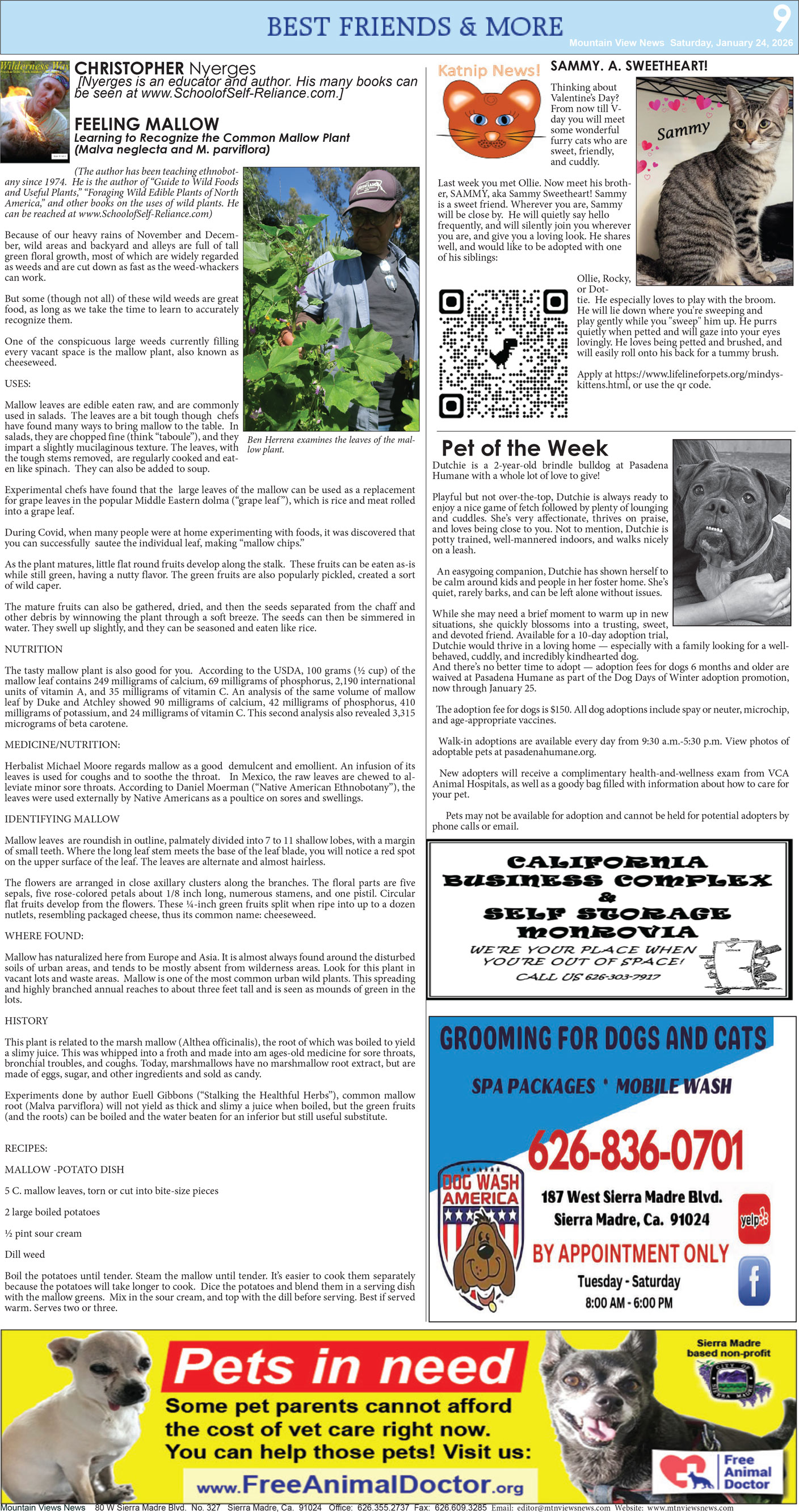
Mountain View News Saturday, January 24, 2026 CHRISTOPHER Nyerges [Nyerges is an educator and author. His many books canbe seen at www.SchoolofSelf-Reliance.com.] FEELING MALLOW Learning to Recognize the Common Mallow Plant(Malva neglecta and M. parviflora) (The author has been teaching ethnobotany since 1974. He is the author of “Guide to Wild Foods and Useful Plants,” “Foraging Wild Edible Plants of North America,” and other books on the uses of wild plants. He can be reached at www.SchoolofSelf-Reliance.com) Because of our heavy rains of November and December, wild areas and backyard and alleys are full of tall green floral growth, most of which are widely regarded as weeds and are cut down as fast as the weed-whackers can work. But some (though not all) of these wild weeds are great food, as long as we take the time to learn to accurately recognize them. One of the conspicuous large weeds currently filling every vacant space is the mallow plant, also known as cheeseweed. USES: Mallow leaves are edible eaten raw, and are commonly used in salads. The leaves are a bit tough though chefs have found many ways to bring mallow to the table. In salads, they are chopped fine (think “taboule”), and theyimpart a slightly mucilaginous texture. The leaves, with the tough stems removed, are regularly cooked and eaten like spinach. They can also be added to soup. Experimental chefs have found that the large leaves of the mallow can be used as a replacement for grape leaves in the popular Middle Eastern dolma (“grape leaf ”), which is rice and meat rolled into a grape leaf. During Covid, when many people were at home experimenting with foods, it was discovered that you can successfully sautee the individual leaf, making “mallow chips.” As the plant matures, little flat round fruits develop along the stalk. These fruits can be eaten as-is while still green, having a nutty flavor. The green fruits are also popularly pickled, created a sort of wild caper. The mature fruits can also be gathered, dried, and then the seeds separated from the chaff and other debris by winnowing the plant through a soft breeze. The seeds can then be simmered in water. They swell up slightly, and they can be seasoned and eaten like rice. NUTRITION The tasty mallow plant is also good for you. According to the USDA, 100 grams (½ cup) of the mallow leaf contains 249 milligrams of calcium, 69 milligrams of phosphorus, 2,190 international units of vitamin A, and 35 milligrams of vitamin C. An analysis of the same volume of mallow leaf by Duke and Atchley showed 90 milligrams of calcium, 42 milligrams of phosphorus, 410 milligrams of potassium, and 24 milligrams of vitamin C. This second analysis also revealed 3,315 micrograms of beta carotene. MEDICINE/NUTRITION: Herbalist Michael Moore regards mallow as a good demulcent and emollient. An infusion of its leaves is used for coughs and to soothe the throat. In Mexico, the raw leaves are chewed to alleviate minor sore throats. According to Daniel Moerman (“Native American Ethnobotany”), the leaves were used externally by Native Americans as a poultice on sores and swellings. IDENTIFYING MALLOW Mallow leaves are roundish in outline, palmately divided into 7 to 11 shallow lobes, with a margin of small teeth. Where the long leaf stem meets the base of the leaf blade, you will notice a red spot on the upper surface of the leaf. The leaves are alternate and almost hairless. The flowers are arranged in close axillary clusters along the branches. The floral parts are five sepals, five rose-colored petals about 1/8 inch long, numerous stamens, and one pistil. Circular flat fruits develop from the flowers. These ¼-inch green fruits split when ripe into up to a dozen nutlets, resembling packaged cheese, thus its common name: cheeseweed. WHERE FOUND: Mallow has naturalized here from Europe and Asia. It is almost always found around the disturbed soils of urban areas, and tends to be mostly absent from wilderness areas. Look for this plant in vacant lots and waste areas. Mallow is one of the most common urban wild plants. This spreading and highly branched annual reaches to about three feet tall and is seen as mounds of green in the lots. HISTORY This plant is related to the marsh mallow (Althea officinalis), the root of which was boiled to yield a slimy juice. This was whipped into a froth and made into am ages-old medicine for sore throats, bronchial troubles, and coughs. Today, marshmallows have no marshmallow root extract, but are made of eggs, sugar, and other ingredients and sold as candy. Experiments done by author Euell Gibbons (“Stalking the Healthful Herbs”), common mallow root (Malva parviflora) will not yield as thick and slimy a juice when boiled, but the green fruits (and the roots) can be boiled and the water beaten for an inferior but still useful substitute. RECIPES: MALLOW -POTATO DISH 5 C. mallow leaves, torn or cut into bite-size pieces 2 large boiled potatoes ½ pint sour cream Dill weed Boil the potatoes until tender. Steam the mallow until tender. It’s easier to cook them separatelybecause the potatoes will take longer to cook. Dice the potatoes and blend them in a serving dish with the mallow greens. Mix in the sour cream, and top with the dill before serving. Best if served warm. Serves two or three. Ben Herrera examines the leaves of the mal- low plant. SAMMY. A. SWEETHEART! Thinking about Valentine’s Day? From now till V- day you will meet some wonderful furry cats who are sweet, friendly, and cuddly. Last week you met Ollie. Now meet his brother, SAMMY, aka Sammy Sweetheart! Sammyis a sweet friend. Wherever you are, Sammy will be close by. He will quietly say hello frequently, and will silently join you wherever you are, and give you a loving look. He shares well, and would like to be adopted with one of his siblings: Ollie, Rocky, or Dottie. He especially loves to play with the broom. He will lie down where you're sweeping and play gently while you "sweep" him up. He purrs quietly when petted and will gaze into your eyes lovingly. He loves being petted and brushed, and will easily roll onto his back for a tummy brush. Apply at https://www.lifelineforpets.org/mindyskittens. html, or use the qr code. Pet of the Week Dutchie is a 2-year-old brindle bulldog at PasadenaHumane with a whole lot of love to give! Playful but not over-the-top, Dutchie is always ready toenjoy a nice game of fetch followed by plenty of loungingand cuddles. She’s very affectionate, thrives on praise, and loves being close to you. Not to mention, Dutchie ispotty trained, well-mannered indoors, and walks nicelyon a leash. An easygoing companion, Dutchie has shown herself tobe calm around kids and people in her foster home. She’squiet, rarely barks, and can be left alone without issues. While she may need a brief moment to warm up in newsituations, she quickly blossoms into a trusting, sweet, and devoted friend. Available for a 10-day adoption trial, Dutchie would thrive in a loving home — especially with a family looking for a well- behaved, cuddly, and incredibly kindhearted dog. And there’s no better time to adopt — adoption fees for dogs 6 months and older arewaived at Pasadena Humane as part of the Dog Days of Winter adoption promotion, now through January 25. The adoption fee for dogs is $150. All dog adoptions include spay or neuter, microchip, and age-appropriate vaccines. Walk-in adoptions are available every day from 9:30 a.m.-5:30 p.m. View photos of adoptable pets at pasadenahumane.org. New adopters will receive a complimentary health-and-wellness exam from VCA Animal Hospitals, as well as a goody bag filled with information about how to care for your pet. Pets may not be available for adoption and cannot be held for potential adopters byphone calls or email. Mountain Views News 80 W Sierra Madre Blvd. No. 327 Sierra Madre, Ca. 91024 Office: 626.355.2737 Fax: 626.609.3285 Email: editor@mtnviewsnews.com Website: www.mtnviewsnews.com | ||||||||||||||||||
| |