| Best Friends and More | ||||||||||||||||||
| Mountain Views News, Combined Edition Saturday, July 25, 2026 | ||||||||||||||||||
| ||||||||||||||||||
|
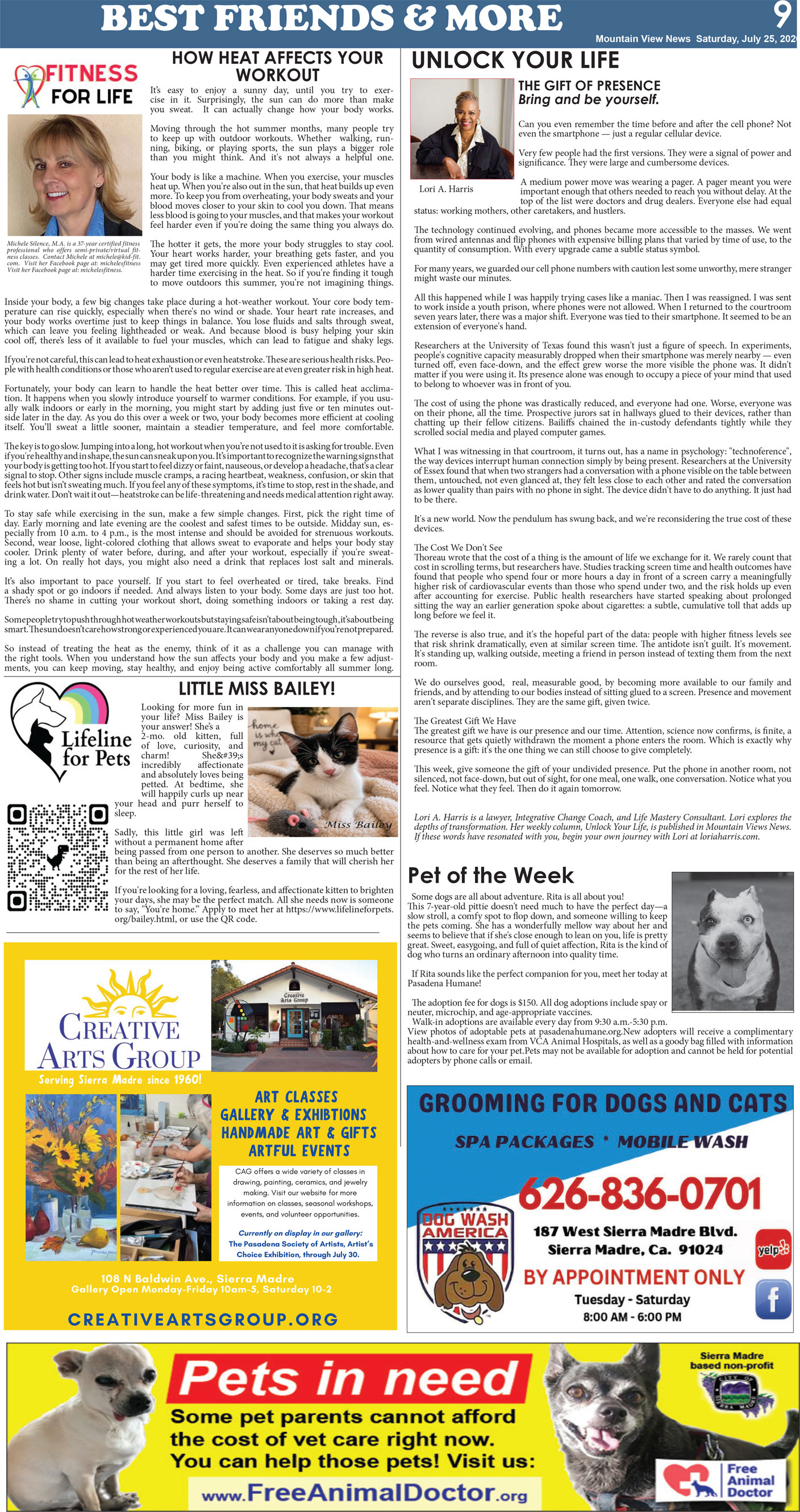
Mountain View News Saturday, July 25, 2026 99BEST FRIENDS & MORE Mountain View News Saturday, July 25, 2026 99BEST FRIENDS & MORE HOW HEAT AFFECTS YOUR WORKOUT It’s easy to enjoy a sunny day, until you try to exercise in it. Surprisingly, the sun can do more than make you sweat. It can actually change how your body works. Moving through the hot summer months, many people try to keep up with outdoor workouts. Whether walking, running, biking, or playing sports, the sun plays a bigger role than you might think. And it's not always a helpful one. Your body is like a machine. When you exercise, your muscles heat up. When you're also out in the sun, that heat builds up even more. To keep you from overheating, your body sweats and your blood moves closer to your skin to cool you down. That means less blood is going to your muscles, and that makes your workout feel harder even if you're doing the same thing you always do. Michele Silence, M.A. is a 37-year certified fitness The hotter it gets, the more your body struggles to stay cool. professional who offers semi-private/virtual fit ness classes. Contact Michele at michele@kid-fit. Your heart works harder, your breathing gets faster, and you com. Visit her Facebook page at: michelesfitness may get tired more quickly. Even experienced athletes have a Visit her Facebook page at: michelesfitness. harder time exercising in the heat. So if you're finding it tough to move outdoors this summer, you're not imagining things. Inside your body, a few big changes take place during a hot-weather workout. Your core body temperature can rise quickly, especially when there's no wind or shade. Your heart rate increases, and your body works overtime just to keep things in balance. You lose fluids and salts through sweat, which can leave you feeling lightheaded or weak. And because blood is busy helping your skin cool off, there’s less of it available to fuel your muscles, which can lead to fatigue and shaky legs. If you're not careful, this can lead to heat exhaustion or even heatstroke. These are serious health risks. People with health conditions or those who aren’t used to regular exercise are at even greater risk in high heat. Fortunately, your body can learn to handle the heat better over time. This is called heat acclimation. It happens when you slowly introduce yourself to warmer conditions. For example, if you usually walk indoors or early in the morning, you might start by adding just five or ten minutes outside later in the day. As you do this over a week or two, your body becomes more efficient at coolingitself. You’ll sweat a little sooner, maintain a steadier temperature, and feel more comfortable. The key is to go slow. Jumping into a long, hot workout when you’re not used to it is asking for trouble. Even if you're healthy and in shape, the sun can sneak up on you. It’s important to recognize the warning signs that your body is getting too hot. If you start to feel dizzy or faint, nauseous, or develop a headache, that’s a clear signal to stop. Other signs include muscle cramps, a racing heartbeat, weakness, confusion, or skin that feels hot but isn’t sweating much. If you feel any of these symptoms, it’s time to stop, rest in the shade, and drink water. Don’t wait it out—heatstroke can be life-threatening and needs medical attention right away. To stay safe while exercising in the sun, make a few simple changes. First, pick the right time of day. Early morning and late evening are the coolest and safest times to be outside. Midday sun, especially from 10 a.m. to 4 p.m., is the most intense and should be avoided for strenuous workouts. Second, wear loose, light-colored clothing that allows sweat to evaporate and helps your body stay cooler. Drink plenty of water before, during, and after your workout, especially if you're sweating a lot. On really hot days, you might also need a drink that replaces lost salt and minerals. It’s also important to pace yourself. If you start to feel overheated or tired, take breaks. Find a shady spot or go indoors if needed. And always listen to your body. Some days are just too hot. There’s no shame in cutting your workout short, doing something indoors or taking a rest day. Some people try to push through hot weather workouts but staying safe isn’t about being tough, it’s about beingsmart. The sun doesn’t care how strong or experienced you are. It can wear anyone down if you’re not prepared. So instead of treating the heat as the enemy, think of it as a challenge you can manage with the right tools. When you understand how the sun affects your body and you make a few adjustments, you can keep moving, stay healthy, and enjoy being active comfortably all summer long. LITTLE MISS BAILEY! Looking for more fun in your life? Miss Bailey is your answer! She’s a2-mo. old kitten, full of love, curiosity, and charm! She'sincredibly affectionate and absolutely loves beingpetted. At bedtime, shewill happily curls up near your head and purr herself to sleep. Sadly, this little girl was leftwithout a permanent home after being passed from one person to another. She deserves so much better than being an afterthought. She deserves a family that will cherish her for the rest of her life. If you're looking for a loving, fearless, and affectionate kitten to brighten your days, she may be the perfect match. All she needs now is someone to say, "You're home.” Apply to meet her at https://www.lifelineforpets. org/bailey.html, or use the QR code. ART CLASSES GALLERY & EXHIBTIONS HANDMADE ART & GIFTS ARTFUL EVENTS CAG offers a wide variety of classes indrawing, painting, ceramics, and jewelrymaking. Visit our website for moreinformation on classes, seasonal workshops, events, and volunteer opportunities. Currently on display in our gallery: The Pasadena Society of Artists, Artist’sChoice Exhibition, through July 30. 108 N Baldwin Ave., Sierra Madre Gallery Open Monday-Friday 10am-5, Saturday 10-2 CREATIVEARTSGROUP.ORG UNLOCK YOUR LIFE THE GIFT OF PRESENCE Bring and be yourself. Can you even remember the time before and after the cell phone? Not even the smartphone — just a regular cellular device. Very few people had the first versions. They were a signal of power and significance. They were large and cumbersome devices. A medium power move was wearing a pager. A pager meant you wereLori A. Harris important enough that others needed to reach you without delay. At the top of the list were doctors and drug dealers. Everyone else had equal status: working mothers, other caretakers, and hustlers. The technology continued evolving, and phones became more accessible to the masses. We went from wired antennas and flip phones with expensive billing plans that varied by time of use, to the quantity of consumption. With every upgrade came a subtle status symbol. For many years, we guarded our cell phone numbers with caution lest some unworthy, mere stranger might waste our minutes. All this happened while I was happily trying cases like a maniac. Then I was reassigned. I was sent to work inside a youth prison, where phones were not allowed. When I returned to the courtroom seven years later, there was a major shift. Everyone was tied to their smartphone. It seemed to be an extension of everyone's hand. Researchers at the University of Texas found this wasn't just a figure of speech. In experiments, people's cognitive capacity measurably dropped when their smartphone was merely nearby — even turned off, even face-down, and the effect grew worse the more visible the phone was. It didn't matter if you were using it. Its presence alone was enough to occupy a piece of your mind that used to belong to whoever was in front of you. The cost of using the phone was drastically reduced, and everyone had one. Worse, everyone was on their phone, all the time. Prospective jurors sat in hallways glued to their devices, rather than chatting up their fellow citizens. Bailiffs chained the in-custody defendants tightly while they scrolled social media and played computer games. What I was witnessing in that courtroom, it turns out, has a name in psychology: "technoference", the way devices interrupt human connection simply by being present. Researchers at the University of Essex found that when two strangers had a conversation with a phone visible on the table between them, untouched, not even glanced at, they felt less close to each other and rated the conversation as lower quality than pairs with no phone in sight. The device didn't have to do anything. It just had to be there. It's a new world. Now the pendulum has swung back, and we're reconsidering the true cost of these devices. The Cost We Don't See Thoreau wrote that the cost of a thing is the amount of life we exchange for it. We rarely count that cost in scrolling terms, but researchers have. Studies tracking screen time and health outcomes have found that people who spend four or more hours a day in front of a screen carry a meaningfullyhigher risk of cardiovascular events than those who spend under two, and the risk holds up even after accounting for exercise. Public health researchers have started speaking about prolonged sitting the way an earlier generation spoke about cigarettes: a subtle, cumulative toll that adds uplong before we feel it. The reverse is also true, and it's the hopeful part of the data: people with higher fitness levels see that risk shrink dramatically, even at similar screen time. The antidote isn't guilt. It's movement. It's standing up, walking outside, meeting a friend in person instead of texting them from the next room. We do ourselves good, real, measurable good, by becoming more available to our family and friends, and by attending to our bodies instead of sitting glued to a screen. Presence and movement aren't separate disciplines. They are the same gift, given twice. The Greatest Gift We Have The greatest gift we have is our presence and our time. Attention, science now confirms, is finite, a resource that gets quietly withdrawn the moment a phone enters the room. Which is exactly why presence is a gift: it's the one thing we can still choose to give completely. This week, give someone the gift of your undivided presence. Put the phone in another room, not silenced, not face-down, but out of sight, for one meal, one walk, one conversation. Notice what you feel. Notice what they feel. Then do it again tomorrow. Lori A. Harris is a lawyer, Integrative Change Coach, and Life Mastery Consultant. Lori explores the depths of transformation. Her weekly column, Unlock Your Life, is published in Mountain Views News. If these words have resonated with you, begin your own journey with Lori at loriaharris.com. Pet of the Week Some dogs are all about adventure. Rita is all about you! This 7-year-old pittie doesn't need much to have the perfect day—a slow stroll, a comfy spot to flop down, and someone willing to keep the pets coming. She has a wonderfully mellow way about her and seems to believe that if she's close enough to lean on you, life is pretty great. Sweet, easygoing, and full of quiet affection, Rita is the kind of dog who turns an ordinary afternoon into quality time. If Rita sounds like the perfect companion for you, meet her today atPasadena Humane! The adoption fee for dogs is $150. All dog adoptions include spay or neuter, microchip, and age-appropriate vaccines. Walk-in adoptions are available every day from 9:30 a.m.-5:30 p.m. View photos of adoptable pets at pasadenahumane.org.New adopters will receive a complimentary health-and-wellness exam from VCA Animal Hospitals, as well as a goody bag filled with information about how to care for your pet.Pets may not be available for adoption and cannot be held for potential adopters by phone calls or email. | ||||||||||||||||||
| |