| Best Friends and More | ||||||||||||||||||||
| Mountain Views News, Combined Edition Saturday, March 28, 2026 | ||||||||||||||||||||
| ||||||||||||||||||||
|
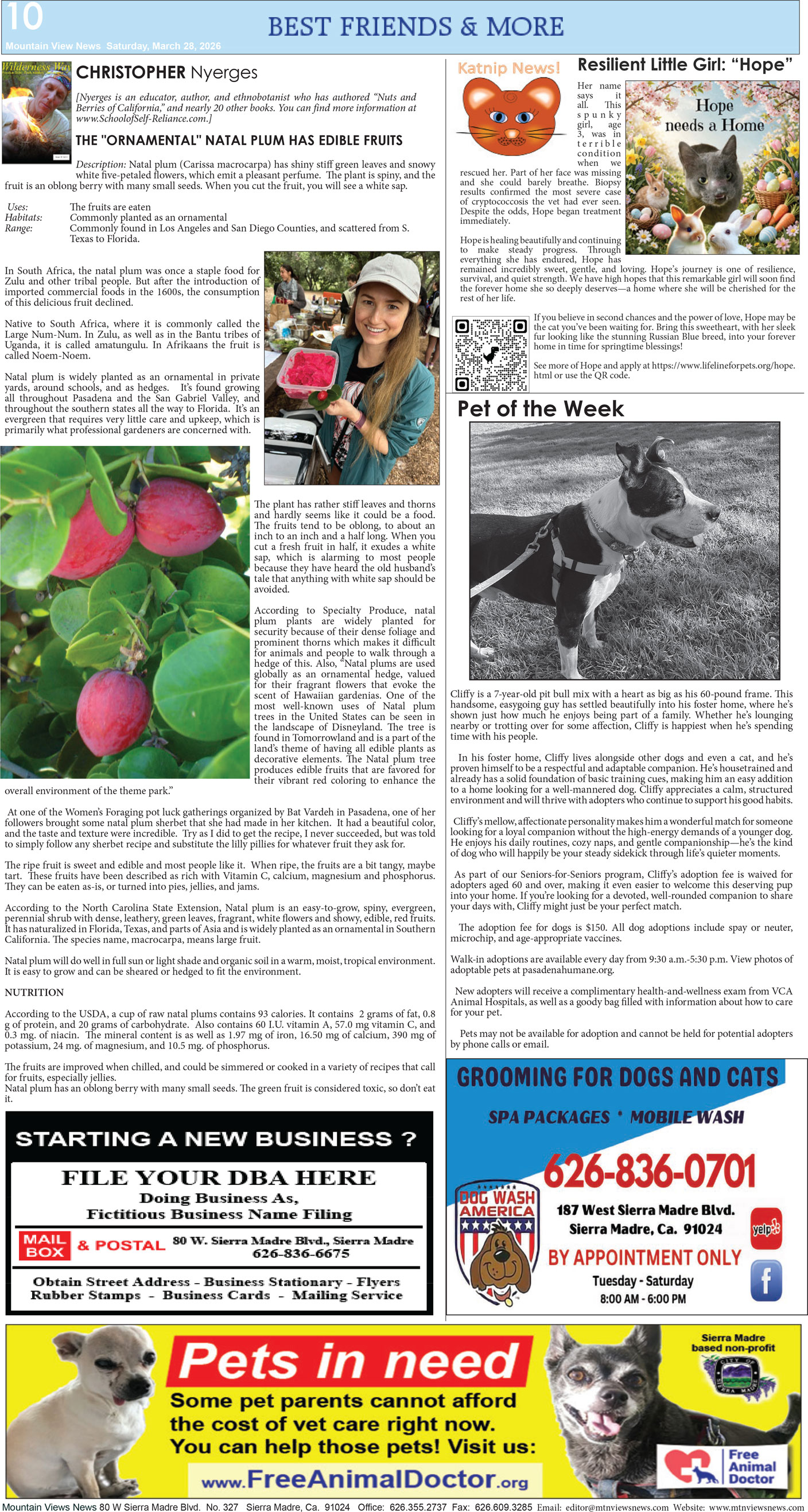
Mountain View News Saturday, March 28, 2026 CHRISTOPHER Nyerges [Nyerges is an educator, author, and ethnobotanist who has authored “Nuts and Berries of California,” and nearly 20 other books. You can find more information at www.SchoolofSelf-Reliance.com.] THE "ORNAMENTAL" NATAL PLUM HAS EDIBLE FRUITS Description: Natal plum (Carissa macrocarpa) has shiny stiff green leaves and snowy white five-petaled flowers, which emit a pleasant perfume. The plant is spiny, and the fruit is an oblong berry with many small seeds. When you cut the fruit, you will see a white sap. Uses: The fruits are eaten Habitats: Commonly planted as an ornamental Range: Commonly found in Los Angeles and San Diego Counties, and scattered from S. Texas to Florida. In South Africa, the natal plum was once a staple food for Zulu and other tribal people. But after the introduction of imported commercial foods in the 1600s, the consumption of this delicious fruit declined. Native to South Africa, where it is commonly called the Large Num-Num. In Zulu, as well as in the Bantu tribes of Uganda, it is called amatungulu. In Afrikaans the fruit is called Noem-Noem. Natal plum is widely planted as an ornamental in private yards, around schools, and as hedges. It’s found growing all throughout Pasadena and the San Gabriel Valley, and throughout the southern states all the way to Florida. It’s an evergreen that requires very little care and upkeep, which is primarily what professional gardeners are concerned with. The plant has rather stiff leaves and thorns and hardly seems like it could be a food. The fruits tend to be oblong, to about an inch to an inch and a half long. When you cut a fresh fruit in half, it exudes a white sap, which is alarming to most people because they have heard the old husband’s tale that anything with white sap should be avoided. According to Specialty Produce, natal plum plants are widely planted for security because of their dense foliage and prominent thorns which makes it difficult for animals and people to walk through a hedge of this. Also, “Natal plums are used globally as an ornamental hedge, valued for their fragrant flowers that evoke the scent of Hawaiian gardenias. One of the most well-known uses of Natal plum trees in the United States can be seen in the landscape of Disneyland. The tree is found in Tomorrowland and is a part of the land’s theme of having all edible plants as decorative elements. The Natal plum tree produces edible fruits that are favored for their vibrant red coloring to enhance the overall environment of the theme park.” At one of the Women’s Foraging pot luck gatherings organized by Bat Vardeh in Pasadena, one of her followers brought some natal plum sherbet that she had made in her kitchen. It had a beautiful color, and the taste and texture were incredible. Try as I did to get the recipe, I never succeeded, but was told to simply follow any sherbet recipe and substitute the lilly pillies for whatever fruit they ask for. The ripe fruit is sweet and edible and most people like it. When ripe, the fruits are a bit tangy, maybe tart. These fruits have been described as rich with Vitamin C, calcium, magnesium and phosphorus. They can be eaten as-is, or turned into pies, jellies, and jams. According to the North Carolina State Extension, Natal plum is an easy-to-grow, spiny, evergreen, perennial shrub with dense, leathery, green leaves, fragrant, white flowers and showy, edible, red fruits. It has naturalized in Florida, Texas, and parts of Asia and is widely planted as an ornamental in Southern California. The species name, macrocarpa, means large fruit. Natal plum will do well in full sun or light shade and organic soil in a warm, moist, tropical environment. It is easy to grow and can be sheared or hedged to fit the environment. NUTRITION According to the USDA, a cup of raw natal plums contains 93 calories. It contains 2 grams of fat, 0.8 g of protein, and 20 grams of carbohydrate. Also contains 60 I.U. vitamin A, 57.0 mg vitamin C, and 0.3 mg. of niacin. The mineral content is as well as 1.97 mg of iron, 16.50 mg of calcium, 390 mg of potassium, 24 mg. of magnesium, and 10.5 mg. of phosphorus. The fruits are improved when chilled, and could be simmered or cooked in a variety of recipes that call for fruits, especially jellies. Natal plum has an oblong berry with many small seeds. The green fruit is considered toxic, so don’t eat it. Mountain Views News 80 W Sierra Madre Blvd. No. 327 Sierra Madre, Ca. 91024 Office: 626.355.2737 Fax: 626.609.3285 Email: editor@mtnviewsnews.com Website: www.mtnviewsnews.com Resilient Little Girl: “Hope” Her name says it all. This spunkygirl, age3, was interrible condition when we rescued her. Part of her face was missingand she could barely breathe. Biopsyresults confirmed the most severe case of cryptococcosis the vet had ever seen. Despite the odds, Hope began treatment immediately. Hope is healing beautifully and continuing to make steady progress. Througheverything she has endured, Hope hasremained incredibly sweet, gentle, and loving. Hope’s journey is one of resilience, survival, and quiet strength. We have high hopes that this remarkable girl will soon findthe forever home she so deeply deserves—a home where she will be cherished for therest of her life. If you believe in second chances and the power of love, Hope may be the cat you’ve been waiting for. Bring this sweetheart, with her sleekfur looking like the stunning Russian Blue breed, into your foreverhome in time for springtime blessings! See more of Hope and apply at https://www.lifelineforpets.org/hope. html or use the QR code. Pet of the Week Cliffy is a 7-year-old pit bull mix with a heart as big as his 60-pound frame. Thishandsome, easygoing guy has settled beautifully into his foster home, where he’s shown just how much he enjoys being part of a family. Whether he’s loungingnearby or trotting over for some affection, Cliffy is happiest when he’s spendingtime with his people. In his foster home, Cliffy lives alongside other dogs and even a cat, and he’s proven himself to be a respectful and adaptable companion. He’s housetrained andalready has a solid foundation of basic training cues, making him an easy additionto a home looking for a well-mannered dog. Cliffy appreciates a calm, structuredenvironment and will thrive with adopters who continue to support his good habits. Cliffy’s mellow, affectionate personality makes him a wonderful match for someonelooking for a loyal companion without the high-energy demands of a younger dog. He enjoys his daily routines, cozy naps, and gentle companionship—he’s the kindof dog who will happily be your steady sidekick through life’s quieter moments. As part of our Seniors-for-Seniors program, Cliffy’s adoption fee is waived foradopters aged 60 and over, making it even easier to welcome this deserving pupinto your home. If you’re looking for a devoted, well-rounded companion to shareyour days with, Cliffy might just be your perfect match. The adoption fee for dogs is $150. All dog adoptions include spay or neuter, microchip, and age-appropriate vaccines. Walk-in adoptions are available every day from 9:30 a.m.-5:30 p.m. View photos ofadoptable pets at pasadenahumane.org. New adopters will receive a complimentary health-and-wellness exam from VCAAnimal Hospitals, as well as a goody bag filled with information about how to carefor your pet. Pets may not be available for adoption and cannot be held for potential adoptersby phone calls or email. | ||||||||||||||||||||
| |