| Health & Fitness | ||||||||||||||||||||
| Mountain Views News, Combined Edition Saturday, June 14, 2025 | ||||||||||||||||||||
| ||||||||||||||||||||
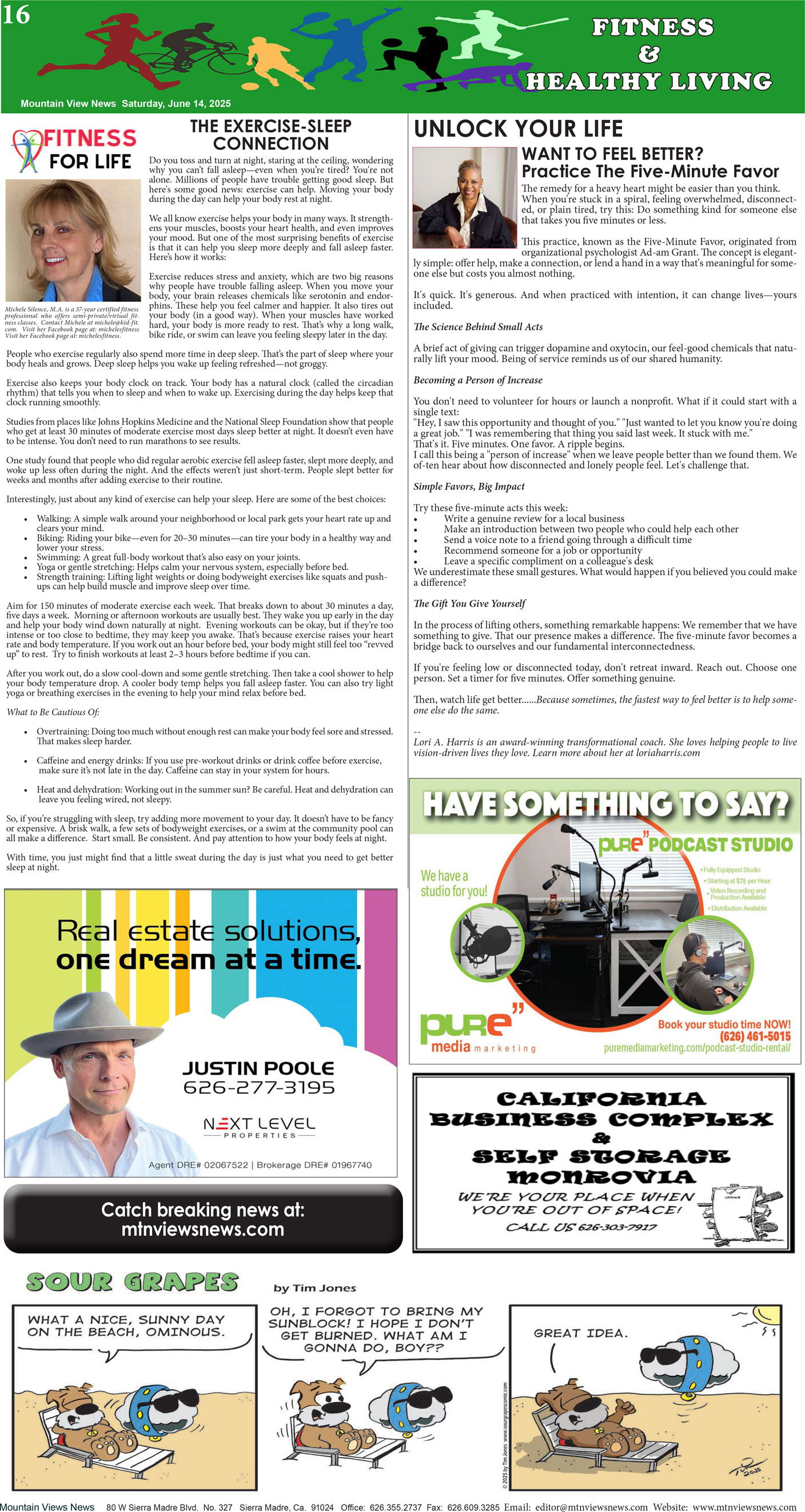
16 FITNESS FITNESS & & HEALTHY LIVINGHEALTHY LIVING Mountain View News Saturday, June 14, 2025 Michele Silence, M.A. is a 37-year certified fitness professional who offers semi-private/virtual fitness classes. Contact Michele at michele@kid-fit. com. Visit her Facebook page at: michelesfitness Visit her Facebook page at: michelesfitness. UNLOCK YOUR LIFE THE EXERCISE-SLEEP CONNECTION WANT TO FEEL BETTER? Practice The Five-Minute Favor Do you toss and turn at night, staring at the ceiling, wondering why you can’t fall asleep—even when you’re tired? You're not alone. Millions of people have trouble getting good sleep. But here's some good news: exercise can help. Moving your body during the day can help your body rest at night. We all know exercise helps your body in many ways. It strengthens your muscles, boosts your heart health, and even improves your mood. But one of the most surprising benefits of exercise is that it can help you sleep more deeply and fall asleep faster. Here’s how it works: Exercise reduces stress and anxiety, which are two big reasons why people have trouble falling asleep. When you move your body, your brain releases chemicals like serotonin and endorphins. These help you feel calmer and happier. It also tires out your body (in a good way). When your muscles have worked hard, your body is more ready to rest. That’s why a long walk, bike ride, or swim can leave you feeling sleepy later in the day. People who exercise regularly also spend more time in deep sleep. That’s the part of sleep where your body heals and grows. Deep sleep helps you wake up feeling refreshed—not groggy. Exercise also keeps your body clock on track. Your body has a natural clock (called the circadian rhythm) that tells you when to sleep and when to wake up. Exercising during the day helps keep that clock running smoothly. Studies from places like Johns Hopkins Medicine and the National Sleep Foundation show that people who get at least 30 minutes of moderate exercise most days sleep better at night. It doesn’t even have to be intense. You don’t need to run marathons to see results. One study found that people who did regular aerobic exercise fell asleep faster, slept more deeply, and woke up less often during the night. And the effects weren’t just short-term. People slept better for weeks and months after adding exercise to their routine. Interestingly, just about any kind of exercise can help your sleep. Here are some of the best choices: • Walking: A simple walk around your neighborhood or local park gets your heart rate up and clears your mind. • Biking: Riding your bike—even for 20–30 minutes—can tire your body in a healthy way and lower your stress. • Swimming: A great full-body workout that’s also easy on your joints. • Yoga or gentle stretching: Helps calm your nervous system, especially before bed. • Strength training: Lifting light weights or doing bodyweight exercises like squats and push- ups can help build muscle and improve sleep over time. Aim for 150 minutes of moderate exercise each week. That breaks down to about 30 minutes a day, five days a week. Morning or afternoon workouts are usually best. They wake you up early in the day and help your body wind down naturally at night. Evening workouts can be okay, but if they’re too intense or too close to bedtime, they may keep you awake. That’s because exercise raises your heart rate and body temperature. If you work out an hour before bed, your body might still feel too “revved up” to rest. Try to finish workouts at least 2–3 hours before bedtime if you can. After you work out, do a slow cool-down and some gentle stretching. Then take a cool shower to help your body temperature drop. A cooler body temp helps you fall asleep faster. You can also try light yoga or breathing exercises in the evening to help your mind relax before bed. What to Be Cautious Of: • Overtraining: Doing too much without enough rest can make your body feel sore and stressed. That makes sleep harder. • Caffeine and energy drinks: If you use pre-workout drinks or drink coffee before exercise, make sure it’s not late in the day. Caffeine can stay in your system for hours. • Heat and dehydration: Working out in the summer sun? Be careful. Heat and dehydration can leave you feeling wired, not sleepy. So, if you’re struggling with sleep, try adding more movement to your day. It doesn’t have to be fancy or expensive. A brisk walk, a few sets of bodyweight exercises, or a swim at the community pool can all make a difference. Start small. Be consistent. And pay attention to how your body feels at night. With time, you just might find that a little sweat during the day is just what you need to get better sleep at night. The remedy for a heavy heart might be easier than you think. When you're stuck in a spiral, feeling overwhelmed, disconnected, or plain tired, try this: Do something kind for someone else that takes you five minutes or less. This practice, known as the Five-Minute Favor, originated from organizational psychologist Ad-am Grant. The concept is elegantly simple: offer help, make a connection, or lend a hand in a way that's meaningful for someone else but costs you almost nothing. It's quick. It's generous. And when practiced with intention, it can change lives—yours included. The Science Behind Small Acts A brief act of giving can trigger dopamine and oxytocin, our feel-good chemicals that naturally lift your mood. Being of service reminds us of our shared humanity. Becoming a Person of Increase You don't need to volunteer for hours or launch a nonprofit. What if it could start with a single text: "Hey, I saw this opportunity and thought of you." "Just wanted to let you know you're doing a great job." "I was remembering that thing you said last week. It stuck with me." That's it. Five minutes. One favor. A ripple begins. I call this being a "person of increase" when we leave people better than we found them. We of-ten hear about how disconnected and lonely people feel. Let's challenge that. Simple Favors, Big Impact Try these five-minute acts this week: • Write a genuine review for a local business • Make an introduction between two people who could help each other • Send a voice note to a friend going through a difficult time • Recommend someone for a job or opportunity • Leave a specific compliment on a colleague's desk We underestimate these small gestures. What would happen if you believed you could make a difference? The Gift You Give Yourself In the process of lifting others, something remarkable happens: We remember that we have something to give. That our presence makes a difference. The five-minute favor becomes a bridge back to ourselves and our fundamental interconnectedness. If you're feeling low or disconnected today, don't retreat inward. Reach out. Choose one person. Set a timer for five minutes. Offer something genuine. Then, watch life get better......Because sometimes, the fastest way to feel better is to help someone else do the same. -- Lori A. Harris is an award-winning transformational coach. She loves helping people to live vision-driven lives they love. Learn more about her at loriaharris.com Mountain Views News 80 W Sierra Madre Blvd. No. 327 Sierra Madre, Ca. 91024 Office: 626.355.2737 Fax: 626.609.3285 Email: editor@mtnviewsnews.com Website: www.mtnviewsnews.com | ||||||||||||||||||||
| |