| Best Friends and More | ||||||||||||||||||||
| Mountain Views News, Combined Edition Saturday, April 11, 2026 | ||||||||||||||||||||
| ||||||||||||||||||||
|
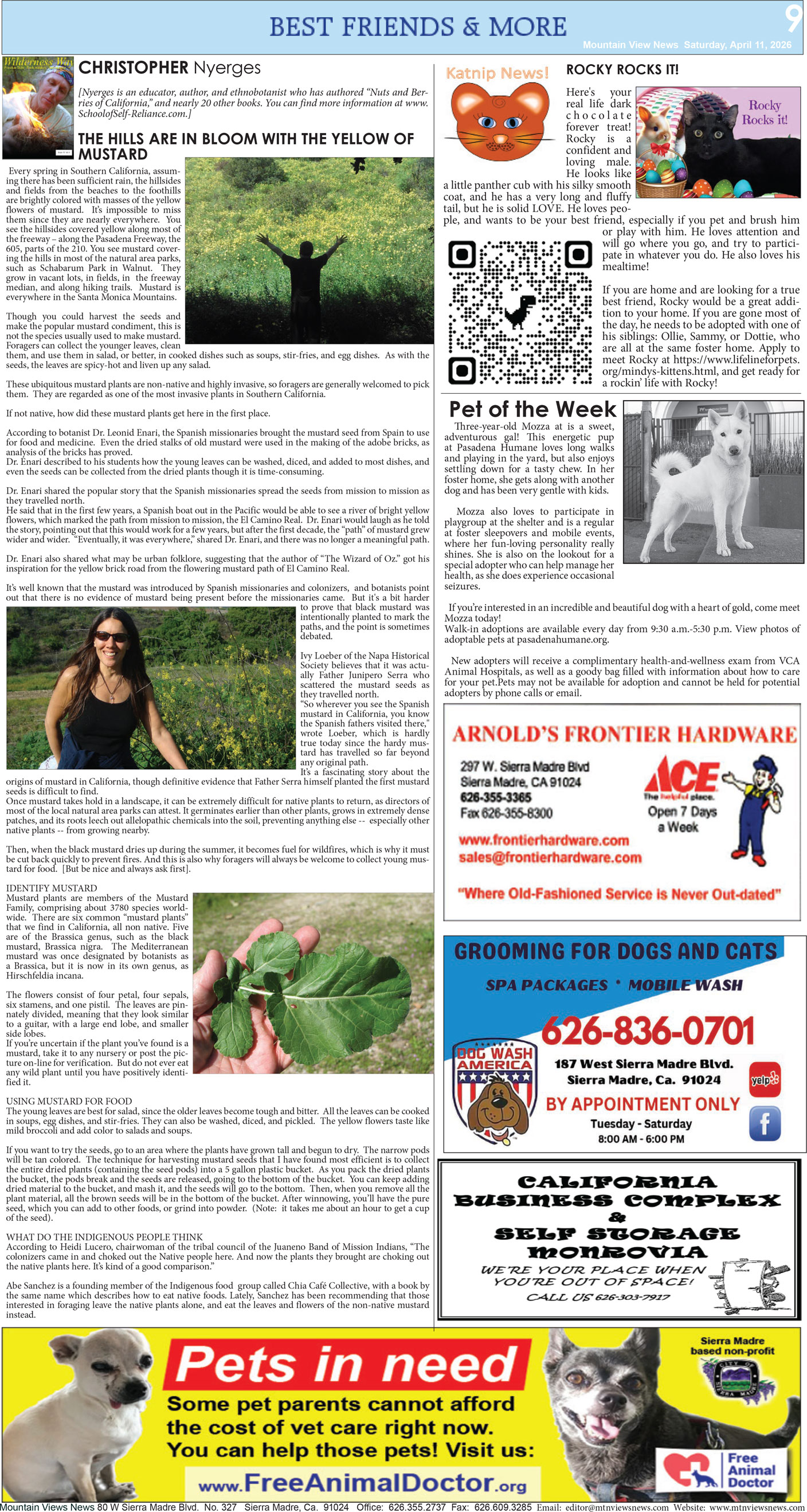
Mountain View News Saturday, April 11, 2026 CHRISTOPHER Nyerges [Nyerges is an educator, author, and ethnobotanist who has authored “Nuts and Ber- ries of California,” and nearly 20 other books. You can find more information at www. SchoolofSelf-Reliance.com.] THE HILLS ARE IN BLOOM WITH THE YELLOW OF MUSTARD Pet of the Week Every spring in Southern California, assum- ing there has been sufficient rain, the hillsides and fields from the beaches to the foothills are brightly colored with masses of the yellow flowers of mustard. It’s impossible to miss them since they are nearly everywhere. You see the hillsides covered yellow along most of the freeway – along the Pasadena Freeway, the 605, parts of the 210. You see mustard cover- ing the hills in most of the natural area parks, such as Schabarum Park in Walnut. They grow in vacant lots, in fields, in the freeway median, and along hiking trails. Mustard is everywhere in the Santa Monica Mountains. Though you could harvest the seeds and make the popular mustard condiment, this is not the species usually used to make mustard. Foragers can collect the younger leaves, clean them, and use them in salad, or better, in cooked dishes such as soups, stir-fries, and egg dishes. As with the seeds, the leaves are spicy-hot and liven up any salad. These ubiquitous mustard plants are non-native and highly invasive, so foragers are generally welcomed to pick them. They are regarded as one of the most invasive plants in Southern California. If not native, how did these mustard plants get here in the first place. According to botanist Dr. Leonid Enari, the Spanish missionaries brought the mustard seed from Spain to use for food and medicine. Even the dried stalks of old mustard were used in the making of the adobe bricks, as analysis of the bricks has proved. Dr. Enari described to his students how the young leaves can be washed, diced, and added to most dishes, and even the seeds can be collected from the dried plants though it is time-consuming. Dr. Enari shared the popular story that the Spanish missionaries spread the seeds from mission to mission as they travelled north. He said that in the first few years, a Spanish boat out in the Pacific would be able to see a river of bright yellow flowers, which marked the path from mission to mission, the El Camino Real. Dr. Enari would laugh as he told the story, pointing out that this would work for a few years, but after the first decade, the “path” of mustard grew wider and wider. “Eventually, it was everywhere,” shared Dr. Enari, and there was no longer a meaningful path. Dr. Enari also shared what may be urban folklore, suggesting that the author of “The Wizard of Oz.” got his inspiration for the yellow brick road from the flowering mustard path of El Camino Real. It’s well known that the mustard was introduced by Spanish missionaries and colonizers, and botanists point out that there is no evidence of mustard being present before the missionaries came. But it's a bit harder to prove that black mustard was intentionally planted to mark the paths, and the point is sometimes debated. Ivy Loeber of the Napa Historical Society believes that it was actu- ally Father Junipero Serra who scattered the mustard seeds as they travelled north. “So wherever you see the Spanish mustard in California, you know the Spanish fathers visited there," wrote Loeber, which is hardly true today since the hardy mus- tard has travelled so far beyond any original path. It’s a fascinating story about the origins of mustard in California, though definitive evidence that Father Serra himself planted the first mustard seeds is difficult to find. Once mustard takes hold in a landscape, it can be extremely difficult for native plants to return, as directors of most of the local natural area parks can attest. It germinates earlier than other plants, grows in extremely dense patches, and its roots leech out allelopathic chemicals into the soil, preventing anything else --especially other native plants -- from growing nearby. Then, when the black mustard dries up during the summer, it becomes fuel for wildfires, which is why it must be cut back quickly to prevent fires. And this is also why foragers will always be welcome to collect young mus- tard for food. [But be nice and always ask first]. IDENTIFY MUSTARD Mustard plants are members of the Mustard Family, comprising about 3780 species world- wide. There are six common “mustard plants” that we find in California, all non native. Five are of the Brassica genus, such as the black mustard, Brassica nigra. The Mediterranean mustard was once designated by botanists as a Brassica, but it is now in its own genus, as Hirschfeldia incana. The flowers consist of four petal, four sepals, six stamens, and one pistil. The leaves are pin- nately divided, meaning that they look similar to a guitar, with a large end lobe, and smaller side lobes. If you’re uncertain if the plant you’ve found is a mustard, take it to any nursery or post the pic- ture on-line for verification. But do not ever eat any wild plant until you have positively identi- fied it. USING MUSTARD FOR FOOD The young leaves are best for salad, since the older leaves become tough and bitter. All the leaves can be cooked in soups, egg dishes, and stir-fries. They can also be washed, diced, and pickled. The yellow flowers taste like mild broccoli and add color to salads and soups. If you want to try the seeds, go to an area where the plants have grown tall and begun to dry. The narrow pods will be tan colored. The technique for harvesting mustard seeds that I have found most efficient is to collect the entire dried plants (containing the seed pods) into a 5 gallon plastic bucket. As you pack the dried plants the bucket, the pods break and the seeds are released, going to the bottom of the bucket. You can keep addingdried material to the bucket, and mash it, and the seeds will go to the bottom. Then, when you remove all the plant material, all the brown seeds will be in the bottom of the bucket. After winnowing, you’ll have the pure seed, which you can add to other foods, or grind into powder. (Note: it takes me about an hour to get a cup of the seed). WHAT DO THE INDIGENOUS PEOPLE THINK According to Heidi Lucero, chairwoman of the tribal council of the Juaneno Band of Mission Indians, “The colonizers came in and choked out the Native people here. And now the plants they brought are choking out the native plants here. It’s kind of a good comparison.” Abe Sanchez is a founding member of the Indigenous food group called Chia Café Collective, with a book by the same name which describes how to eat native foods. Lately, Sanchez has been recommending that those interested in foraging leave the native plants alone, and eat the leaves and flowers of the non-native mustard instead. ROCKY ROCKS IT! Here's your real life dark ch o c o l a te forever treat! Rocky is a confident and loving male. He looks like a little panther cub with his silky smooth coat, and he has a very long and fluffy tail, but he is solid LOVE. He loves peo- ple, and wants to be your best friend, especially if you pet and brush him or play with him. He loves attention and will go where you go, and try to partici- pate in whatever you do. He also loves his mealtime! If you are home and are looking for a true best friend, Rocky would be a great addi- tion to your home. If you are gone most of the day, he needs to be adopted with one of his siblings: Ollie, Sammy, or Dottie, who are all at the same foster home. Apply to meet Rocky at https://www.lifelineforpets. org/mindys-kittens.html, and get ready for a rockin’ life with Rocky! Three-year-old Mozza at is a sweet, adventurous gal! This energetic pupat Pasadena Humane loves long walksand playing in the yard, but also enjoyssettling down for a tasty chew. In herfoster home, she gets along with anotherdog and has been very gentle with kids. Mozza also loves to participate in playgroup at the shelter and is a regularat foster sleepovers and mobile events, where her fun-loving personality reallyshines. She is also on the lookout for a special adopter who can help manage herhealth, as she does experience occasionalseizures. If you’re interested in an incredible and beautiful dog with a heart of gold, come meetMozza today! Walk-in adoptions are available every day from 9:30 a.m.-5:30 p.m. View photos ofadoptable pets at pasadenahumane.org. New adopters will receive a complimentary health-and-wellness exam from VCAAnimal Hospitals, as well as a goody bag filled with information about how to care for your pet.Pets may not be available for adoption and cannot be held for potentialadopters by phone calls or email. Mountain Views News 80 W Sierra Madre Blvd. No. 327 Sierra Madre, Ca. 91024 Office: 626.355.2737 Fax: 626.609.3285 Email: editor@mtnviewsnews.com Website: www.mtnviewsnews.com | ||||||||||||||||||||
| |